Supernetting and Special IP Address MCQs: 12 Solved Questions with Step-by-Step Explanations
Solve 12 MCQs on supernets, CIDR boundaries and special IP addresses. Each explanation shows the rule, calculation or range check that determines the answer.
KnowledgeGate Team
Exam prep & CS education
Updated 18 Sep 20266 min read96 views
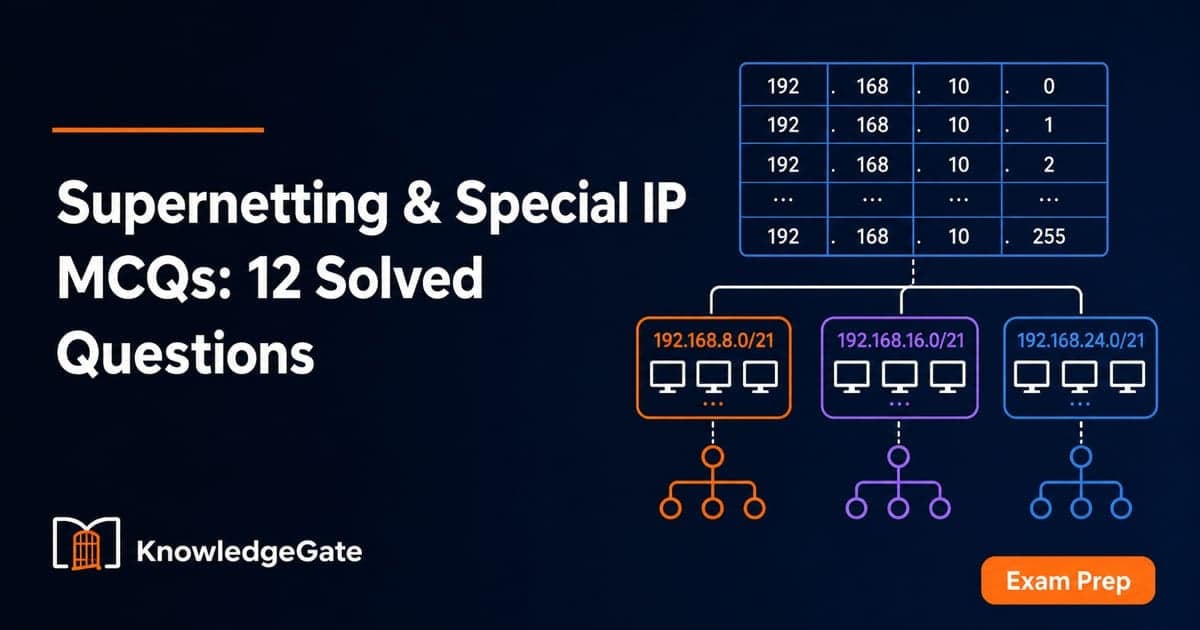
Under time pressure, three ideas are easy to mix up: shortening a prefix to form a supernet, finding the exact span of a CIDR block, and recognising addresses reserved for private, loopback, link-local or boot-time use. Attempt each question before opening its explanation. Use Computer Networks MCQs for broader mixed practice and CS Fundamentals when you need to revise the underlying concepts.
Write the relevant prefix, block size or reserved range before checking an option, then use the Supernetting and Special IP Addresses practice module for another practice route.
1. Supernetting MCQs: combine blocks and test a route span
Merging N = 2^k equal, contiguous blocks moves k network bits into the host portion. The aggregate prefix is therefore old prefix - k. Subnetting does the opposite: it lengthens the prefix.
Q1
What is the supernet mask after combining 64 Class B blocks into one?
A. 255.240.0.0
B. 255.192.0.0
C. 255.255.252.0
D. 255.255.255.252
Correct answer: B. 255.192.0.0.
A Class B block begins at /16, and 64 = 2^6, so combining 64 blocks removes six network bits: /16 - 6 = /10. In binary, /10 is 11111111.11000000.00000000.00000000, which converts to 255.192.0.0. The address count also agrees: 2^22 = 4,194,304, while 64 × 2^16 = 4,194,304.
Q2 (Indian Space Research Organization 2014, Computer Science)
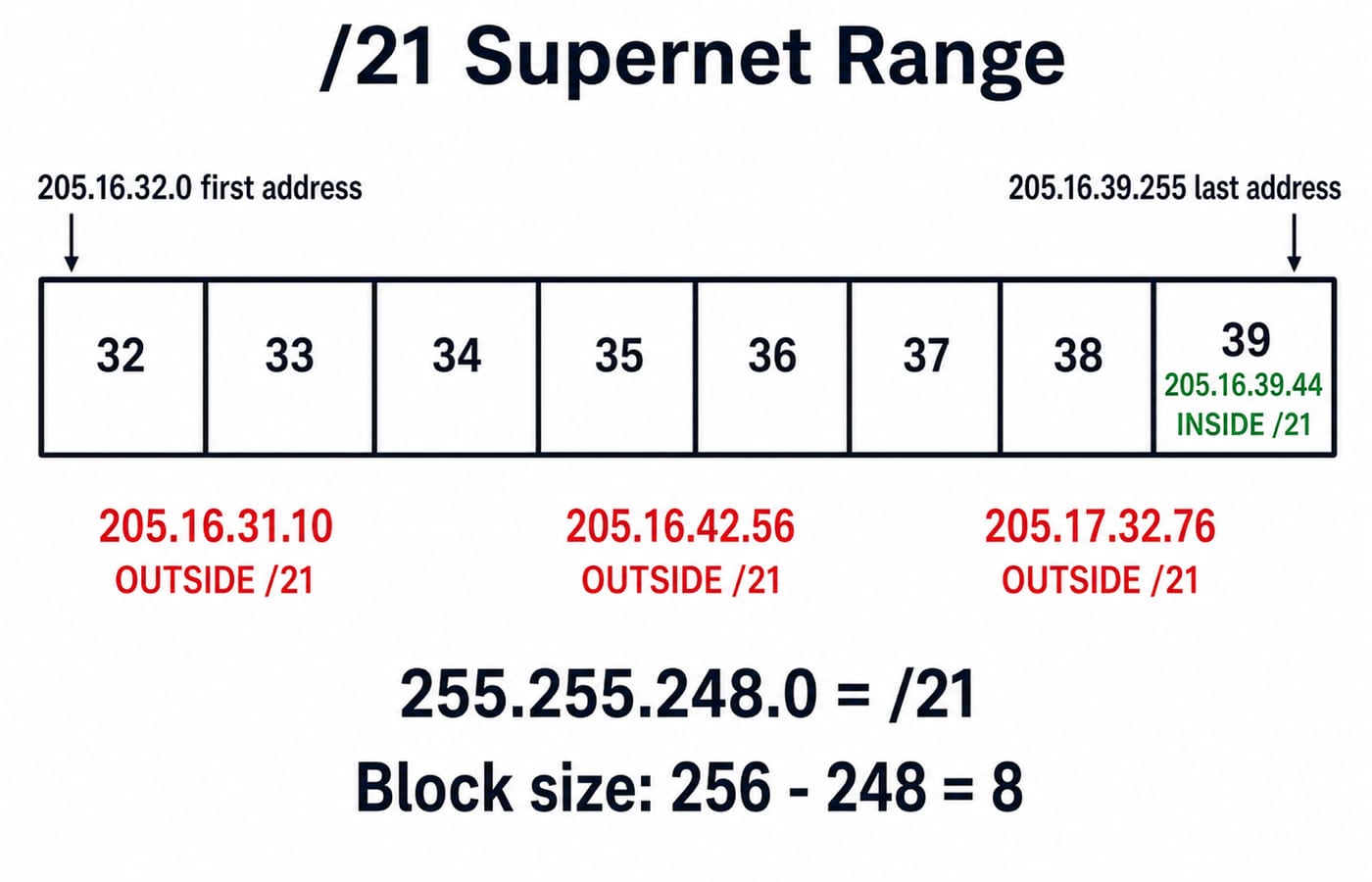
A supernet has a first address of 205.16.32.0 and a supernet mask of 255.255.248.0. A router receives 4 packets with the following destination addresses. Which packet belongs to this supernet?
A. 205.16.42.56
B. 205.17.32.76
C. 205.16.31.10
D. 205.16.39.44
Correct answer: D. 205.16.39.44.
The mask 255.255.248.0 is /21, so the third-octet block size is 256 - 248 = 8. Starting at 32, the third octet runs from 32 through 39, giving the complete range 205.16.32.0 to 205.16.39.255. Only 205.16.39.44 falls inside it; see the solved page.
2. CIDR block-boundary MCQ: first address, last address and count
Q3 (Coal India 2017, Computer Science)
A block of addresses is granted to a small organization. If one of the addresses is 210.32.64.79/26, then what will be the values of the following? (i) First address (ii) Last address (iii) Total number of addresses
A. (i) 210.32.64.64, (ii) 210.32.64.127, (iii) 64
B. (i) 210.32.64.64, (ii) 210.32.64.255, (iii) 32
C. (i) 210.32.64.79, (ii) 210.32.64.255, (iii) 64
D. (i) 210.32.64.64, (ii) 210.32.64.79, (iii) 128
Correct answer: A. (i) 210.32.64.64, (ii) 210.32.64.127, (iii) 64.
A /26 leaves 32 - 26 = 6 host bits, so the block contains 2^6 = 64 total addresses and last-octet boundaries advance by 64. The value 79 lies in the 64-127 interval. Setting all six host bits to 0 gives 210.32.64.64, while setting them all to 1 gives 210.32.64.127; the question asks for total addresses, not usable-host conventions. You can see the solved page, then practise more boundaries with Subnetting MCQs: 12 Solved IP Addressing Questions.
3. Private and public IPv4 address MCQs
The three private IPv4 ranges are 10.0.0.0/8, 172.16.0.0/12 and 192.168.0.0/16. The middle range is the common trap: its second octet runs from 16 through 31, not across every 172.x.x.x address.
Q4
Which of the following IP addresses is not a valid private IP address?
A. 10.224.168.0
B. 172.23.0.1
C. 192.168.248.254
D. 172.15.5.224
Correct answer: D. 172.15.5.224.
Options A, B and C belong to the three private blocks. 172.15.5.224 falls below the lower boundary 172.16.0.0, so it is not a private address.
Q5
Which of the following is a public IP address ?
A. Both 192.168.10.24 and 172.16.31.2
B. 172.16.31.1
C. 10.10.10.10
D. None of these
Correct answer: D. None of these.
192.168.10.24 is inside 192.168.0.0/16, both 172.16.31.1 and 172.16.31.2 are inside 172.16.0.0/12, and 10.10.10.10 is inside 10.0.0.0/8. Every address named in the options is private, so none is public.
4. IPv6 link-local and IPv4 boot-time special-address MCQs
Q6 (IBPS 2023)
Identify the link-local address from the following IPv6 addresses:
A. 2001:0db8:abcd:0012:0000:0000:0000:0001
B. FE80:0000:0000:0000:0202:B3FF:FE1E:8329
C. FF02:0000:0000:0000:0000:0000:0000:0001
D. ::1
E. 2001:4860:4860::8888
Correct answer: B. FE80:0000:0000:0000:0202:B3FF:FE1E:8329.
2001:db8::/32 is for documentation, FE80::/10 is link-local unicast, FF00::/8 is multicast, ::1/128 is loopback, and 2000::/3 is global unicast. For the exact prefix check, FE80 = 1111111010000000; its first ten bits match FE80::/10. Option B is therefore the link-local address, as shown on the solved page.
Q7 (UGC NET 2017, Computer Science, Paper 2 (November))
The IP address __________ is used by hosts when they are being booted.
A. 0.0.0.0
B. 1.0.0.0
C. 1.1.1.1
D. 255.255.255.255
Correct answer: A. 0.0.0.0.
A host without an assigned IPv4 address can use 0.0.0.0 as its unspecified source while bootstrapping, including when seeking configuration through DHCP. By contrast, 255.255.255.255 is the limited-broadcast destination; the two addresses are not interchangeable. Review the distinction on the solved page.
5. Loopback and classful special-address MCQs
Q8 (DSSSB 2018, Computer Science)
The IP address range ____ to ____ is reserved for loopback.
A. 127.10.10.0, 127.255.255.255
B. 127.0.0.0, 127.255.255.255
C. 127.10.10.10, 127.255.255.255
D. 127.0.0.0, 127.255.0.0
Correct answer: B. 127.0.0.0, 127.255.255.255.
The complete loopback block is 127.0.0.0/8, from 127.0.0.0 through 127.255.255.255. Traffic sent to this historical Class A space stays on the host for local communication and testing. The solved page gives the same range.
Q9 (UGC NET 2019, Computer Science, Paper 2 (June))
Consider the following two statements with respect to IPv4 in computer networking: P: The loopback (IP) address is a member of class B network. Q: The loopback (IP) address is used to send a packet from host to itself. What can you say about the statements P and Q?
A. P – True; Q – False
B. P – False; Q – True
C. P – True; Q – True
D. P – False; Q – False
Correct answer: B. P – False; Q – True.
Statement P is false because 127.0.0.0/8 belongs to historical Class A space, not Class B. Statement Q is true because loopback sends a packet back to the same host without placing it on an external network. See the full solution.
Q10 (UGC NET 2015, Computer Science, Paper 2 (December))
In a classful addressing the IP address with 0(zero) as network number:
A. refers to the current network
B. refers to broadcast on the local network
C. refers to the broadcast on a distant network
D. refers to loopback testing
Correct answer: A. refers to the current network.
In legacy classful terminology, an all-zero network field means “this network”, while an all-ones host field represents a broadcast for the selected network. Keep that historical convention separate from the modern use of 0.0.0.0 as an unspecified address in Q7. The solved page covers the original item.
6. PAT and DHCP MCQs: address translation and assignment
Q11
What flavor of Network Address Translation can be used to have one IP address allow many users to connect to the global Internet?
A. NAT
B. Static
C. Dynamic
D. PAT
Correct answer: D. PAT.
Port Address Translation lets many private hosts share one public IP address. It distinguishes their simultaneous transport connections using port numbers, which is why “many users through one address” points specifically to PAT rather than merely to generic NAT.
Q12 (Bihar STET 2019, Computer Science)
Which protocol assigns IP address to the client connected in the internet?
A. DHCP
B. IP
C. RPC
D. ARP
E. None of these
Correct answer: A. DHCP.
DHCP is the client-server protocol that provides IP configuration to a client. Before it receives that configuration, the client can use 0.0.0.0 as its source while seeking a lease, which connects this answer directly to the boot-time address in Q7.
7. Supernetting and special IP MCQs: exam traps and the next practice step
Keep this six-line checklist beside your next practice set:
Aggregation shortens a prefix.
A mask gives the block size.
172.16.0.0/12stops at second octet 31.127.0.0.0/8is loopback.FE80::/10is IPv6 link-local.0.0.0.0is unspecified, while255.255.255.255is limited broadcast.
Redo Q1 to Q3 without looking at the explanations because those three demand computation, not only recognition. If block boundaries still feel uncertain, return to Subnetting MCQs: 12 Solved IP Addressing Questions. For a structured path through Computer Networks and other core subjects, use CS Fundamentals for Placements by Sanchit Sir.
The short version
Compute prefixes and ranges on paper, but memorise only the small reserved-address table. Then use Computer Networks MCQs for the next mixed set and check whether you can switch cleanly between calculation and classification.
Keep learning
Computer Networks Basics & Criteria MCQs: 12 Solved Questions with Explanations
Solve 12 Computer Networks questions, then use clear explanations and worked criteria checks to separate similar terms confidently.
3 Oct 20268 min readComputer Networks MCQs
TCP Timers, RTT Estimation & SWS: 10 Solved MCQs and NATs
Solve 10 TCP exam questions covering timer roles, Silly Window Syndrome, recursive RTT estimates, Jacobson/Karels RTO and Karn's rule.
Updated 28 Sep 20267 min readComputer Networks MCQs
RSA Algorithm MCQs: 12 Solved Questions with Step-by-Step Explanations
Practise RSA key generation, modular inverses, encryption, signatures and defining equations, with concise working for conceptual and numerical answers.
25 Sep 20268 min readComputer Networks MCQs
Firewall, VPN, IDS and IPS MCQs: 11 Network Security Questions Solved
Solve 11 previous-year questions on firewalls, VPNs, IDS and IPS. Learn rule filtering, connection state, DMZ design, IPsec modes, tunnels and signatures.
Updated 24 Sep 20267 min readComputer Networks MCQs