Authentication and Digital Signature MCQs: 12 Solved Hash and Signing Questions
Work through 12 solved exam questions that connect challenge-response, integrity, hash lengths, X.509 certificates and the exact key order for signing and confidentiality.
KnowledgeGate Team
Exam prep & CS education
Updated 25 Oct 20267 min read
Authentication, hashing and digital signatures are easy to revise as separate definitions. The difficulty begins when one option set mixes identity, integrity, non-repudiation, certificate formats and sender-versus-receiver keys. The distinctions involve arithmetic, security properties and key ownership; choose an option before reading its explanation, and write the key owner beside every public-key operation. You can practise with over 20 questions on Authentication and Digital Signature; use the GATE CS Exam Preparation page when you need to place this topic inside your wider revision plan.
Authentication, integrity and digital signatures before the MCQs
Security goal | Question it answers |
|---|---|
Authentication | Who is communicating? |
Integrity | Did the data change? |
Confidentiality | Who can read it? |
Non-repudiation | Is there evidence that the signer cannot plausibly deny the signed action? |
The signature rule is direct: the signer signs a message digest with the signer's private key, and the verifier checks it with the signer's public key. That evidence is meaningful only when the public key is reliably tied to the claimed signer.
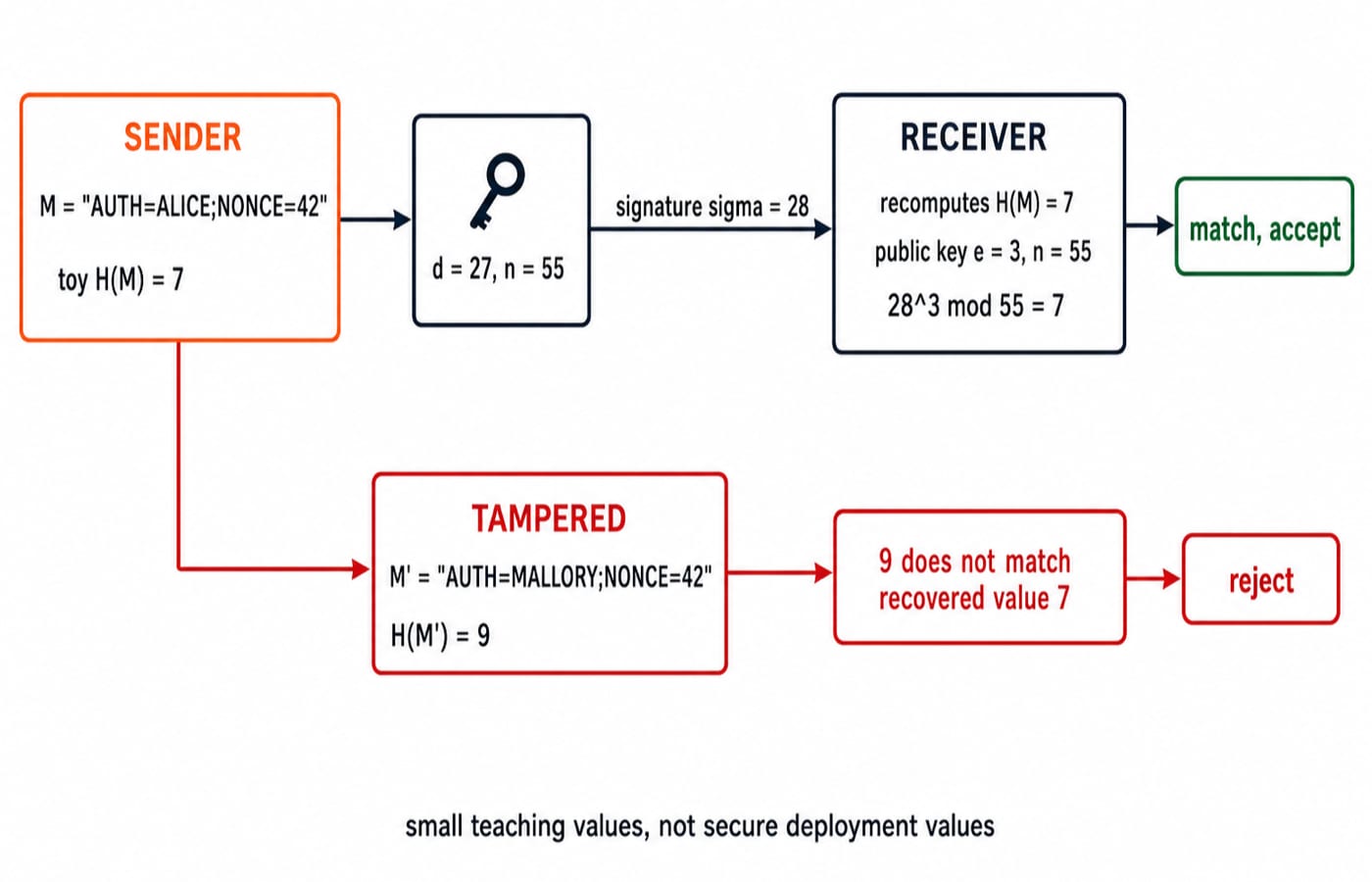
For key generation and modular encryption, use the earlier RSA Algorithm MCQs set. The same toy key pair is reused here only to trace signing, verification and tamper detection; its tiny parameters are not secure for deployment. Choose p = 5 and q = 11, so n = 5 x 11 = 55 and phi(n) = (5 - 1)(11 - 1) = 40. Choose e = 3 and d = 27, because 3 x 27 = 81 and 81 mod 40 = 1. Map M = "AUTH=ALICE;NONCE=42" to the toy digest H(M) = 7. The signer computes sigma = 7^27 mod 55 = 28. The verifier computes 28^3 mod 55 = 7, matching the recomputed digest. If the message changes to M' = "AUTH=MALLORY;NONCE=42" with H(M') = 9, recovered value 7 does not match 9, so verification fails.
Continue with the Computer Networks MCQs collection.
Authentication MCQs 1-2: challenge-response and integrity
Question 1 (UGC NET 2018)
In Challenge-Response authentication the claimant ________.
A. Proves that she knows the secret without revealing it
B. Proves that she doesn’t know the secret
C. Reveals the secret
D. Gives a challenge
Correct answer: A. Proves that she knows the secret without revealing it.
The verifier sends a challenge, and the claimant computes a response using that challenge and the secret without transmitting the secret. A response captured for nonce 17 will not satisfy a fresh challenge with nonce 42, because the expected response changes. Open the solved challenge-response question.
Question 2 (TPSC 2025)
_______ means the security of data from tampering by unidentified users.
A. Confidentiality
B. Integrity
C. Authentication
D. Non-repudiation
Correct answer: B. Integrity.
Tampering changes data, so integrity is the tested property. Confidentiality limits reading, authentication checks identity, and non-repudiation supplies evidence against later denial. In the worked example, the digest change from 7 to 9 reveals lost integrity. Review this integrity question.
Hash and message-digest MCQs 3-4: fingerprint versus encryption
Question 3 (UPLT 2026)
Which of these is specifically used to verify message integrity by generating a cryptographic fingerprint of the message?
A. Decryption algorithm
B. Digital signature
C. Protocol
D. Message digest
Correct answer: D. Message digest.
A hash function maps a message to a fixed-size digest, the fingerprint named in the question. A digital signature uses a digest inside a wider authenticity and non-repudiation mechanism, but a digest neither encrypts nor hides the message. Open the solved message-digest question.
Question 4 (ISRO 2017)
Which of the following are used to generate a message digest by the network security protocols? (P) SHA-256 (Q) AES (R) DES (S) MD5
A. P and S only
B. P and Q only
C. R and S only
D. P and R only
Correct answer: A. P and S only.
Classify the algorithms before selecting the pair. SHA-256 and MD5 are hash functions that produce digests, while AES and DES are symmetric encryption algorithms, so P and S is correct. Check the full worked answer.
Digest-size MCQs 5-6: bits, bytes and hexadecimal digits
Question 5 (RSSB 2022)
Secure Hash Algorithm-1 (SHA-1) has a message digest of –
A. 160 bits
B. 512 bits
C. 628 bits
D. 820 bits
Correct answer: A. 160 bits.
SHA-1 produces a 160-bit digest. That is 160 / 8 = 20 bytes or 160 / 4 = 40 hexadecimal digits. The familiar 512 belongs to input block-size discussions, not the digest length asked here. Review the SHA-1 digest-size question.
Question 6 (ISRO 2017)
MD5 is a widely used hash function for producing hash value of
A. 64 bits
B. 128 bits
C. 512 bits
D. 1024 bits
Correct answer: B. 128 bits.
MD5's output is 128 bits, equal to 128 / 8 = 16 bytes or 128 / 4 = 32 hexadecimal digits. This is shorter than SHA-1's 160-bit output, but the output-size fact does not make MD5 suitable for a modern security design. Open the solved MD5 question.
Digital-signature MCQs 7-8: who signs and what is signed
Question 7 (ISRO 2007 and BEL 2007)
A hashed message is signed by a sender using:
A. his public key
B. his private key
C. receiver’s public key
D. receiver’s private key
Correct answer: B. his private key.
The sender creates the signature with the sender's private key, and the receiver verifies it with the sender's public key. For confidentiality, the key ownership changes: the sender encrypts for the receiver with the receiver's public key. Review the signing-key question.
Question 8 (UGC NET 2023)
Hash functions are used to produce the message digests which are then encrypted with a private key to get :
A. Public key
B. Digital signature
C. Cipher text
D. Data Encryption Standard
Correct answer: B. Digital signature.
First hash the message to obtain its digest, then apply the signer's private-key operation to that digest. In the small teaching example, H(M) = 7 and 7^27 mod 55 = 28, so 28 is the signature value. Open this digital-signature question.
Signature-purpose MCQs 9-10: non-repudiation and certificates
Question 9 (IBPS 2025)
Which of the following is mainly used for non-repudiation in cybersecurity?
A. Firewall
B. Encryption
C. Digital certificate
D. Digital signature
E. Hash function
Correct answer: D. Digital signature.
A digital signature binds a digest to the signer's private-key operation, supplying evidence about origin and unchanged content. A hash has no signer identity, encryption mainly serves confidentiality, and a certificate binds an identity to a public key rather than signing the message itself. Review the non-repudiation question.
Question 10 (Coal India 2020)
Digital Certificates are described using ______ format.
A. X.509
B. X.510
C. X.508
D. X.409
Correct answer: A. X.509.
X.509 is the recognised certificate format used with public-key infrastructure. It lets a verifier associate a public key with the named subject. Open the solved certificate-format question.
Mixed authentication and signature MCQs 11-12: classification and key order
Question 11 (UGC NET 2025)
Match List I with List II
List I | List II |
|---|---|
A. Digital Signature | I. Asymmetric encryption algorithm |
B. Hash Function | II. Confirms authenticity and integrity |
C. AES | III. Produces a fixed-size digest |
D. RSA | IV. Symmetric encryption algorithm |
Choose the correct answer from the options given below:
A. A-II, B-III, C-I, D-IV
B. A-II, B-III, C-IV, D-I
C. A-III, B-II, C-I, D-IV
D. A-IV, B-II, C-I, D-III
Correct answer: B. A-II, B-III, C-IV, D-I.
Match the algorithm families first: AES is symmetric, so C-IV, and RSA is asymmetric, so D-I. A hash function gives B-III, a fixed-size digest, leaving digital signature as A-II, authenticity and integrity. Only option B has all four. Review the matching question.
Question 12 (BARC 2013)
Using public key cryptography, X adds a digital signature σ to message M, encrypts ⟨M, σ⟩, and sends it to Y, where it is decrypted. Which one of the following sequences of keys is used for the operations?
A. Encryption: X’s private key followed by Y’s private key; Decryption: X’s public key followed by Y’s public key
B. Encryption: X’s private key followed by Y’s public key; Decryption: X’s public key followed by Y’s private key
C. Encryption: X’s public key followed by Y’s private key; Decryption: Y’s public key followed by X’s private key
D. Encryption: X’s private key followed by Y’s public key; Decryption: Y’s private key followed by X’s public key
Correct answer: D. Encryption: X’s private key followed by Y’s public key; Decryption: Y’s private key followed by X’s public key.
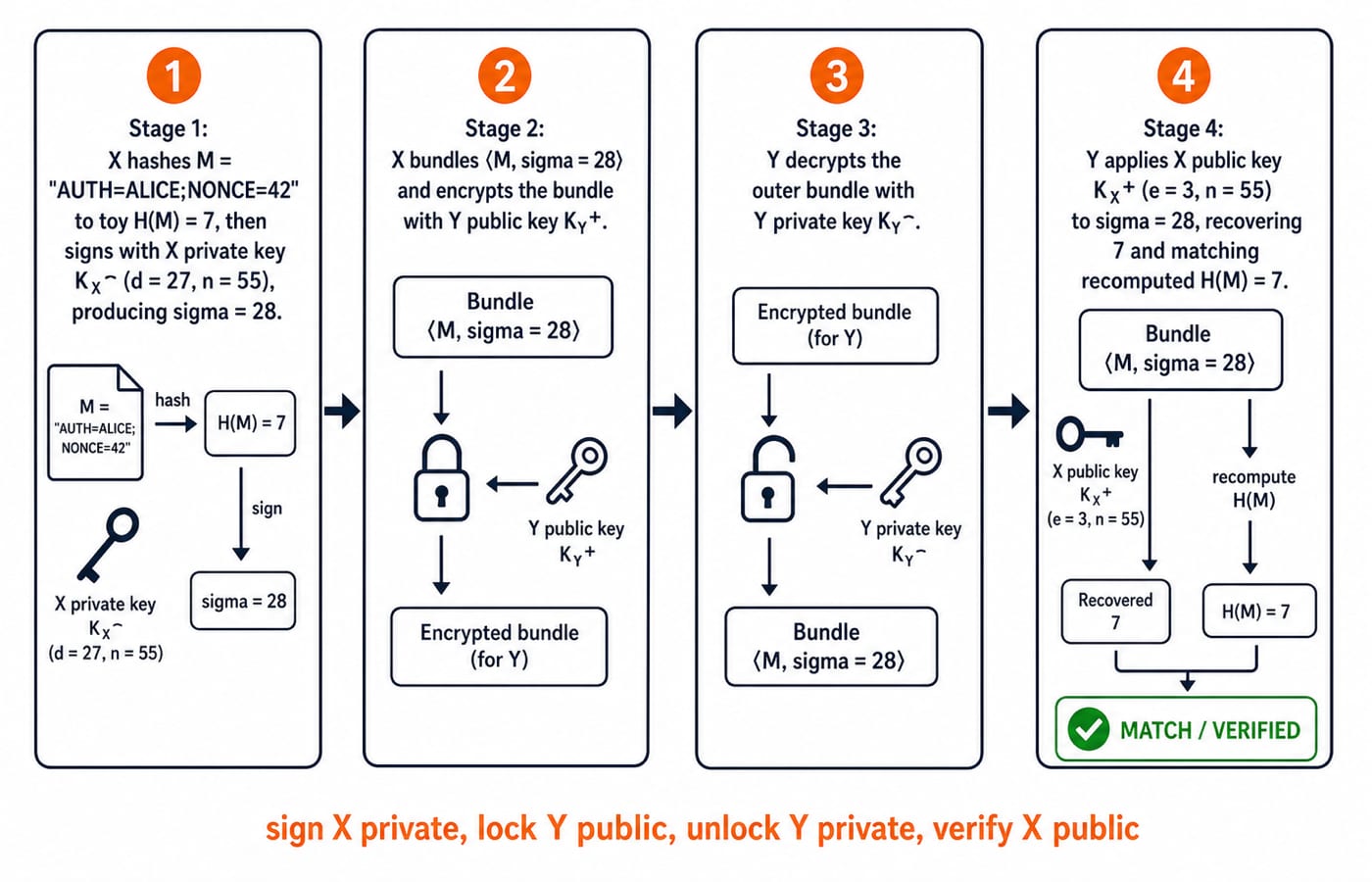
Split the workflow by purpose. X signs with X's private key, then encrypts the signed package for Y with Y's public key. Y removes that outer layer with Y's private key and verifies the signature with X's public key, giving X private, Y public, Y private, X public. Open the solved key-order question.
The short version and the next practice step
Authentication verifies identity.
A digest fingerprints content.
A signer uses the signer's private key.
A verifier uses the signer's public key.
Confidentiality for Y uses Y's public key and Y's private key.
Spend ten minutes on an error log. Reattempt Questions 1, 7 and 12 without looking, write identity, X private and Y public -> Y private beside the relevant steps, then retry only the questions where you assigned the wrong key owner or security property.
For concept-led support, use GATE Guidance by Sanchit Sir. For timed practice, use the GATE Test Series.
Keep learning
UDP Protocol and Header MCQs: 12 Solved Questions with Explanations
Solve 12 UDP questions, then check the reasoning behind connectionless service, application choices, the 8-byte header, and packet-length calculations.
24 Oct 20267 min readComputer Networks MCQs
Repeater, Hub, Bridge & Switch MCQs: 12 Solved Questions with Explanations
Solve 12 exam questions on device layers, MAC forwarding, VLANs, collision and broadcast domains, port mirroring, bridges and crosspoint counting.
Updated 20 Oct 20267 min readComputer Networks MCQs
Ethernet IEEE 802.3 MCQs: 12 Solved Questions with Explanations
Solve 12 Ethernet questions on IEEE 802.3, speed generations, hubs, MAC addresses, multicast, CSMA/CD and the first binary backoff race.
Updated 16 Oct 20267 min readComputer Networks MCQs
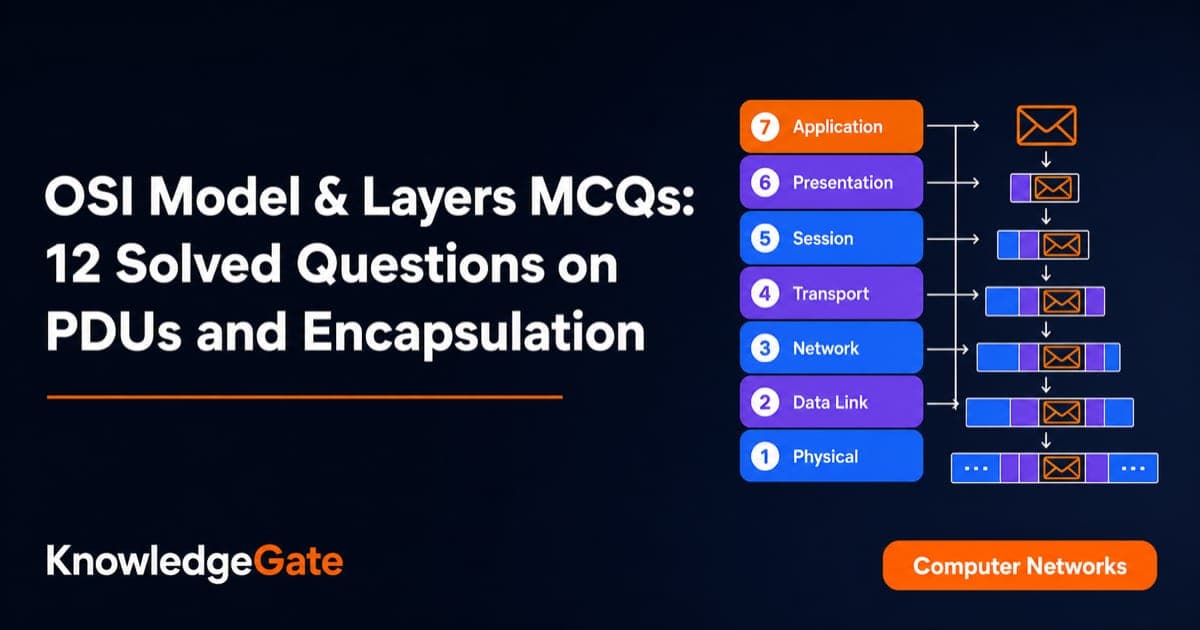
OSI Model & Layers MCQs: 12 Solved Questions on PDUs and Encapsulation
Test OSI layers, PDUs, encapsulation and router traversal through solved MCQs, with explanations, a byte-by-byte frame trace and a layer-visit method.
12 Oct 20267 min read52 viewsComputer Networks MCQs