Conflict Serializability MCQs: 12 Solved Schedule Questions
Solve 12 conflict serializability questions with precedence-graph checks, equivalent serial orders, blind-write traps and a worked lost-update trace.
KnowledgeGate Team
Exam prep & CS education
Updated 15 Sep 20268 min read58 views
A reversed edge or false read-read conflict changes the answer. Final values do not prove serializability, and interleaving does not disprove it. KnowledgeGate has over 50 practice questions on schedules and conflict serializability. Use CS Fundamentals for Placements for broader DBMS learning. Draw each graph first.
Related reading: transaction management and ACID property MCQs.
Conflict serializability in one fully worked schedule
Four rules decide the conflict test. The full theory behind them is in DBMS Transactions: ACID, Serializability, 2PL Explained.
Test | Result |
|---|---|
Different transactions, same item, at least one write | Conflict |
| No conflict |
| Conflict |
Acyclic precedence graph | Conflict serializable |
Direct an edge from the earlier transaction to the later one. A topological order gives the equivalent serial order.
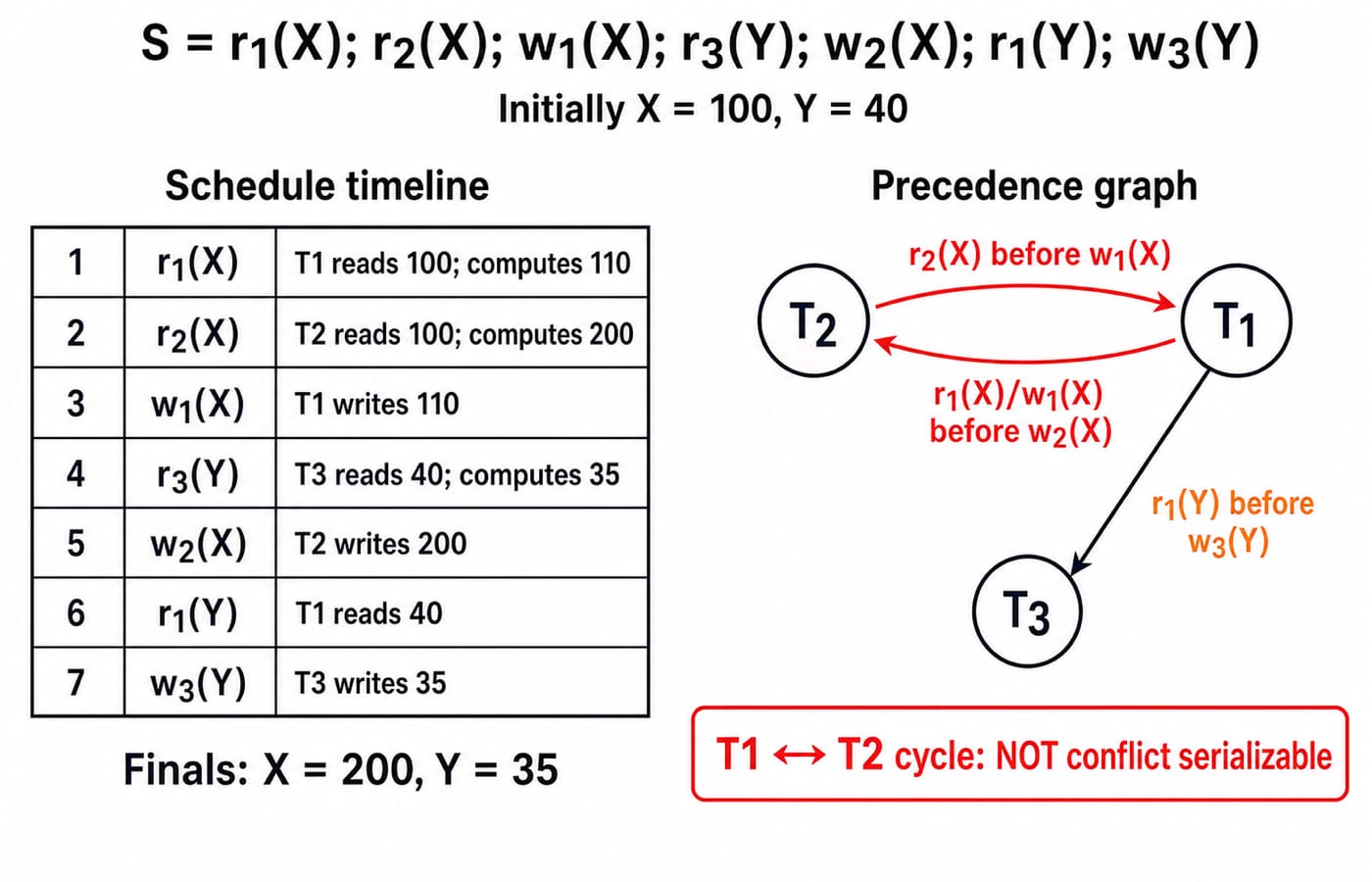
Let X = 100, Y = 40, and S = r1(X); r2(X); w1(X); r3(Y); w2(X); r1(Y); w3(Y). T1 computes 110, T2 200, and T3 35.
On X, r2(X) before w1(X) gives T2 -> T1; r1(X) and w1(X) before w2(X) give T1 -> T2. On Y, r1(Y) before w3(Y) gives T1 -> T3. Reads do not conflict. The T1 -> T2 -> T1 cycle proves failure.
T1 and T2 read 100. T1 writes 110, then T2 writes 200, so X = 200. T3 changes 40 to 35. Serial T1, T2 gives 220; serial T2, T1 gives 210. Neither matches.
MCQs 1-3: conflicts, conflict equivalence and blind writes
Question 1
Two schedules are said to be ______ if the order of any two conflicting operations is same in both the schedules.
A. conflict equivalent
B. schema equivalent
C. result equivalent
D. view equivalent
Answer: A. Conflict equivalence preserves conflicting-pair order. View equivalence preserves reads-from relationships and the final writer. Practice this question.
Question 2
In the context of concurrency control, a given pair of operations in a schedule is called conflict schedule if
(A) At least one of the operations is write operation
(B) Both the operations are performed on the same data item
(C) Both the operations are performed by different transactions
(D) Both the operations are performed on different data items
Choose the correct answer from the options given below:
A. (A) and (B) Only
B. (A), (B) and (C) Only
C. (A), (C) and (D) Only
D. (C) and (D) Only
Answer: B. The tests are different transactions, same item and at least one write. Thus r1(X) conflicts with w2(X), not r2(X). Practice this question.
Question 3
Which one of the following statements are CORRECT ?
(A) Granularity is the size of data item in a database.
(B) Two operations in a schedule are said to be conflict if they belong to same transaction.
(C) Two Schedulers are said to be conflict equivalent if the order of any two conflicting operations is the same in both schedules.
(D) Write operations which are performed without performing the write operation are known as Blind Writes.
Choose the correct answer from the options given below :
A. (A) and (B) Only
B. (A), and (C) Only
C. (A), (B) and (D) Only
D. (B) and (C) Only
Answer: B. A and C are true. Conflicts need different transactions; a blind write has no prior read. Practice this question.
MCQs 4-6: serial, view-serializable and precedence-graph claims
Question 4
Considering the following statements:
A. A non-serial schedule is said to be conflict serializable, if it is conflict-equivalent to some serial schedule.
B. A non-serial schedule is said to be view serializable if it is view-equivalent to some serial schedule.
C. A schedule is said to be serial, if instructions of participating transactions are chronologically interleaved with each other.
D. A conflict-serializable schedule will be view-serializable also, but vice-versa may not be true.
Choose the correct answer from the options given below:
A. A, B, C, D
B. A, B, C Only
C. A, B, D Only
D. B, C, D Only
Answer: C. A, B and D are true. Serial means no interleaving. Conflict serializability implies view serializability, not conversely. Practice this question.
Question 5
Suppose a database schedule S involves transactions . Construct the precedence graph of with vertices representing the transactions and edges representing the conflicts. If is serializable, which one of the following orderings of the vertices of the precedence graph is guaranteed to yield a serial schedule?
A. Topological order
B. Depth-first order
C. Breadth-first order
D. Ascending order of transaction indices
Answer: A. A topological order respects every edge. DFS, BFS and transaction indices do not guarantee that. Practice this question.
Question 6
Suppose two schedules S1 and S2 of the same set of transactions and we know that S1 is conflict serializable, and the precedence graphs of the two schedules are the same, i.e. P(S1) = P(S2).
Consider the following claims about S2:
(i) S2 is serial schedule
(ii) S2 is conflict serializable
(iii) S2 is conflict equivalent to S1
Which of the above is/are valid claims?
A. i and ii only
B. ii and iii only
C. ii only
D. iii only
Answer: C. The acyclic graph proves ii, but not serial execution in i or pair-by-pair equivalence in iii. Practice more questions on this topic.
MCQs 7-9: construct the graph and detect cycles
Question 7
Consider the following four schedules due to three transactions (indicated by the subscript) using read and write on a data item X, denoted by r(X) and w(X) respectively. Which one of them is conflict serializable ?
S1 : r1 (X); r2 (X); w1 (X); r3 (X); w2 (X)
S2 : r2 (X); r1 (X); w2 (X); r3 (X); w1 (X)
S3 : r3 (X); r2 (X); r1 (X); w2 (X); w1 (X)
S4 : r2 (X); w2 (X); r3 (X); r1 (X); w1 (X)
A. S1
B. S2
C. S3
D. S4
Answer: D. S1, S2 and S3 contain T1 -> T2 -> T1. S4 has T2 -> T3, T2 -> T1, T3 -> T1, giving T2, T3, T1. Practice this question.
Question 8
Let and denote read and write operations respectively on a data item by a transaction . Consider the following two schedules.
Which one of the following options is correct?
A. is conflict serializable, and is not conflict serializable.
B. is not conflict serializable, and is conflict serializable
C. Both and are conflict serializable
D. Neither nor is conflict serializable
Answer: B. S1 has T2 -> T1 on x and T1 -> T2 on y. S2 has only T2 -> T1, giving T2, T1. Practice this question.
Question 9
Consider two transactions T1 and T2, and four schedules S1, S2, S3, S4 of T1 and T2 as given below:
T1 = R1[X] W1[X] W1[Y]
T2 = R2[X] R2[Y] W2[Y]
S1 = R1[X] R2[X] R2[Y] W1[X] W1[Y] W2[Y]
S2 = R1[X] R2[X] R2[Y] W1[X] W2[Y] W1[Y]
S3 = R1[X] W1[X] R2[X] W1[Y] R2[Y] W2[Y]
S4 = R2[X] R2[Y] R1[X] W1[X] W1[Y] W2[Y] Which of the above schedules are conflict-serializable?
A. S1 and S2
B. S2 and S3
C. S3 only
D. S4 only
Answer: B. S1 and S4 cycle. S2 has only T2 -> T1; S3 only T1 -> T2. Practice this question.
Practise ACID, locking and recoverability with DBMS Transaction MCQs: 12 Solved Questions.
MCQs 10-12: equivalent serial order, non-serial interleaving and lost update
Question 10
Let Ri (z) and Wi (z) denote read and write operations on a data element z by a transaction Ti , respectively. Consider the schedule S with four transactions.
S : R4(x), R2(x), R3(x), R1(y), W1(y), W2(x), W3(y), R4(y)
Which one of the following serial schedules is conflict equivalent to S?
A. T1 → T3 → T4 → T2
B. T1 → T4 → T3 → T2
C. T4 → T1 → T3 → T2
D. T3 → T1 → T4 → T2
Answer: A. X gives T4 -> T2, T3 -> T2; Y gives T1 -> T3, T1 -> T4, T3 -> T4. These force T1, T3, T4, T2. Practice this question.
Question 11
Consider the following transactions with data items P and Q initialized to zero:
T1 :read (P);
read (Q);
if P = 0 then Q := Q + 1 ;
write (Q).
T2 : read (Q);
read (P);
if Q = 0 then P := P + 1 ;
write (P).
Any non-serial interleaving of T1 and T2 for concurrent execution leads to
A. a serializable schedule
B. a schedule that is not conflict serializable
C. a conflict serializable schedule
D. a schedule for which a precedence graph cannot be drawn
Answer: B. P gives T1 -> T2 and Q gives T2 -> T1, so the precedence graph cycles. Practice this question.
Question 12
Consider the following schedule on data object Q, whose initial value is 500. What will be the final value of Q after the last operation?
1. T1: Read(Q)
2. T2: Read(Q)
3. T1: Q = Q + 100
4. T2: Q = Q + 100
5. T2: Write(Q)
6. T1: Write(Q)
A. 600
B. 700
C. 550
D. 500
Answer: A. Both read 500 and compute 600. T2 then T1 write 600, so final Q is 600: a lost update. r1(Q) before w2(Q) gives T1 -> T2; r2(Q) before w1(Q) gives T2 -> T1. Practice this question.
The four traps these questions repeatedly test
Adding an
R-Redge. Reads do not conflict.Using transaction numbers. Follow operation order.
Stopping early. Scan every item for reverse edges.
Using values. Decide from the graph, then trace anomalies.
Short version and the next practice step
Use this five-line recall check:
Same item.
Different transactions.
At least one write.
Edge follows time.
Acyclic graph means conflict serializable.
A topological order supplies an equivalent serial order. Review at two minutes per question. Classify each miss, then redraw without options.
Continue with GATE Guidance by Sanchit Sir, or rebuild core subjects through CS Fundamentals for Placements by Sanchit Sir.
Keep learning
SQL Library Functions MCQs: 12 Solved Math, Aggregate, String and Date Questions
Practise 12 solved SQL library function MCQs with inside-out calculations, exact intermediate values and clear explanations of the common traps.
Updated 3 Oct 20268 min readDBMS MCQs
SQL Introduction, Components & Structure MCQs: 12 Solved Questions
Test your SQL foundations with 12 explained MCQs covering terminology, query behaviour, metadata, dynamic SQL, database models and QBE.
28 Sep 20267 min readDBMS MCQs
GROUP BY Clause MCQs: 10 Solved SQL Questions with Explanations
Solve ten published GROUP BY questions, then check each answer with row-level and group-level reasoning. Two full traces make the common SQL traps visible.
Updated 25 Sep 20268 min readDBMS MCQs
Third Normal Form (3NF) MCQs: 12 Solved Questions with Explanations
Solve 12 real 3NF exam MCQs with clear explanations, candidate-key closures, a raw-row decomposition, and the prime-attribute exception that separates 3NF from BCNF.
Updated 24 Sep 20267 min readDBMS MCQs