Lossless Join Decomposition MCQs: 12 Solved Questions with Explanations
Solve 12 lossless join decomposition questions with direct explanations, from the shared-attribute test to multi-relation decomposition.
KnowledgeGate Team
Exam prep & CS education
Updated 13 Sep 20267 min read
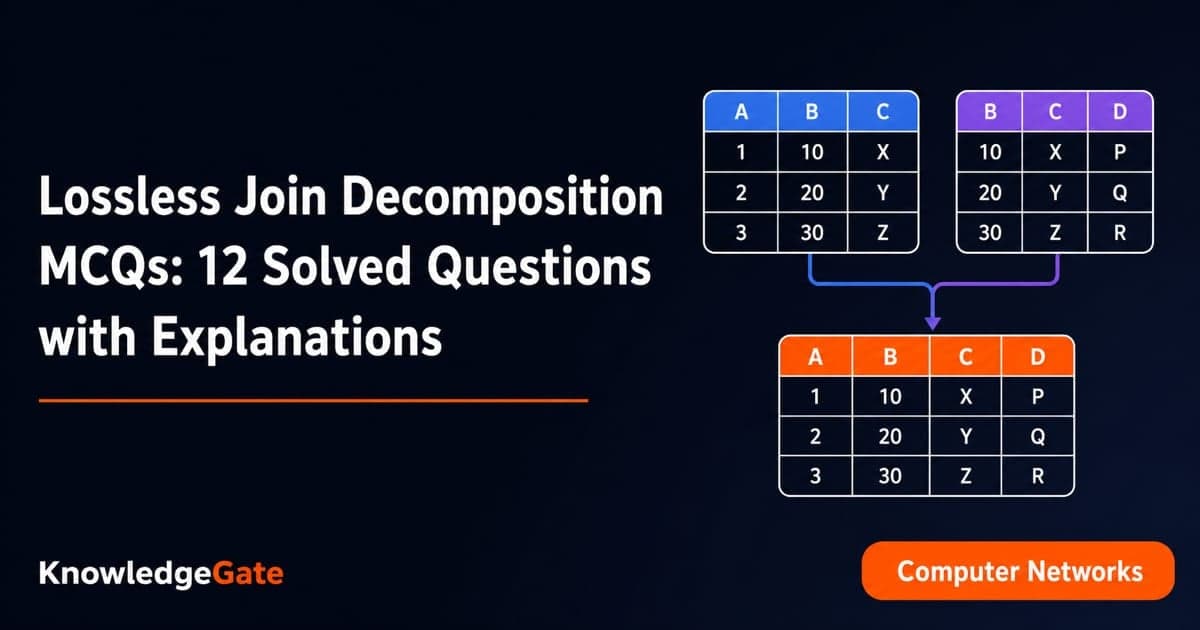
Lossless-join questions turn on one small set: the attributes shared by the fragments. Write the intersection, compute its closure, and check whether it determines either fragment. Use the Lossless Join Decomposition question hub when a question does not carry its own inline solution link.
Lossless join decomposition criterion: Questions 1 and 2
For R -> R1, R2, R1 ∪ R2 = R proves coverage, not losslessness. With X = R1 ∩ R2, the test is X -> R1 or X -> R2 in F+.
For R(A,B,C,D), F = {A→B, C→D}, R1(A,B,C), R2(C,D), the intersection is {C} and C+ = {C,D}. It determines R2, so the join is lossless. R1(A,B) and R2(C,D) have an empty intersection, producing a possible Cartesian product. Revise Attribute Closure and Candidate Keys for GATE if needed.
Question 1
Which of the following conditions must hold for a decomposition of a relation R into R1 and R2 to be lossless?
A. R1∩R2→R1
B. R1∩R2→R2
C. Either (A) or (B)
D. Both (A) and (B)
Answer: C. Either (A) or (B).
X = R1 ∩ R2 must determine one fragment, not both. Hence either condition works.
Question 2
Consider a relation R(A,B,C,D) with FDs A→B and C→D. Which of the following decompositions is lossless?
A. R1(A,B), R2(C,D)
B. R1(A,C), R2(B,D)
C. R1(A,B,C), R2(C,D)
D. None of the above
Answer: C. R1(A,B,C), R2(C,D).
In C, C+ = {C,D} determines R2. A and B have empty intersections, so neither guarantees losslessness.
Lossy decomposition and spurious tuples: Question 3
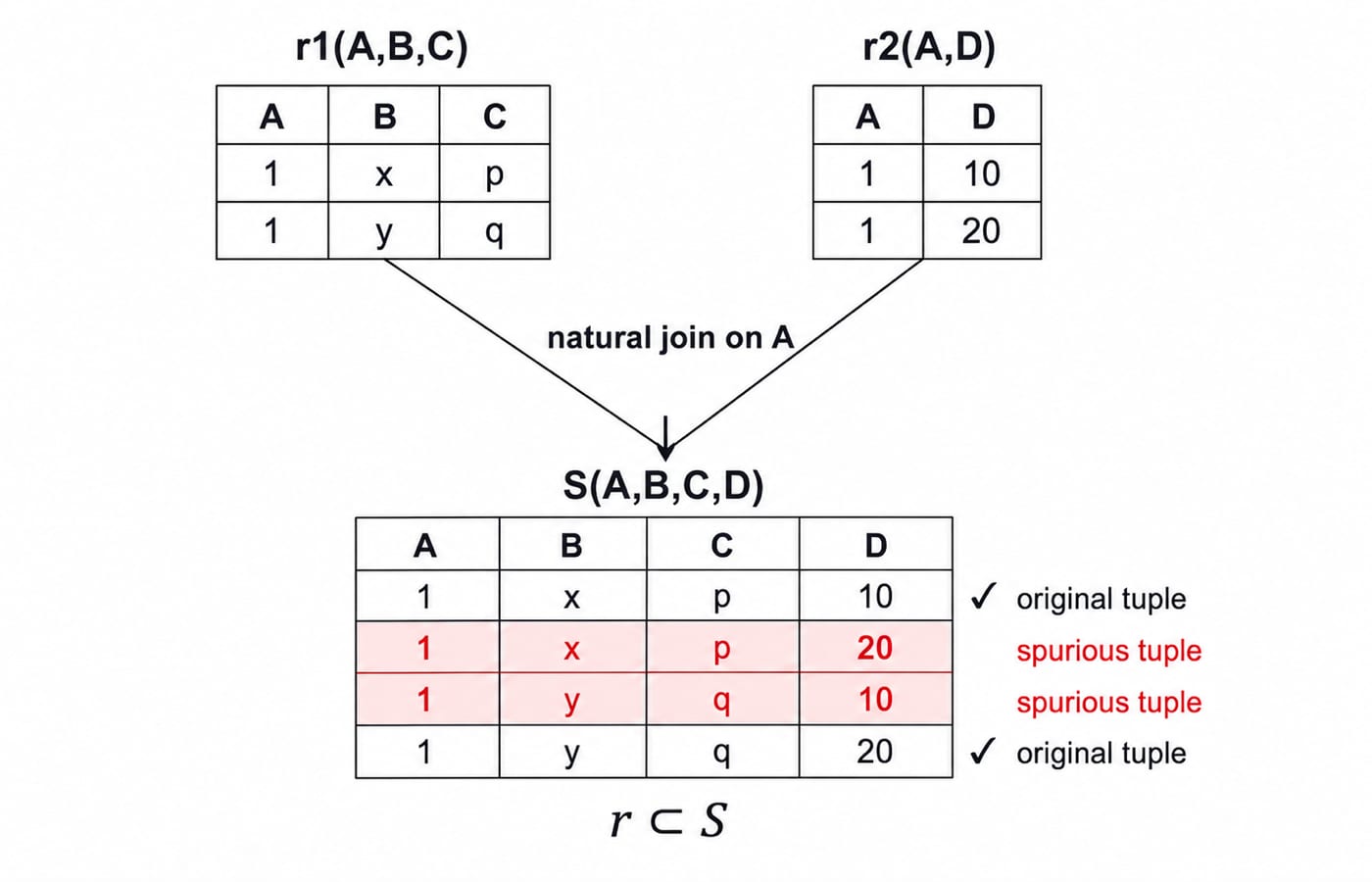
Always r ⊆ πR1(r) ⋈ πR2(r). Lossiness makes this containment strict.
For r = {(1,x,p,10), (1,y,q,20)}, project r1 = {(1,x,p), (1,y,q)} and r2 = {(1,10), (1,20)}. Their join is (1,x,p,10), (1,x,p,20), (1,y,q,10), (1,y,q,20). The middle tuples are spurious, so r ⊂ S. Rejoining retains every original tuple.
Question 3
Let r be a relation instance with schema R = (A, B, C, D).
Define r1 = πA,B,C(r) and r2 = πA,D(r). Let S = r1 ⋈ r2, where ⋈ denotes natural join.
Given that the decomposition of R into r1 and r2 is lossy, which one of the following is true?
A. S ⊂ r
B. r ∪ S
C. r ⊂ S
D. r ⋈ S = S
Answer: C. r ⊂ S.
The join adds two cross-combinations to the originals, so r ⊂ S. Open the exact solved question.
Multivalued dependencies and lossless joins: Questions 4 and 5
For R(X,Y,Z), X ↠ Y gives lossless fragments R1(X,Y) and R2(X,Z): for fixed X, Y varies independently of Z.
Question 4
Consider a relation R(A,B,C) with the MVD A↠B. Which of the following decompositions is guaranteed to be a lossless join?
A. R into R1(A,B) and R2(A,C)
B. R into R1(A,B,C) and R2(B,C)
C. R into R1(A,B) and R2(B,C)
D. None
Answer: A. R into R1(A,B) and R2(A,C).
Here X=A, Y=B, Z=C. Projections (A,B) and (A,C) preserve the combinations required by A↠B.
Question 5
The relation schemas 𝑅1 and 𝑅2 form a Lossless join decomposition of 𝑅 if and only if
(a)
(b)
(c)
(d)
Codes :
A. (a) and (b) happens
B. (a) and (d) happens
C. (a) and (c) happens
D. (b) and (c) happens
Answer: C. (a) and (c) happens.
For X = R1 ∩ R2, complementation pairs X ↠ (R1-R2) with X ↠ (R2-R1). Hence (a) and (c). Open the exact solved question.
Attribute closure proves the join: Questions 6 to 8
Use the same four checks each time:
Fragments | Intersection | Intersection closure under | Verdict |
|---|---|---|---|
|
| Compute | Lossless if |
Question 6
Consider the table R with attributes A, B and C. The functional dependencies that hold on
R are : A → B, C → AB. Which of the following statements is/are True ?
I. The decomposition of R into R1(C, A) and R2(A, B) is lossless.
II. The decomposition of R into R1(A, B) and R2(B, C) is lossy.
A. Only I
B. Only II
C. Both I and II
D. Neither I nor II
Answer: C. Both I and II.
For I, A+ = {A,B} determines R2. For II, B+ = {B} determines neither fragment. Both hold. Open the exact solved question.
Question 7
Which of the following statements is TRUE ?
D1 : The decomposition of the schema R(A, B, C) into R1(A, B) and R2 (A, C) is always lossless.
D2 : The decomposition of the schema R(A, B, C, D, E) having AD → B, C → DE, B → AE and AE → C, into R1 (A, B, D) and R2 (A, C, D, E) is lossless.
A. Both D1 and D2
B. Neither D1 nor D2
C. Only D1
D. Only D2
Answer: D. Only D2.
D1 gives no dependency from A. In D2, intersection {A,D} determines R1(A,B,D) through AD→B. Open the exact solved question.
Question 8
Consider the relation R(V, W, X, Y, Z) with functional dependencies {Z→Y, Y→Z, X→Y, X→V, VW→X}.
Suppose that relation R is decomposed into two relations, R1(V, W, X) and R2(X, Y, Z). Is this decomposition a lossless decomposition?
A. Lossless due to X → Y,Z.
B. Lossless due to VW → X.
C. Lossy because X is insufficient.
D. Lossy due to dependency break.
Answer: A. Lossless due to X → Y,Z.
From {X}, apply X→Y, Y→Z, X→V: X+ = {X,Y,Z,V} contains all of R2. Missing W is irrelevant.
BCNF and dependency preservation: Questions 9 to 11
Losslessness asks whether joining the fragments reconstructs exactly the original relation. Dependency preservation asks whether projected FDs can enforce F without a join, while BCNF asks whether every non-trivial determinant is a fragment superkey. For projected-FD closures and preservation proofs, work through Dependency Preserving Decomposition MCQs; Questions 9 to 11 use preservation only as a separate verdict after the lossless-join test.
Question 9
Consider a relation R = (A, B, C, D, E) with the set of functional dependency FDs
{A -> ABCDE, B -> C }. Which of the following statement is true?
A. R1 = (A, C, D, E) and R2 = (B, C) are both in BCNF and preserve lossless-join.
B. R1 = (A, B, D, E) and R2 = (B, C) are both in BCNF and preserve lossless-join.
C. both (a) and (b)
D. None of the above.
Answer: B. R1 = (A, B, D, E) and R2 = (B, C) are both in BCNF and preserve lossless-join.
In B, the intersection is {B} and B→C determines R2(B,C), so the join is lossless. A is a key of R1 and B is a key of R2, so both fragments are in BCNF. The projected dependencies A→ABDE in R1 and B→C in R2 together preserve A→ABCDE.
Question 10
Consider a schema R(A,B,C,D) and functional dependencies A→B and C→D. Then the decomposition of R into R₁(AB) and R₂(CD) is
A. dependency preserving and lossless join
B. lossless join but not dependency preserving
C. dependency preserving but not lossless join
D. not dependency preserving and not lossless join
Answer: C. dependency preserving but not lossless join.
Both FDs remain local. The fragments have an empty intersection, so their join is a Cartesian product and the decomposition is lossy. DBMS Normalization MCQs uses this same GATE 2001 item inside the broader 1NF-to-BCNF ladder; here the decisive step is the empty-intersection proof. Open the exact solved question.
Question 11
Consider relation R(A,B,C,D,E,F,G) with functional dependencies F = {AD→BF, CD→EGC, BD→F, E→D, F→C, D→F}. After finding the minimal cover, R is decomposed into R1(A,B,C,D,E) and R2(A,D,F,G). Determine whether this decomposition is lossless and dependency preserving.
A. Decomposition is lossless and dependency preserving
B. Decomposition is lossy and dependency preserving
C. Decomposition is lossy and not dependency preserving
D. Decomposition is lossless and not dependency preserving
Answer: D. Decomposition is lossless and not dependency preserving.
From {A,D}, apply AD→B, D→F, F→C, then CD→E,G. Thus {A,D}+ = {A,B,C,D,E,F,G}, proving losslessness. Preservation fails because projected dependencies cannot enforce cross-fragment F→C without a join.
Multi-relation lossless decomposition: Question 12
For several fragments, join a pair whose intersection determines one member, replace it by their union, and repeat. Disjointness creates a Cartesian product.
Question 12
Consider the relation with the following functional dependencies.
Consider the decomposition of the relation R into the constituent relations according to the following two decomposition schemes.
Which one of the following options is correct?
A. is a lossless decomposition, but is a lossy decomposition
B. is a lossy decomposition, but is a lossless decomposition
C. Both and are lossless decompositions
D. Both and are lossy decompositions
Answer: A. is a lossless decomposition, but is a lossy decomposition.
For D1, join (Q,Y) to (Y,Z,W) by Y→ZW, add (P,Q,S,T) by Q→Y→ZW, then add (P,T,X) by P→X. Each step is lossless. In D2, (T,X) is disjoint and forces Cartesian combinations. Open the exact solved question.
The short version
Lossless-join analysis involves the binary criterion, spurious tuples, MVDs, closure, BCNF, dependency preservation and multi-relation assembly. Miss two together, then revise that method.
Write R1 ∩ R2, compute its closure, then check whether it determines either fragment. Test preservation separately. GATE Guidance by Sanchit Sir provides the full DBMS sequence; for a shorter revision loop, redo only the questions whose intersection closure you wrote incorrectly.
Keep learning
SQL Library Functions MCQs: 12 Solved Math, Aggregate, String and Date Questions
Practise 12 solved SQL library function MCQs with inside-out calculations, exact intermediate values and clear explanations of the common traps.
Updated 3 Oct 20268 min readDBMS MCQs

SQL Introduction, Components & Structure MCQs: 12 Solved Questions
Test your SQL foundations with 12 explained MCQs covering terminology, query behaviour, metadata, dynamic SQL, database models and QBE.
28 Sep 20267 min readDBMS MCQs

GROUP BY Clause MCQs: 10 Solved SQL Questions with Explanations
Solve ten published GROUP BY questions, then check each answer with row-level and group-level reasoning. Two full traces make the common SQL traps visible.
Updated 25 Sep 20268 min readDBMS MCQs
Third Normal Form (3NF) MCQs: 12 Solved Questions with Explanations
Solve 12 real 3NF exam MCQs with clear explanations, candidate-key closures, a raw-row decomposition, and the prime-attribute exception that separates 3NF from BCNF.
Updated 24 Sep 20267 min readDBMS MCQs