Third Normal Form (3NF) MCQs: 12 Solved Questions with Explanations
Solve 12 real 3NF exam MCQs with clear explanations, candidate-key closures, a raw-row decomposition, and the prime-attribute exception that separates 3NF from BCNF.
KnowledgeGate Team
Exam prep & CS education
Updated 24 Sep 20267 min read
Third Normal Form questions are not solved by repeating “remove transitive dependency”. They require candidate-key closures, prime-attribute checks, dependency tests, and a clear distinction between 3NF and BCNF; the 12 questions below add decomposition and highest-normal-form classification. Questions 5, 6 and 10 also appear in DBMS Normalization MCQs: 12 Solved (1NF to BCNF), where they test the full normalization ladder; here they isolate partial-dependency gating, the all-determinants-are-keys case, and the prime-side exception. The ENROLMENT walkthrough extends Second Normal Form (2NF) MCQs: 12 Solved Questions with Explanations: that earlier set owns the partial-dependency split, while this one carries the design forward through StudentID -> DeptID -> DeptPhone and the 3NF decomposition. Work each closure before reading the answer; Questions 1 and 4 use the Third Normal Form (3NF) lesson hub because they do not have stable individual question pages.
The 3NF test, worked from raw rows to decomposition
For every non-trivial dependency X -> A, 3NF holds when X is a superkey or A is prime, meaning it belongs to at least one candidate key. BCNF keeps only the first allowance: every determinant must be a superkey.
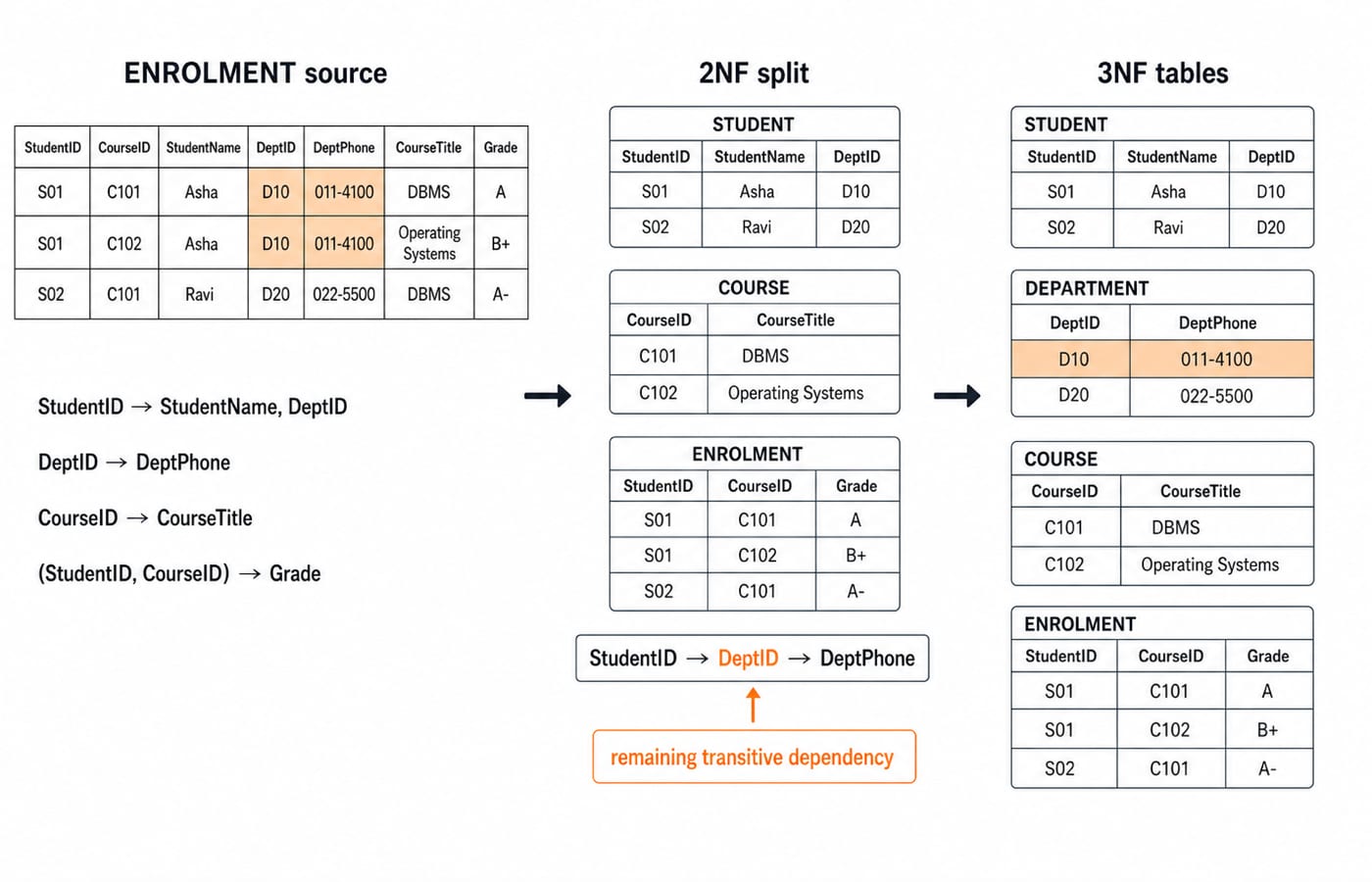
Consider ENROLMENT(StudentID, CourseID, StudentName, DeptID, DeptPhone, CourseTitle, Grade).
StudentID | CourseID | StudentName | DeptID | DeptPhone | CourseTitle | Grade |
|---|---|---|---|---|---|---|
S01 | C101 | Asha | D10 | 011-4100 | DBMS | A |
S01 | C102 | Asha | D10 | 011-4100 | Operating Systems | B+ |
S02 | C101 | Ravi | D20 | 022-5500 | DBMS | A- |
The dependencies are StudentID -> StudentName, DeptID, DeptID -> DeptPhone, CourseID -> CourseTitle, and (StudentID, CourseID) -> Grade. The candidate key is (StudentID, CourseID). Atomic values establish 1NF. StudentName and DeptID depend only on StudentID, and CourseTitle only on CourseID, so 2NF fails.
Split to STUDENT_2NF(StudentID, StudentName, DeptID, DeptPhone), COURSE(CourseID, CourseTitle) and ENROLMENT(StudentID, CourseID, Grade). The first table retains StudentID -> DeptID -> DeptPhone. Originally, changing D10's phone means editing both S01 rows.
For 3NF, use STUDENT(StudentID, StudentName, DeptID) with S01/Asha/D10 and S02/Ravi/D20; DEPARTMENT(DeptID, DeptPhone) with D10/011-4100 and D20/022-5500; COURSE(CourseID, CourseTitle) with C101/DBMS and C102/Operating Systems; and ENROLMENT(StudentID, CourseID, Grade). Each determinant is a key.
MCQs 1-3: transitive dependency and the formal 3NF rule
Question 1
Which normal form eliminates transitive dependencies ?A. 1NF
B. 2NF
C. 3NF
D. BCNFAnswer: C. 3NF. 1NF handles atomicity, 2NF handles partial dependency, and 3NF handles prohibited transitive dependency. BCNF is stricter.
Question 2
Third normal form is based on the concept of ______. A. Closure Dependency
B. Transitive Dependency
C. Normal Dependency
D. Functional DependencyAnswer: B. Transitive Dependency. StudentID -> DeptID -> DeptPhone is transitive. The formal 3NF test remains superkey-or-prime. Exact question.
Question 3
A relation is in __________, if and only if the non key attribute are mutually independent and irreducibly dependent on the primary key.A. 1NF
B. 3NF
C. 2NF
D. BCNFAnswer: B. 3NF. “Irreducibly dependent” means fully key-dependent. “Mutually independent” rules out one non-key attribute determining another. Exact question.
MCQs 4-6: candidate keys and the highest normal form
Question 4
Pick the incorrect statement.
P. 2NF deals with transitive dependency.
Q. X -> Y is allowed in 3NF if X is a superkey or Y is a part of a key.A. P
B. Q
C. P and Q
D. none of the aboveAnswer: A. P. 2NF addresses partial dependency. Q correctly uses “part of a key” to mean prime.
Question 5
A table has fields Fl, F2, F3, F4, F5 with the following functional dependencies
F1 → F3   F2→ F4   (F1 . F2) → F5
In terms of Normalization, this table is in
A. 1 NF
B. 2 NF
C. 3 NF
D. none
Answer: A. 1 NF. For key (F1, F2), F1 -> F3 and F2 -> F4 are partial, so 2NF fails. Atomic fields leave 1NF. The question uses both Fl/F1 for the same field. Exact question.
Question 6
Consider the schema R = (S, T, U, V) and the functional dependencies S→T, T→U, U→V and V→S. The relation R is:A. Not in 2NF
B. In 2NF but not in 3NF
C. In 3NF but not in 2NF
D. In both 2NF and 3NFAnswer: D. In both 2NF and 3NF. S+ = {S,T,U,V}, T+ = {T,U,V,S}, U+ = {U,V,S,T}, and V+ = {V,S,T,U}. Every singleton is a key, so BCNF holds, and therefore 3NF and 2NF hold. Exact question.
MCQs 7-9: the prime-attribute exception
Question 7
Consider the relation: R(Roll_No, Student_ID, Course_ID) with the following functional dependencies:
{Roll_No, Course_ID} → {Student_ID}
{Student_ID, Course_ID} → {Roll_No}
Student_ID → Roll_No
The above dependencies completely describe all functional dependencies of the relation. Identify the highest normal form satisfied by the relation.A. First Normal Form (1NF)
B. Second Normal Form (2NF)
C. Third Normal Form (3NF)
D. Boyce-Codd Normal Form (BCNF)
E. Fourth Normal Form (4NF)Answer: C. Third Normal Form (3NF). Keys {Roll_No, Course_ID} and {Student_ID, Course_ID} make all attributes prime. Student_ID is not a superkey, so BCNF fails, but prime right side Roll_No preserves 3NF. Exact question.
Question 8
The relation scheme Student Performance (name, courseNo, rollNo, grade) has the following functional dependencies:
name, courseNo → grade
rollNo, courseNo → grade
name → rollNo
rollNo → name
The highest normal form of this relation scheme isA. 2NF
B. 3NF
C. BCNF
D. 4NFAnswer: B. 3NF. Keys {name, courseNo} and {rollNo, courseNo} cover the grade dependencies. For name -> rollNo and rollNo -> name, non-superkey determinants break BCNF, while prime right sides preserve 3NF. Exact question.
Question 9
The best normal form of relation scheme R(A, B, C, D) along with the set of functional dependencies F = {AB → C, AB → D, C → A, D → B} isA. Boyce-Codd Normal form
B. Third Normal form
C. Second Normal form
D. First Normal formAnswer: B. Third Normal form. Keys are AB, BC, AD and CD; CD gets A from C -> A and B from D -> B. All attributes are prime, so C -> A and D -> B break BCNF but satisfy 3NF. Exact question.
MCQs 10-12: BCNF claims, decomposition and classification
Question 10
Which one of the following statements is FALSE?A. Any relation with two attributes is in BCNF
B. A relation in which every key has only one attribute is in 2NF
C. A prime attribute can be transitively dependent on a key in a 3 NF relation.
D. A prime attribute can be transitively dependent on a key in a BCNF relation.Answer: D. A prime attribute can be transitively dependent on a key in a BCNF relation. A non-trivial determinant among two attributes is a key. A singleton key has no proper subset. 3NF permits a prime-side exception; BCNF does not. Exact question.
Question 11
Given the table Employees(EmpID, Name, Dept, DeptPhone) with dependencies:
EmpID → Name, Dept
Dept → DeptPhone
How should this be decomposed to satisfy 3NF?A. Employees(EmpID, Name, DeptPhone) and Departments(Dept, DeptPhone)
B. Merge all attributes into a single table
C. Employees(EmpID, Name) and Departments(Dept, DeptPhone)
D. Employees(EmpID, Name, Dept) and Departments(Dept, DeptPhone)Answer: D. Employees(EmpID, Name, Dept) and Departments(Dept, DeptPhone). This removes EmpID -> Dept -> DeptPhone, preserves the dependencies and keeps Dept for joining. C loses each employee's department. Exact question.
Question 12
Consider the following relational schemas for a library database :
Book (Title, Author, Catalog_no, Publisher, Year, Price)
Collection(Title, Author, Catalog_no)
with the following functional dependencies :
I. Title, Author → Catalog_no
II. Catalog_no → Title, Author, Publisher, Year
III. Publisher, Title, Year → Price
Assume (Author, Title) is the key for both schemas.Which one of the following is true ?A. Both Book and Collection are in BCNF.
B. Both Book and Collection are in 3NF.
C. Book is in 2NF and Collection in 3NF.
D. Both Book and Collection are in 2NF.Answer: C under the intended highest-normal-form reading. Book fails 3NF on (Publisher, Title, Year) -> Price, but no shown dependency from Title or Author alone breaks 2NF. In Collection, (Title, Author) and Catalog_no are keys, so Collection reaches BCNF. Because BCNF implies 2NF, option D is also literally true if “in 2NF” means at least 2NF; the intended convention treats the options as highest-form classifications, making C the strongest listed classification. Exact question.
A repeatable method for 3NF questions under exam time
Use the same order every time:
Find all candidate keys by closure and mark prime attributes.
Test 2NF for partial dependencies to non-prime attributes.
Test each
X -> A: X must be a superkey or A must be prime.Test BCNF by removing the prime-right-side allowance.
For R(A,B,C) with F = {AB -> C, C -> B}, closures give keys AB and AC, making B prime. C -> B has a non-superkey determinant and prime right side, so 3NF holds but BCNF fails.
Check alternate keys, test 2NF first, reserve the prime exception for 3NF, and preserve dependencies and join attributes in decomposition.
Third Normal Form MCQs: the short version and next step
Partial dependency blocks 2NF. A prohibited transitive dependency blocks 3NF. Any non-superkey determinant blocks BCNF, even when its right side is prime. The safe routine is candidate keys, prime attributes, then one dependency at a time.
Retry Questions 7-9 without looking at the explanations. For a complete GATE CS sequence, continue with GATE Guidance by Sanchit Sir. For interview-focused DBMS revision, use CS Fundamentals for Placements by Sanchit Sir. Then return to any question where your candidate-key set was incomplete.
Keep learning
SQL Library Functions MCQs: 12 Solved Math, Aggregate, String and Date Questions
Practise 12 solved SQL library function MCQs with inside-out calculations, exact intermediate values and clear explanations of the common traps.
Updated 3 Oct 20268 min readDBMS MCQs

SQL Introduction, Components & Structure MCQs: 12 Solved Questions
Test your SQL foundations with 12 explained MCQs covering terminology, query behaviour, metadata, dynamic SQL, database models and QBE.
28 Sep 20267 min readDBMS MCQs

GROUP BY Clause MCQs: 10 Solved SQL Questions with Explanations
Solve ten published GROUP BY questions, then check each answer with row-level and group-level reasoning. Two full traces make the common SQL traps visible.
Updated 25 Sep 20268 min readDBMS MCQs
Second Normal Form (2NF) MCQs: 12 Solved Questions with Explanations
Test your 2NF understanding with 12 solved MCQs on full dependency, partial dependency, candidate keys, closures, and normal-form guarantees.
Updated 23 Sep 20268 min readDBMS MCQs