

Regularity Identification in Automata Theory: DFA/NFA Tests and Worked Proofs
Learn how to classify languages by the memory they need, construct a product DFA, and prove a genuinely non-regular language with pumping and Myhill-Nerode.
KnowledgeGate Team
Exam prep & CS education
Updated 1 Nov 20266 min read

A language can look difficult because its definition contains quantifiers, reversal notation or counting. The decisive question is simpler: can a machine with finitely many memory states recognise it? Start by classifying the memory requirement, then choose a DFA, closure construction or negative proof. The product-DFA construction, the 0^n1^n pumping proof and the NFA traps show why each choice works.
Regularity identification: what a regular language certificate proves
For a finite alphabet Sigma, a language L is regular exactly when a DFA, NFA or epsilon-NFA accepts it. A regular expression or right-linear grammar is an equivalent positive certificate. These form the same language class. An NFA may choose among paths, but still has finitely many states.
A finite automaton can retain a bounded suffix, one of finitely many remainders, whether a fixed pattern has appeared, or a finite combination. It cannot store an arbitrarily long first block for exact comparison later. This memory lens suggests the answer, but proof still needs an automaton, a valid closure result, or a rigorous negative argument.
An n-state NFA can produce up to 2^n subset states during conversion, yet nondeterminism does not enlarge the regular-language class. The GATE CS Theory of Computation Course | PYQs sequences DFA, NFA, regular expressions and pumping lemma.
A regularity identification checklist before any construction
Use the simplest clue first.
Clue | Memory needed | First proof tool |
|---|---|---|
Finite language or fixed bound | Finitely many cases | Finite-language argument |
Fixed prefix, suffix or substring | Bounded progress state | DFA, NFA or regular expression |
Count modulo | One of |
|
Union, intersection, complement, difference, reversal or homomorphic image of known regular languages | Component states | Closure construction |
Exact unbounded equality, arbitrary copying or unbounded palindrome matching | Unbounded memory suspected | Pumping lemma, Myhill-Nerode or closure reduction |
As a finite-language example, {w in {0,1}* : |w| <= 4} has 1 + 2 + 4 + 8 + 16 = 31 strings and is regular because it is finite. Counting 1s modulo 3 needs only R0, R1 and R2. By contrast, {0^n1^n : n >= 0} needs an unbounded equality check. This post uses closure only as one non-regularity test; Decision Properties of Regular Languages: DFA Testsowns the full decision-test treatment.
Worked regularity proof: suffix 01 plus a modulo-3 count
Consider
L = {w in {0,1}* : w ends in 01 and the number of 1s in w is congruent to 2 modulo 3}.
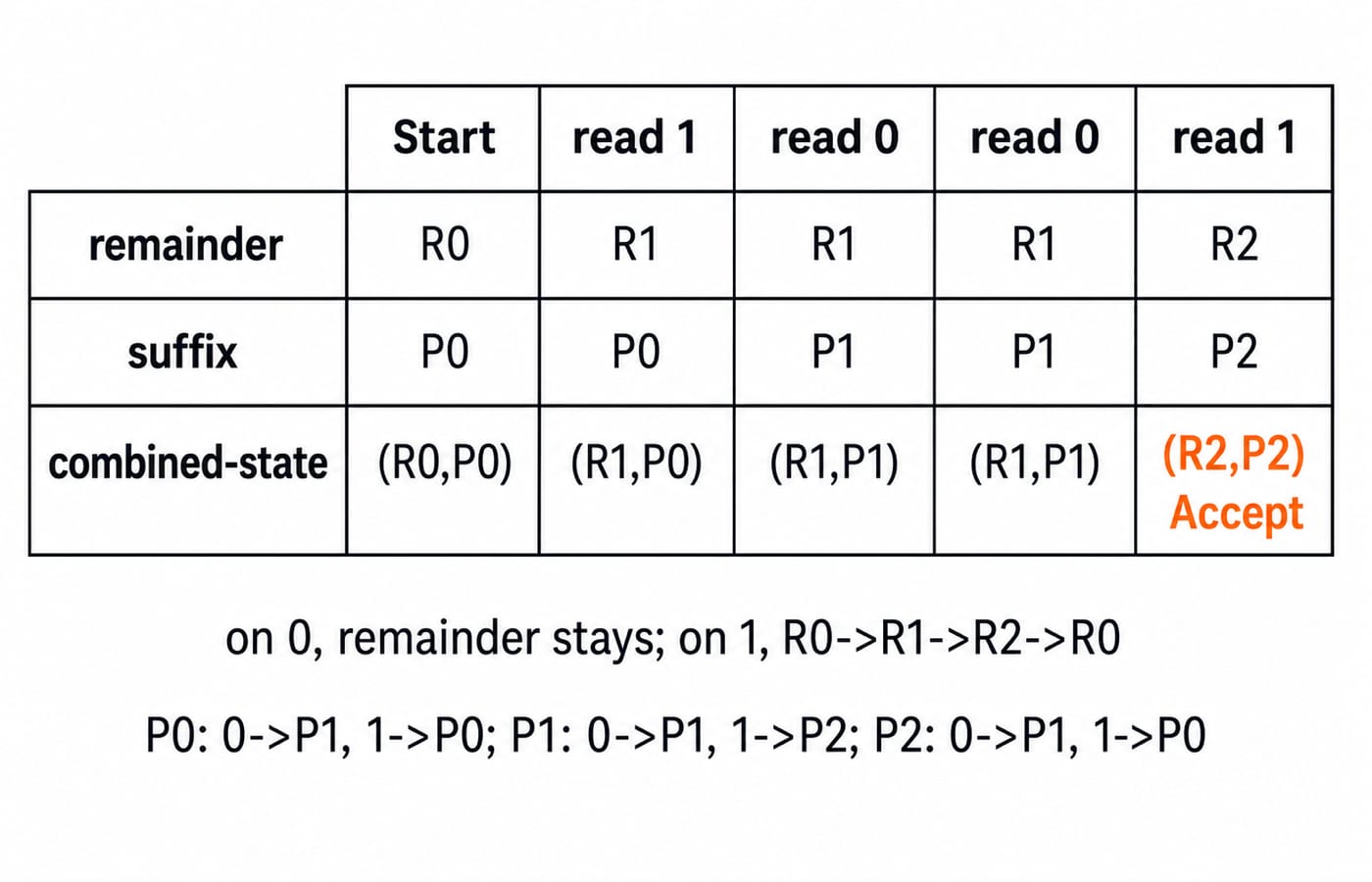
Build two trackers. The count tracker has R0, R1, R2. Input 0 leaves it unchanged, while 1 cycles R0 -> R1 -> R2 -> R0. The suffix tracker uses P0 for no useful suffix, P1 for suffix 0, and P2 for suffix 01.
Suffix state | On | On |
|---|---|---|
|
|
|
|
|
|
|
|
|
The product DFA has nine states (Ri,Pj), start state (R0,P0), and sole accepting state (R2,P2). Define delta((Ri,Pj),a) = (delta_count(Ri,a),delta_suffix(Pj,a)). The pair is necessary because both conditions must hold. This DFA is a positive regularity certificate. For the related subset method, see NFA to DFA Conversion for GATE.
Trace 1001 exactly:
(R0,P0) --1-> (R1,P0) --0-> (R1,P1) --0-> (R1,P1) --1-> (R2,P2).
It is accepted. For 1101, the trace is (R0,P0) --1-> (R1,P0) --1-> (R2,P0) --0-> (R2,P1) --1-> (R0,P2). Its suffix is 01, but its three 1s leave remainder 0, so it is rejected.
Simplify quantified, bounded and reversal definitions first
For L1 = {x0y : x,y in {0,1}*}, both variables may be any binary strings. Thus L1 is the set of strings containing at least one 0, described by (0+1)*0(0+1)*. The string 111 is rejected, while 1101 is accepted with x=11 and y=1. Quantifiers lengthen the notation, not the memory requirement.
Now take B = {ww^R : w in {0,1}*, |w| <= 2}. From w = epsilon, 0, 1, 00, 01, 10, 11, the complete language is {epsilon, 00, 11, 0000, 0110, 1001, 1111}. It is finite and therefore regular. Remove the bound, and you obtain all even-length palindromes. Their arbitrarily long first halves must be matched in reverse, so a negative proof is required. Reversal alone is not the obstacle, since reversing a regular language preserves regularity. Unbounded matching is the obstacle.
Worked non-regularity proof: 0^n1^n by two routes
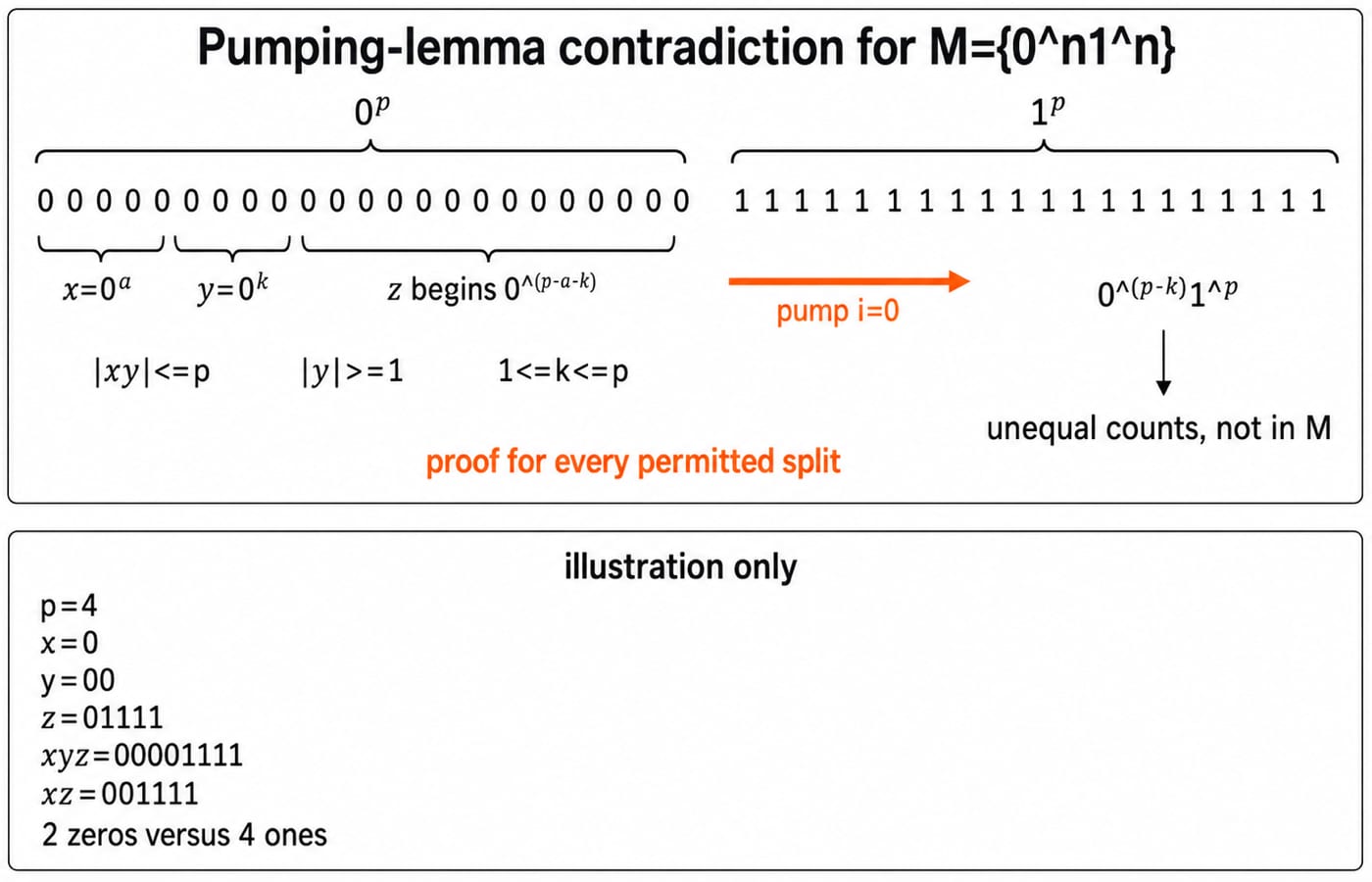
Let M = {0^n1^n : n >= 0}. Assume it is regular and let p be its pumping length. Choose w = 0^p1^p. For every allowed split w=xyz with |xy| <= p and |y| >= 1, the block y lies wholly within the leading zeros. Therefore y=0^k for some 1 <= k <= p. Pump with i=0. The result is xz = 0^(p-k)1^p, whose zero and one counts differ. This contradiction proves that M is not regular.
For a concrete illustration, set p=4, x=0, y=00, and z=01111. Then xyz=00001111 belongs to M, while pumping down gives xz=001111, with two zeros and four ones. This illustrates the calculation, but the symbolic argument above is the proof because it handles every permitted split.
Myhill-Nerode gives another certificate. The prefixes 0^i are distinguishable because appending 1^i accepts 0^i1^i but rejects 0^j1^i when j != i. For K={w : the number of 0s equals the number of 1s}, regularity would make K intersection 0*1* = {0^n1^n : n>=0} regular, another contradiction.
Regularity and NFA traps that invalidate neat answers
Trap | Why it fails | Correct move |
|---|---|---|
“An NFA can guess the midpoint of | The two copies still require an unbounded exact comparison. | Use a negative proof. |
“A CFG or PDA exists, so the language is non-regular.” | Regular languages are also context-free. | Give a regular certificate or a genuine separation proof. |
“My DFA sketch failed.” | One failed construction proves nothing. | Try a regex or closure result before a negative tool. |
“The language is infinite, so it is non-regular.” |
| Use a two-state DFA. |
For pumping, choose the witness after receiving p, then defeat every allowed split with a suitable pumping index. One convenient split is not enough. Closure converses also fail: if A=Sigma* and B is non-regular over Sigma, then A union B=Sigma* is regular.
Regularity identification in exam-style questions
Typical tasks ask you to select the regular language, simplify an existential definition, count states for a suffix or modulo tracker, apply a closure construction, locate a pumping-proof flaw, or isolate a non-regular core.
As a quick check, compare A={0^(2n):n>=0}, B={0^n1^n:n>=0}, and C={ww:w in {0,1}*}. Only A is regular: A remembers parity, B compares unbounded block counts, and C compares an arbitrary exact copy. Use GATE, PSU, Engineering & Technical Exams to place it within the broader subject map.
Regularity identification: the short version and next step
Use five steps: simplify the set notation; identify the memory that must persist; try a DFA, NFA, regex or closure certificate; if the memory is unbounded, choose pumping, Myhill-Nerode or a closure reduction; then test edge cases such as epsilon, a fixed bound, and an infinite periodic language.
The suffix-plus-modulo language is regular through a nine-state product DFA. The language {0^n1^n} is non-regular because pumping changes only its zero block. If you are building the full preparation sequence around these ideas, GATE CS & IT 2027 Guidance by Sanchit Sir | Complete Course is the natural next step.
Keep learning
Non-Deterministic Finite Automata (NFA): Design, Epsilon Closures and NFA-to-DFA Conversion
Learn to follow every branch of an NFA without guesswork. Two worked machines connect active-state sets, epsilon closure and a complete eight-state DFA conversion.
Updated 17 Aug 20266 min read142 viewsTheory of Computation

Finite Automata MCQs: 10 solved questions on DFA, NFA and minimization
Finite automata solved MCQs with explanations: 10 GATE PYQs on DFA design, minimal-state counting, complement, and the NFA to DFA subset-construction bound.
Updated 29 Oct 20267 min read121 viewsTheory of Computation MCQs

Finite automata: DFA vs NFA, with the exam angle
Finite automata explained: the DFA and NFA 5-tuple, DFA vs NFA, a worked subset construction converting an NFA to a DFA, equivalence, and the exam angle.
Updated 30 Oct 20265 min read135 viewsTheory of Computation
Deterministic Finite Automata (DFA): Design, Tracing and Minimisation with Worked Examples
Learn a repeatable way to design DFA states, trace binary inputs, build complements and products, and minimise a complete machine. Every transition is checked through exact tables and worked traces.
Updated 10 Aug 20266 min read60 viewsTheory of Computation