Regular Language Properties: Closure, Decision Tests, and Worked Examples
Connect closure properties, decision tests, and proof tools through product automata, pumping arguments, Myhill-Nerode reasoning, and checked string traces.
KnowledgeGate Team
Exam prep & CS education
Updated 3 Aug 20267 min read
DFA questions, closure statements, and pumping-lemma proofs can look unrelated. Each one asks what finite memory can recognise or decide. Three kinds of tool answer it: constructions that build new regular languages from old ones, graph checks that decide emptiness and equivalence, and proofs that settle regularity in either direction.
Related reading: regular language closure and DFA decision tests.
1. Regular language properties: what the term covers
Over an alphabet such as Σ = {0,1}, a language is regular when a DFA, NFA, or regular expression describes it. Its properties cover closure under operations, decidable questions, and proof tools.
Keep three examples in view:
L_even = {w ∈ {0,1}* | w contains an even number of 1s}needs two parity states.L_end0 = {w ∈ {0,1}* | w ends in 0}needs one state for "currently ends in 0" and another for "does not".L_equal = {0^n1^n | n ≥ 0}is not regular because matching two unbounded counts needs more than finite memory.
Every finite language is regular, while infinite languages may be regular or nonregular: {0, 01, 110} is finite and regular, 0*1* is infinite and regular, but L_equal is infinite and nonregular. If state tracing is unclear, revise Finite Automata: DFA vs NFA and Subset Construction first.
2. Closure properties, built instead of memorised
The closure properties of regular languages are easiest to remember through their constructions.
Operation | Construction |
|---|---|
Union, intersection, difference | Product automaton, with different accepting pairs |
Complement | Complete the DFA, then flip final and non-final states |
Concatenation, Kleene star | NFA with epsilon links |
Reversal | Reverse transitions and add a new start state |
Homomorphism | Replace each symbol by its image |
Inverse homomorphism | Track the source symbols through the target DFA |
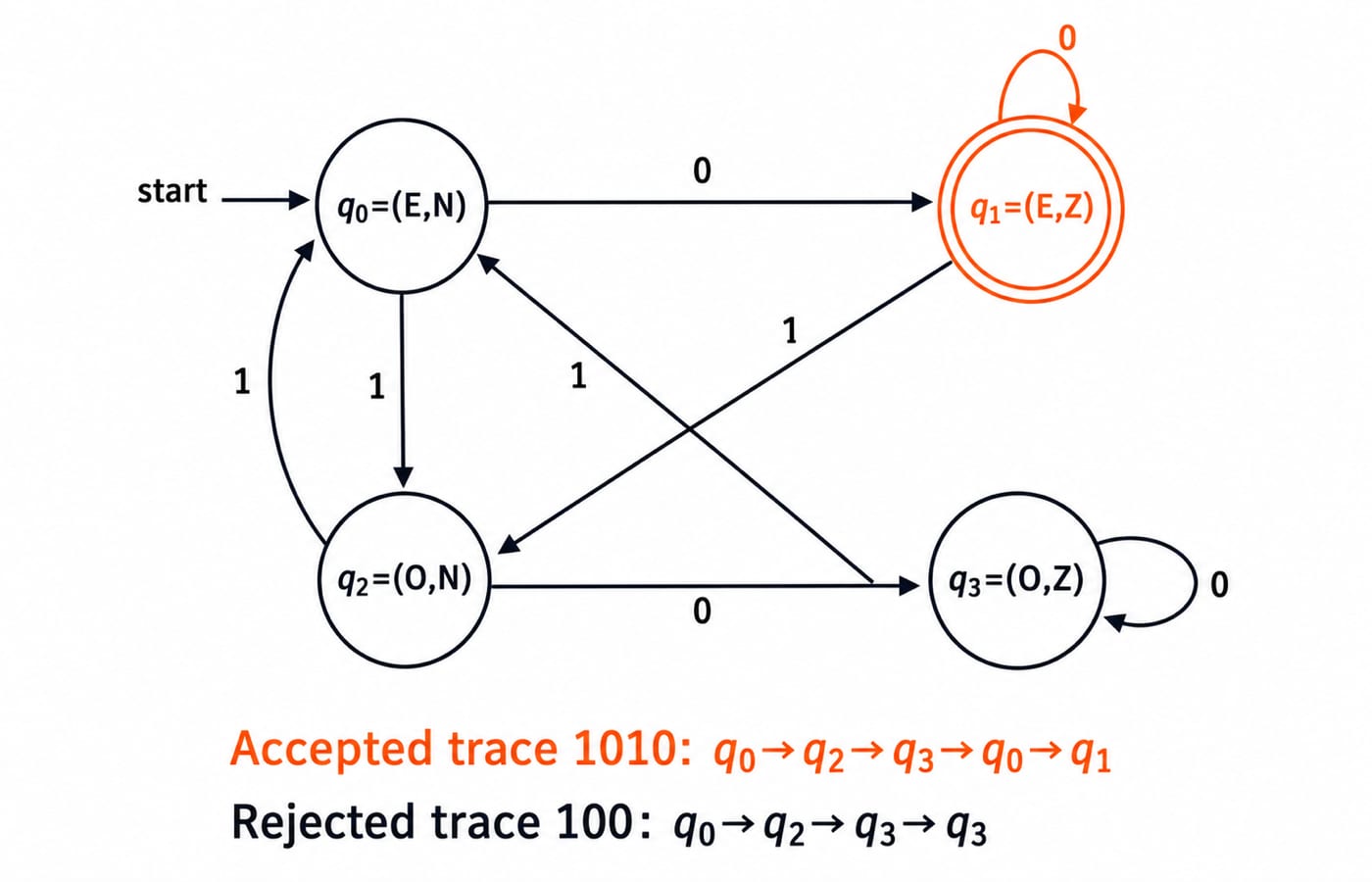
Build L_even ∩ L_end0. DFA A starts and accepts in E, with other state O; 0 stays put and 1 toggles E ↔ O. DFA B starts in non-final N and accepts in Z; from either state, 0 → Z and 1 → N.
Product state | On | On |
|---|---|---|
|
|
|
|
|
|
|
|
|
|
|
|
Only q1 accepts the intersection. Trace 1010 as q0 --1→ q2 --0→ q3 --1→ q0 --0→ q1; it accepts with two 1s and a final 0. Trace 100 as q0 --1→ q2 --0→ q3 --0→ q3; it ends in 0 but rejects with one 1.
The same product proves more. For L_even ∪ L_end0, accept q0, q1, and q3. For L_even - L_end0, accept only q0. For complement, first agree on one alphabet, complete the DFA with a dead state, and only then flip finality.
3. Decision properties from paths, cycles, and products
Decision properties of regular languages reduce to finite checks:
Membership: trace the input.
Emptiness: check whether any final state is reachable from the start.
Infiniteness: find a reachable cycle from which a final state remains reachable.
Universality: complement a complete DFA and test emptiness.
Equivalence: test whether the symmetric-difference product is empty.
Inclusion
L(A) ⊆ L(B): test whetherL(A) ∩ complement(L(B))is empty.
For an NFA, determinise when the check needs a complete DFA.
Consider the DFA for aa*b (one or more a’s followed by a single b). State q0 is the start, q2 is the only accept state, and qd is dead. Its transitions are q0: a→q1, b→qd; q1: a→q1, b→q2; q2: a→qd, b→qd; and qd: a→qd, b→qd.
For aab, trace q0→q1→q1→q2 proves membership. Emptiness is false because ab reaches q2. Infiniteness holds because the reachable a loop at q1 can reach q2 on b, generating a^m b for every m ≥ 1. Universality is false because b reaches qd. The loop at qd proves nothing about infiniteness, because no accepting state is reachable from it.
4. How to prove regularity, and how to disprove it
To prove regularity, exhibit a DFA, NFA, regular expression, or right-linear grammar, or apply closure to known regular languages. A few accepted strings prove nothing general.
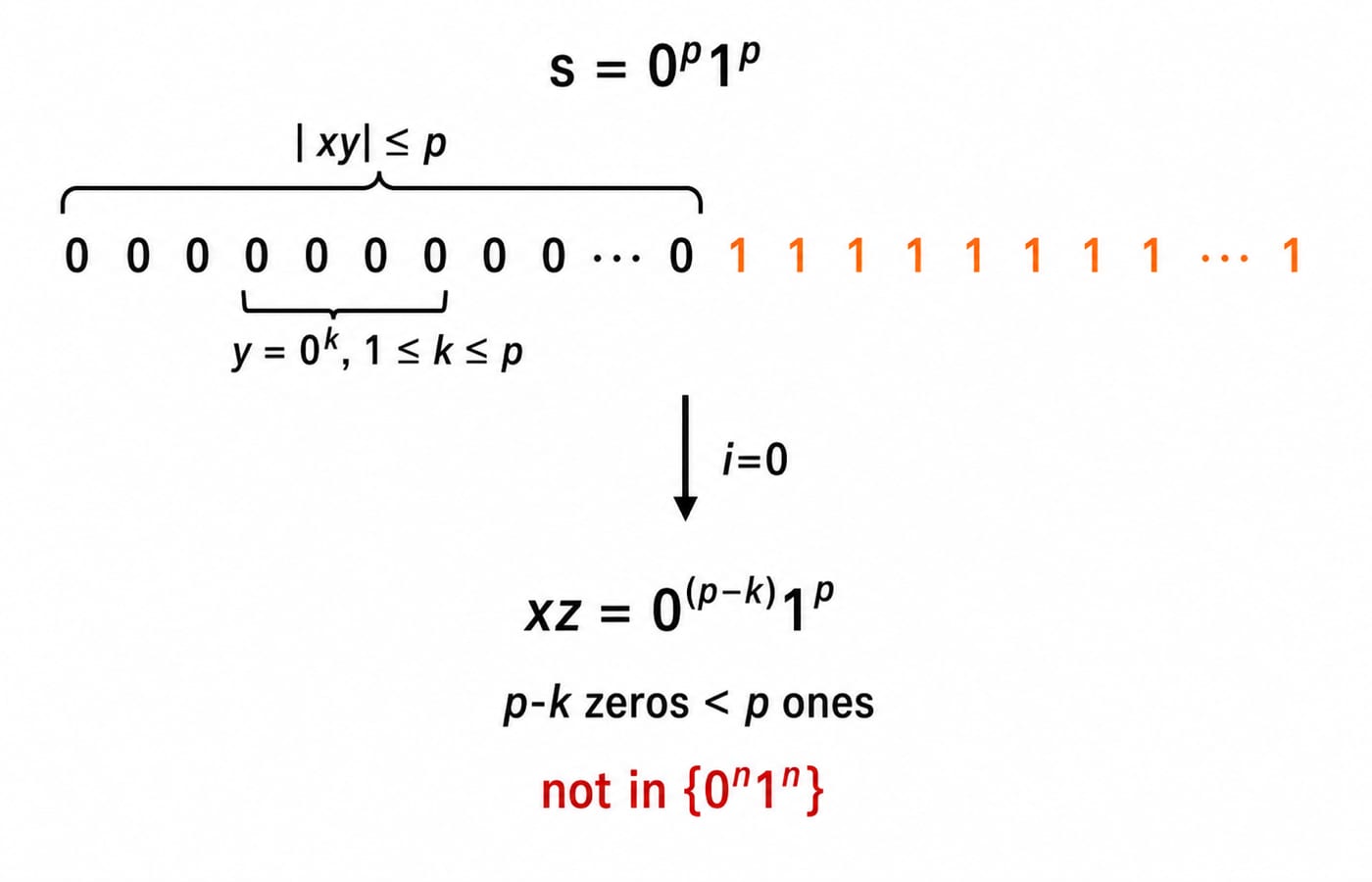
For L_equal, assume it is regular and let its pumping length be p. Choose s = 0^p1^p, so |s| ≥ p. For every allowed split s = xyz with |xy| ≤ p and |y| > 0, y lies wholly inside the first zero block. Therefore y = 0^k for some 1 ≤ k ≤ p.
Pump down with i = 0. Then xz = 0^(p-k)1^p, which has p-k zeros and p ones. Since k ≥ 1, p-k < p, so xz ∉ L_equal. This contradiction proves that L_equal is nonregular.
The pumping lemma is necessary for regular languages, not sufficient. A correct disproof chooses a string from p, handles every permitted decomposition, then pumps to break membership. The proof above pumps down to i = 0; Regular Expressions and Pumping Lemma: Worked Proof states the three conditions in full and runs the pump-up version on a^n b^n.
5. Myhill-Nerode as a state lower-bound tool
Two prefixes need different DFA states when some continuation makes one completed string accepted and the other rejected. A regular language has finitely many such distinguishable classes, and their number equals the state count of its minimal DFA.
For L_mod3, where the number of 1s is divisible by 3, prefixes ε, 1, and 11 represent residues 0, 1, and 2. Distinguish ε from 1 using suffix 11: 11 is rejected, while 111 is accepted. Distinguish ε from 11 using the empty suffix. Distinguish 1 from 11 using suffix 1: again, 11 is rejected and 111 is accepted. Any DFA therefore needs at least three states.
A matching DFA has r0, r1, and r2; r0 starts and accepts, 0 leaves every state unchanged, and 1 cycles r0→r1→r2→r0. Thus three states are both sufficient and necessary. 10101 contains three 1s and ends at r0, so it is accepted. 1100 contains two and ends at r2, so it is rejected.
6. Traps that make correct-looking answers fail
Trap | Why it happens | What goes wrong | Better move |
|---|---|---|---|
Test one pumping split | One split is easy | Other allowed splits remain | Handle every |
Use pumping to prove regularity | The lemma looks like a test | It is only necessary | Build an automaton, expression, grammar, or closure proof |
Flip before completing a DFA | Missing transitions are ignored | Complement is wrong | Add a dead state first |
Assume every subset of a regular language is regular | Closure is misread |
| Prove the subset independently |
Apply closure backwards | A regular result looks informative | Regular output need not imply regular operands | Use closure only in its stated direction |
Separate regular 0*1*, which permits unequal block lengths, from nonregular {0^n1^n}, which requires equal counts. A cycle proves infiniteness only if reachable and able to lead to acceptance. Complement is relative to a stated alphabet, so Σ={0,1} and Σ={0,1,2} are different universes.
7. How GATE-style questions test regular language properties
Typical prompts ask you to judge closure, trace a product automaton, test emptiness or equivalence, find a pumping-proof flaw, or justify a minimum state count. Try these checks:
L1 ∩ complement(L2)is regular when both languages are regular over the same alphabet, by complement and intersection closure.The product above accepts
1010and rejects100, as its two traces show.{0^n1^n}needs a nonregularity proof, not a DFA sketch.The modulo-3 language needs exactly three states, by a three-class lower bound and a three-state construction.
A dead-state self-loop does not prove infiniteness because it cannot reach acceptance.
Use this solving order: write the alphabet and condition, choose a construction, graph check, or proof tool, test boundary strings including ε, then state why the result follows. For the rest of the Theory of Computation syllabus in exam order, start from the GATE CS exam preparation category.
8. Short version, practice set, and next step
DFA, NFA, and regular expressions are equivalent. Closure builds regular languages. Reachability, productive cycles, and products answer decision questions. Automata and closure prove regularity; pumping and Myhill-Nerode prove nonregularity or state lower bounds.
Predict before reading each answer:
In
L_even - L_end0, onlyq0accepts. Henceεand11are accepted, while110is rejected.The language of the DFA for
aa*bis infinite because theq1loop is productive.Odd
0parity combined with even1parity needs a four-state2×2product.The split
x=ε, y=0, z=0^(p-1)1^pis only one split. The proof above covers everyy=0^kpermitted by|xy|≤p.
For a structured exam route, use GATE Guidance by Sanchit Sir. For core CS coverage across multiple exams, consider the ZERO TO HERO complete CS course. Keep the practical sequence fixed: construct → trace → justify.
Keep learning
Linear Bounded Automata: Tape Limits, a Worked LBA Trace and Exam Traps
See exactly what an LBA bounds, where it sits in the language hierarchy, and how a six-cell marking machine accepts aabbcc while rejecting three near misses.
Updated 4 Oct 20266 min readTheory of Computation
Decision Properties in Theory of Computation: DFA Tests, CFG Boundaries and Turing Machine Undecidability
Learn an algorithm-first way to classify membership, emptiness, finiteness, inclusion, equivalence and universality for DFAs, CFGs and Turing machines.
Updated 29 Sep 20266 min readTheory of Computation
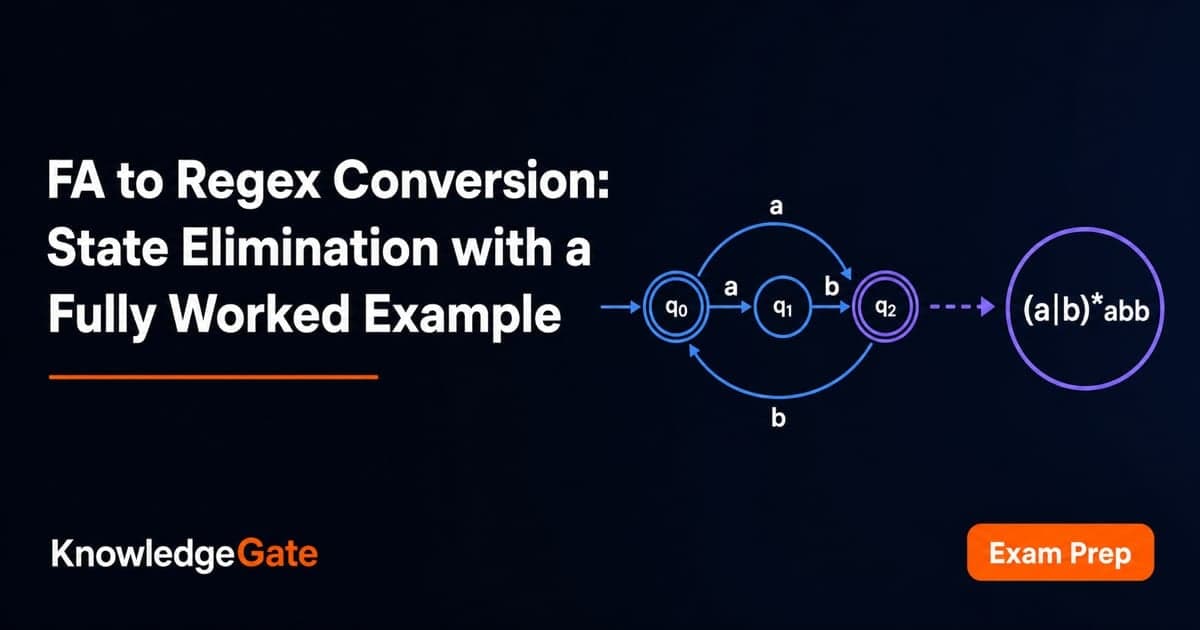
FA to Regex Conversion: State Elimination with a Fully Worked Example
Learn a mechanical state-elimination method for converting a finite automaton to a regular expression, then verify the result with a second order and short strings.
Updated 25 Sep 20265 min readTheory of Computation
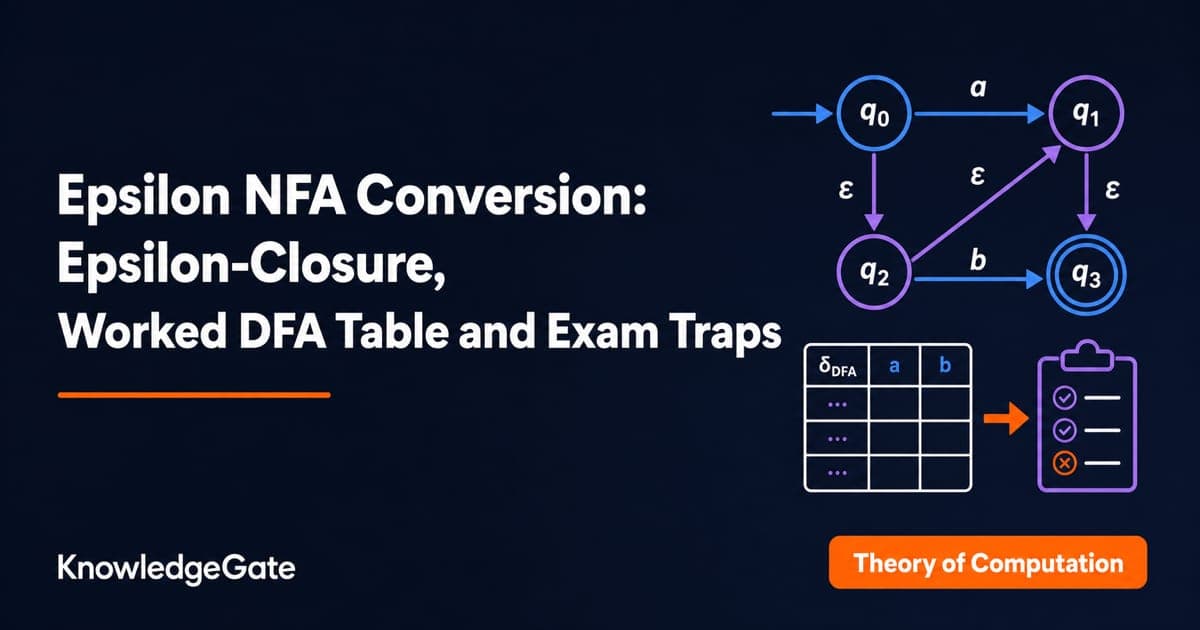
Epsilon NFA Conversion: Epsilon-Closure, Worked DFA Table and Exam Traps
Learn a mechanical epsilon-NFA conversion method through one four-state machine, complete set traces, a reachable-subset DFA table, and epsilon elimination.
Updated 24 Sep 20266 min readTheory of Computation