Percentage for Competitive Exams: Concepts, Shortcuts and Solved Examples
Learn percentage by naming the base first. Work through fraction shortcuts, successive changes, reverse calculations, comparisons and a fictional selection funnel.
KnowledgeGate Team
Exam prep & CS education
Updated 26 Oct 20265 min read

Percentage questions are rarely difficult because of the multiplication. They become confusing when the reference base changes, two percentage changes act in sequence, or you must work backwards from the final value. The reliable method is to name the base first, convert useful percentages into fractions or multipliers, and check whether the answer matches the direction of change. The broader Aptitude for Placements: Section Topics and Weekly Plan can help you place this topic inside a study routine.
Percentage basics: identify the part, whole and base
Percentage means "per hundred". Every percentage calculation connects a part, a whole and a reference base:
percentage = part/whole x 100part = percentage/100 x wholewhole = part x 100/percentage
The denominator is the base, so name it before calculating. For example, 18% = 18/100 = 9/50. Therefore:
18% of 450 = 9/50 x 450 = 81
The same values work in reverse. The percentage represented by 81 out of 450 is 81/450 x 100 = 18%. If 81 is 18% of an unknown whole, then the whole is 81 x 100/18 = 450.
Now check the size. Since 18% is slightly below 20%, and 20% of 450 = 90, an answer of 81 is reasonable. Readers comparing the wider subject path can explore Aptitude Courses for Exams and Placements.
Percentage shortcuts: fractions, one per cent and x% of y
Useful fraction equivalents reduce calculation when the number divides cleanly.
Percentage | Fraction |
|---|---|
1% | 1/100 |
5% | 1/20 |
10% | 1/10 |
12.5% | 1/8 |
16 2/3% | 1/6 |
20% | 1/5 |
25% | 1/4 |
33 1/3% | 1/3 |
50% | 1/2 |
62.5% | 5/8 |
75% | 3/4 |
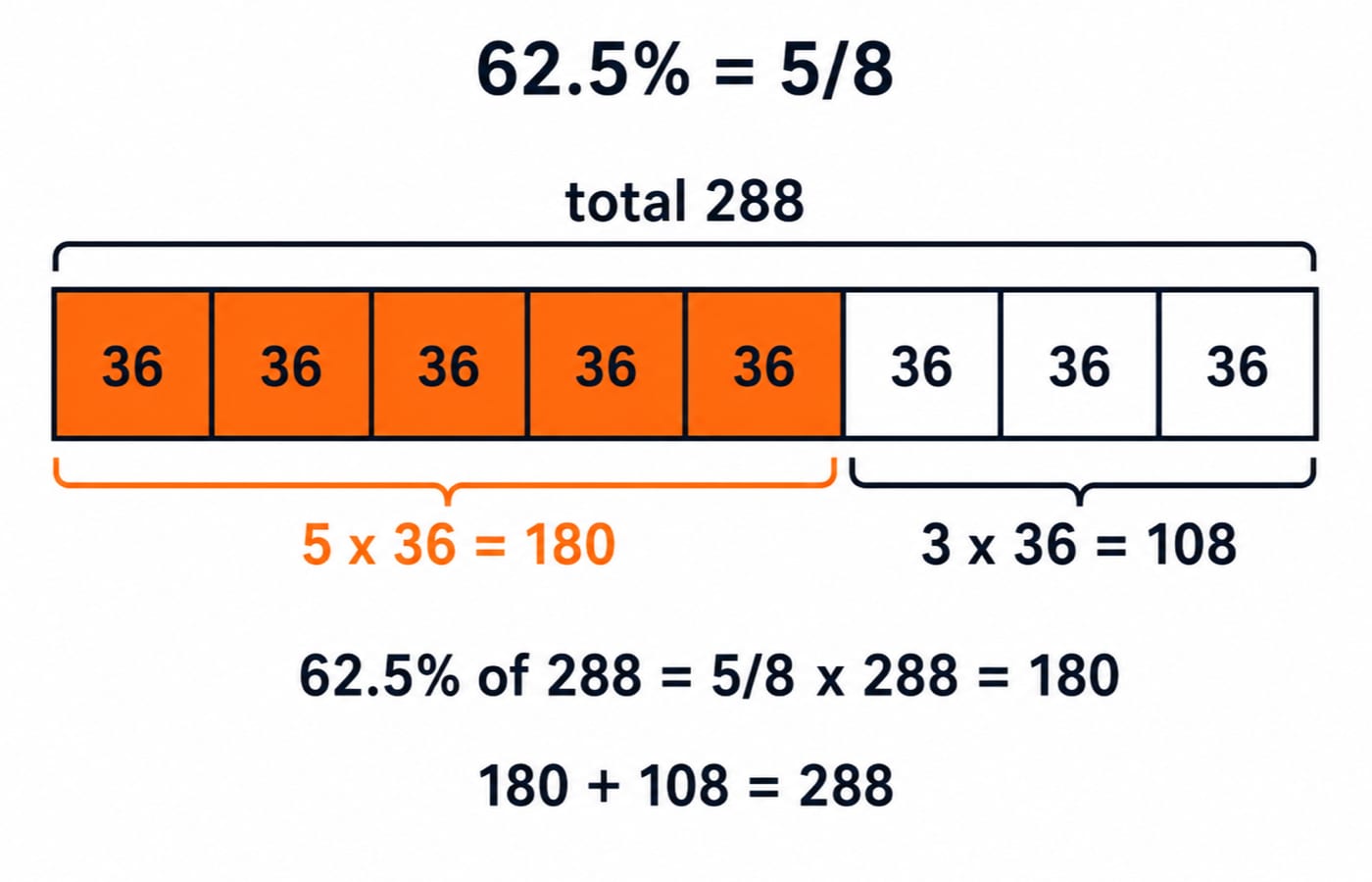
To find 62.5% of 288, replace 62.5% with 5/8:
288/8 = 3636 x 5 = 180
The decimal check gives the same result: 0.625 x 288 = 180.
Another shortcut comes directly from multiplication:
x% of y = xy/100 = y% of x
So 48% of 25 = 25% of 48 = 1/4 x 48 = 12. This changes the order of a product. It does not let you change the base in a comparison such as "A is what per cent more than B?"
Percentage increase and decrease: use multipliers for successive changes
An increase of p% multiplies the old value by 1 + p/100. A decrease of p% multiplies it by 1 - p/100. With successive changes, each rate acts on the value immediately before it.
Suppose a fictional production output starts at 800 units, rises by 15%, and then falls by 15%.
After the rise:
800 x 1.15 = 920.After the fall:
920 x 0.85 = 782.Net change:
782 - 800 = -18units.Net percentage change:
-18/800 x 100 = -2.25%.
The multiplier shortcut confirms it: 1.15 x 0.85 = 0.9775, which leaves 97.75% of the original, a loss of 2.25%. In general, +a% followed by -a% produces a loss of a^2/100%. Equal rates do not cancel because the second change uses a different base.
Reverse percentages: divide by the multiplier
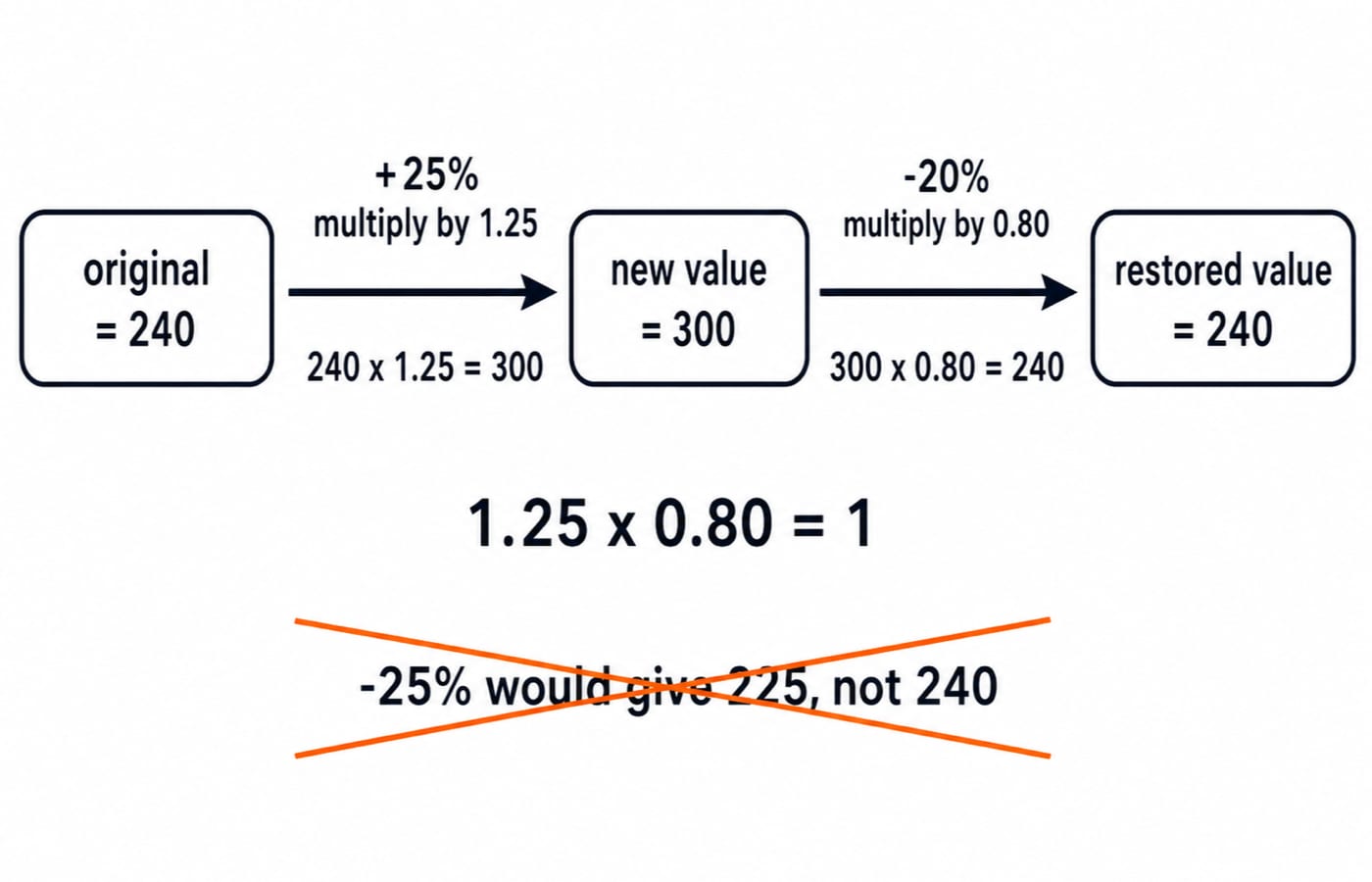
Suppose 240 rises by 25%. The new value is 240 x 1.25 = 300. Returning from 300 to 240 requires a decrease of 60/300 x 100 = 20%, not 25%. The multiplier check is 1.25 x 0.80 = 1.
Now consider two common find-the-original patterns:
After a 15% decrease, a value is 680. Write
original x 0.85 = 680, sooriginal = 680/0.85 = 800.After a 35% increase, a value is 540. Write
original x 1.35 = 540, sooriginal = 540/1.35 = 400.
The decision rule is simple. When the final value is known, divide by the stated multiplier. Do not add or subtract the same numerical percentage from the final value, because the final value is not the original base.
Percentage comparison: more than, less than and percentage points
Let A be 250 and B be 200. Their difference is 50, but the comparison changes with the base.
A is
50/200 x 100 = 25%more than B because B is the base.B is
50/250 x 100 = 20%less than A because A is the base.
Both statements are correct. The visible difference stays 50, but the denominators differ.
Percentage points handle a different situation. If fictional mock-test accuracy moves from 72% to 81%, the rise is 81 - 72 = 9 percentage points. Relative to the original accuracy, the increase is 9/72 x 100 = 12.5%.
Use a language check before calculating. "Of" supplies a whole. "More than" uses the comparison value as the base. When two given values are already percentages, report the difference in percentage points first unless the question explicitly asks for relative percentage change.
Percentage traps: five believable wrong routes and their fixes
Using the wrong base. The visible difference of 50 attracts attention, so 25% and 20% both seem possible. Complete the phrase "percentage of what?" before dividing.
Cancelling equal increases and decreases. Multiply
1.15 x 0.85, or use thea^2/100loss shortcut only when the rates are equal and opposite.Reversing with the same rate. The
240 to 300 to 240example proves that the reverse of a 25% increase is a 20% decrease.Calling 72% to 81% a 9% rise. It is a rise of 9 percentage points, or 12.5% relative to the original value.
Converting to awkward decimals too early. For 62.5% of 288, use
5/8, keep the calculation exact, and round only when a question requires it.
Finish with three checks. Does the direction match an increase or decrease? Is the approximate size sensible? Does substituting the answer into the original statement reproduce the given value?
Percentage in competitive exams: recognise the hidden base
Competitive questions commonly hide percentage inside direct part-whole calculations, find-the-original problems, successive changes, comparisons, ratio conversions and data-interpretation chains. The story may change, but the base rules remain the same.
Consider an explicitly fictional selection funnel with 800 applicants:
First stage:
55% of 800 = 800 x 0.55 = 440.Second stage:
75% of 440 = 440 x 0.75 = 330.Withdrawals:
20% of 330 = 66, so330 - 66 = 264remain.Final share:
264/800 x 100 = 33%.
The multiplier check combines the entire chain: 0.55 x 0.75 x 0.80 = 0.33. The changing base matters at every stage. The second 75% applies to 440, and the final 20% applies to 330, not to the starting 800. For a named-exam application of ratios, percentages and data interpretation, continue with Coal India MT Numerical Ability: Ratios, % and DI Solved.
Percentage: the short version and next practice step
Name the base, then choose a fraction or multiplier. Apply successive rates to successive values. Divide by the multiplier when reversing a change, and keep percentage points separate from relative percentage change. Finally, check the direction and approximate size.
For a five-minute drill, solve 18% of 450, 62.5% of 288, the 800 to 920 to 782 chain, and the original value behind 680 after a 15% decrease without looking back. Then use Aptitude for Placement as a structured route for further practice.
Keep learning

Partnership Aptitude: Concepts, Shortcuts and Solved Examples
Learn one reliable capital-time method for partnership problems, then apply it to delayed entry, changing investments, allowances and reverse calculations.
Updated 24 Oct 20265 min readAptitude & Reasoning
Number System Concepts and Shortcuts: Solved Examples for Competitive Exams
Learn how to classify numbers, choose the right divisibility or prime-factor method, and verify remainders, factors, HCF, LCM, and unit digits.
Updated 22 Oct 20266 min readAptitude & Reasoning

Age Ratio-Based Problems: 12 Questions with Step-by-Step Solutions
Solve 12 age ratio-based questions from the KnowledgeGate practice bank. Each fresh solution shows how to form the equation, shift every age correctly, and verify the answer.
18 Oct 20267 min readAptitude & Reasoning

Mixture and Alligation: Rules, Shortcuts and Solved Examples for Exams
Learn how concentration, alligation and the retention factor solve the main mixture question types, with step-by-step examples and arithmetic checks.
Updated 14 Oct 20265 min readAptitude & Reasoning