Mixture and Alligation: Rules, Shortcuts and Solved Examples for Exams
Learn how concentration, alligation and the retention factor solve the main mixture question types, with step-by-step examples and arithmetic checks.
KnowledgeGate Team
Exam prep & CS education
Updated 14 Oct 20265 min read

Mixture questions can look unrelated when they mention solutions, milk and water, dilution, or repeated replacement. Most become simpler once you choose one component and track how much of it is present. This guide uses three tools: weighted average for understanding, alligation for a two-source shortcut, and a retention factor for repeated replacement. The aim is to know when each tool is valid, not merely memorise a cross diagram.
Start with concentration, ratio and weighted average
Concentration means the amount of the chosen component divided by the total mixture. A milk-to-water ratio of 3:2 gives a milk concentration of 3/(3+2) = 3/5 = 60%. Similarly, 6 L of acid in 24 L of solution means an acid concentration of 6/24 = 25%.
If quantities q1 and q2, with concentrations c1 and c2, are mixed, the final concentration is:
(q1c1 + q2c2)/(q1 + q2)
Use the same chosen component and the same quantity unit throughout. For alligation, if L is the lower concentration, M the target, and H the higher concentration, then L < M < H must hold. If the target lies outside the source range, those two sources cannot produce it. You can build the wider aptitude foundation alongside this topic.
Derive the alligation rule and solve a complete mixture
Suppose x units of concentration L are mixed with y units of concentration H to obtain concentration M. Conservation of the chosen component gives:
xL + yH = (x+y)M
Rearranging:
x(M-L) = y(H-M)
Therefore:
lower quantity : higher quantity = (H-M) : (M-L)
Each source receives the difference from the opposite side of the alligation cross.
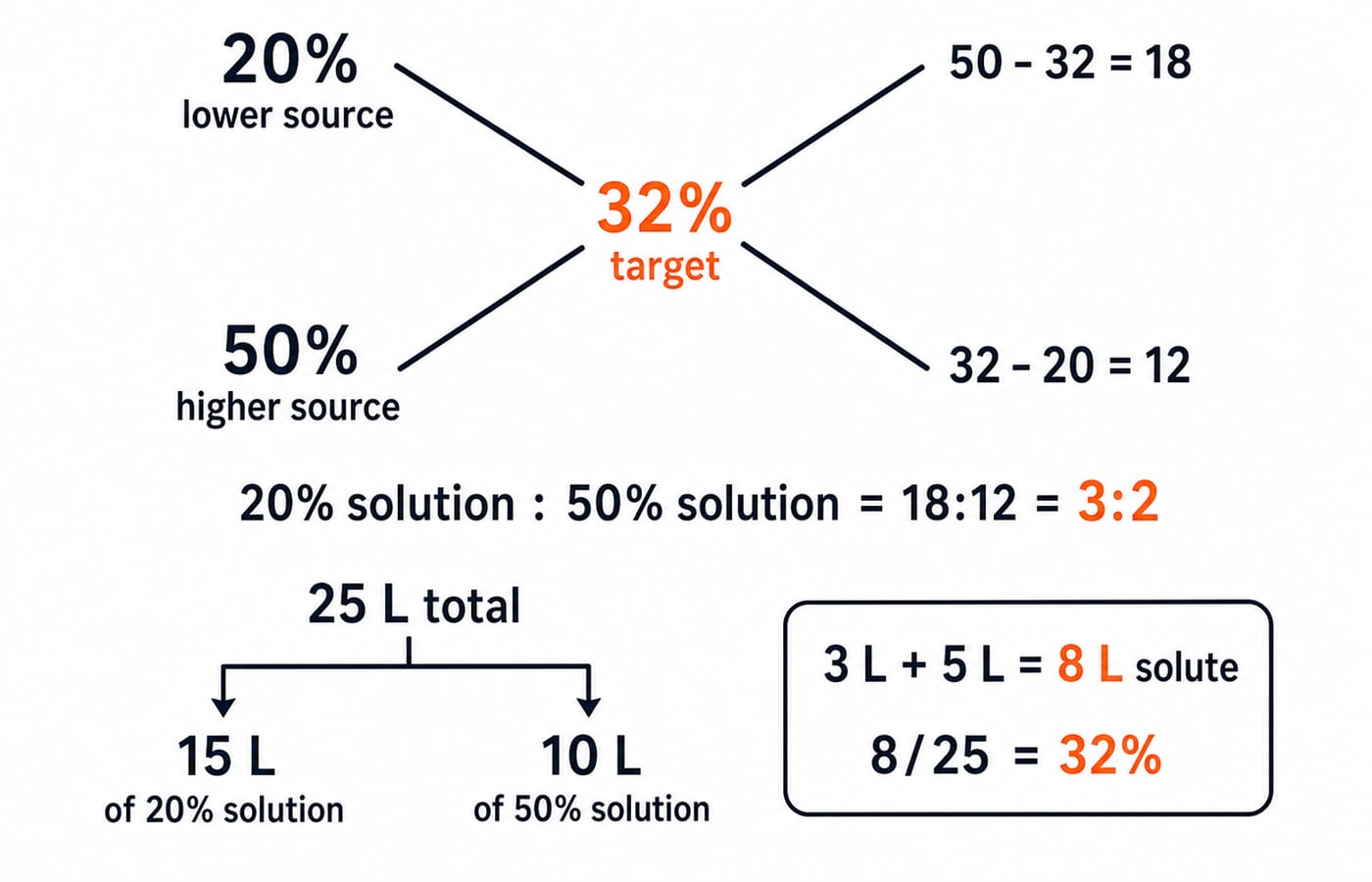
Now mix a 20% solution and a 50% solution to obtain 25 L at 32%.
lower : higher = (50-32):(32-20) = 18:12 = 3:2
Five total parts represent 25 L, so one part is 25/5 = 5 L. Use 3 x 5 = 15 L of the 20% solution and 2 x 5 = 10 L of the 50% solution.
Check the solute: 15 x 0.20 + 10 x 0.50 = 3 + 5 = 8 L. The final concentration is 8/25 = 32%, so the split is correct.
Turn the alligation ratio into exact quantities
If alligation gives the ratio a:b and the required total is T, the two quantities are Ta/(a+b) and Tb/(a+b).
For an 18 L, 30% mixture made from 15% and 45% solutions:
(45-30):(30-15) = 15:15 = 1:1
Take 9 L of each. The solute is 9 x 0.15 + 9 x 0.45 = 1.35 + 4.05 = 5.40 L, exactly 30% of 18 L.
A pure component is simply a 100% source. To make 10 L at 40% from a 25% solution and pure solute:
solution : pure solute = (100-40):(40-25) = 60:15 = 4:1
Use 8 L of solution and 2 L of pure solute. The check is 8 x 0.25 + 2 = 2 + 2 = 4 L, which is 40% of 10 L.
Use zero concentration to solve dilution
Water is a 0% source when solute is the tracked component. Suppose 40 L of a 35% solution is diluted to 28% by adding water.
original solution : water = (28-0):(35-28) = 28:7 = 4:1
The original 40 L represents four parts, so one part is 10 L. Add 10 L of water. The original solute is 40 x 0.35 = 14 L; the final volume is 50 L, and 14/50 = 28%. Adding water changes total volume, but not the amount of solute.
Keep successive replacement separate from alligation
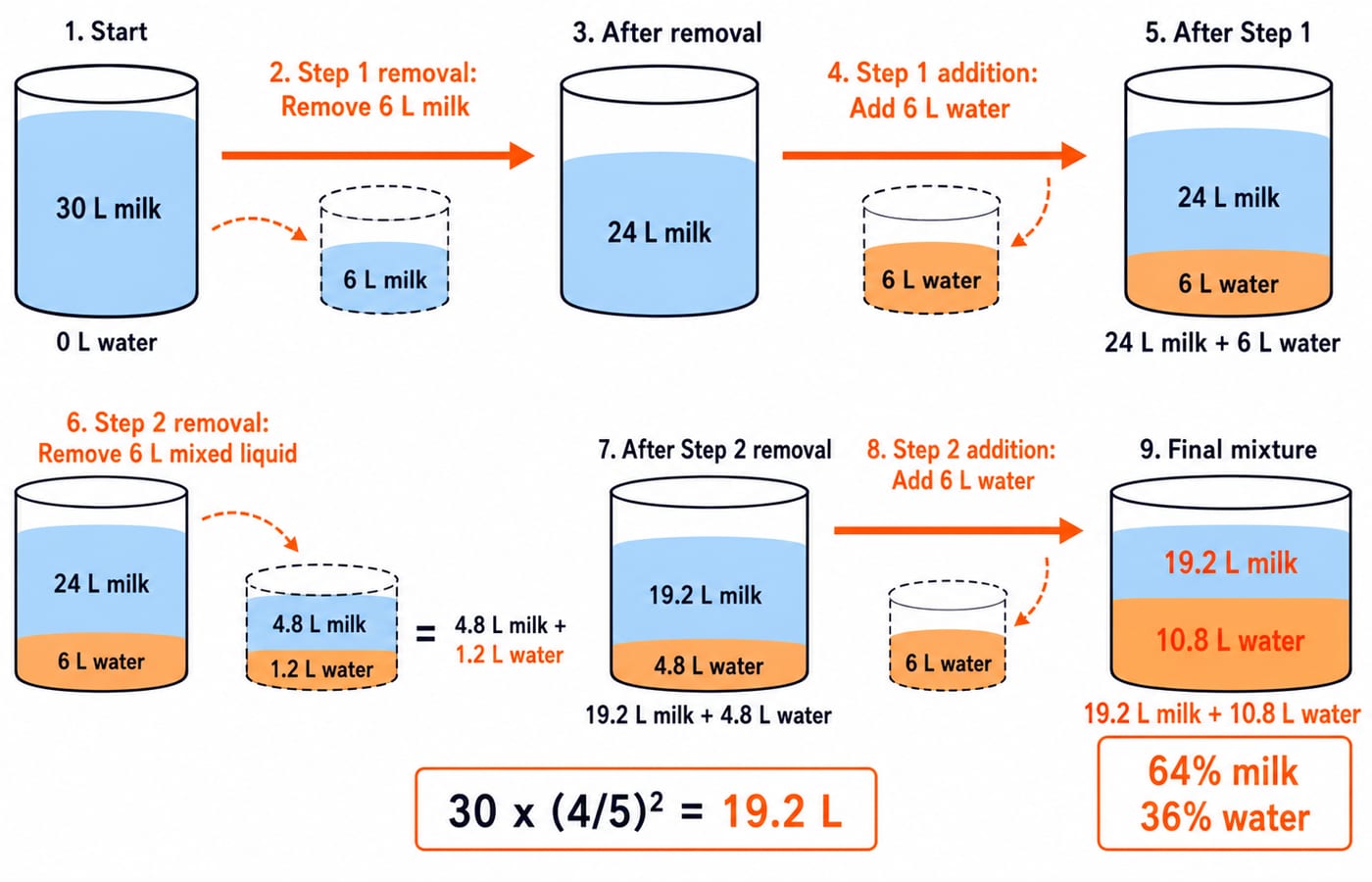
For a well-mixed vessel of volume V, suppose r litres are removed and replaced in each of n equal operations. The fraction of an original component left is (1-r/V)^n, so:
amount left = initial amount x (1-r/V)^n
A 30 L vessel starts with pure milk. Remove 6 L and replace it with water twice. The milk retained is 30 x (1-6/30)^2 = 30 x (4/5)^2 = 19.2 L. Its final concentration is 19.2/30 = 64%. Water is 30-19.2 = 10.8 L, or 36%.
Reduce a mixture of mixtures to concentrations
Mixture A has a milk-to-water ratio of 5:3, so its milk concentration is 5/8 = 62.5%. Mixture B has a ratio of 2:3, so it is 2/5 = 40% milk. A final 1:1 milk-water mixture must be 50% milk.
Convert first, then apply alligation:
A:B = (50-40):(62.5-50) = 10:12.5 = 4:5
For a 36 L final mixture, nine parts mean 4 L per part. Take 16 L of A and 20 L of B. A contributes 10 L milk and 6 L water. B contributes 8 L milk and 12 L water. The result is 18 L milk and 18 L water, exactly a 1:1 ratio.
Recognise the form and avoid shortcut traps
Common forms include direct two-concentration mixing, finding quantities from a total, dilution with a 0% source, adding a pure 100% source, mixture of mixtures, and equal-volume successive replacement. Check an exam's current syllabus and question format in its official notification or syllabus.
Use this decision checklist:
Choose the component to track.
Convert every ratio into a fraction or percentage.
Ask whether exactly two source concentrations lie on opposite sides of the target.
Use alligation if they do. Use conservation algebra if they do not.
Use the retention formula only for repeated withdrawal and replacement from a well-mixed vessel.
The usual traps are mechanical. Do not reverse the low-to-high quantity ratio, average percentages without weighting their quantities, read 3:2 as 3/2 instead of 3/5, accept a target outside the source range, or subtract repeated withdrawals linearly. For a section-wide placement aptitude plan, connect these checks to your broader preparation. If your target needs deeper quantitative progression, see why arithmetic comes before advanced quant.
The short version and the next practice step
Weighted average explains the final concentration. Alligation gives the quantity ratio for two valid sources. Repeated replacement multiplies the retained fraction at every operation. Whichever shortcut you use, verify it by recomputing the final amount of the tracked component.
Redo the 20%, 50%, 32% example without looking. Then change the target to 38%: (50-38):(38-20) = 12:18 = 2:3. For guided practice, use Aptitude for Placement. If you are preparing specifically for GATE aptitude, continue with Aptitude for GATE.
Keep learning
Number System Concepts and Shortcuts: Solved Examples for Competitive Exams
Learn how to classify numbers, choose the right divisibility or prime-factor method, and verify remainders, factors, HCF, LCM, and unit digits.
Updated 22 Oct 20266 min readAptitude & Reasoning

Age Ratio-Based Problems: 12 Questions with Step-by-Step Solutions
Solve 12 age ratio-based questions from the KnowledgeGate practice bank. Each fresh solution shows how to form the equation, shift every age correctly, and verify the answer.
18 Oct 20267 min readAptitude & Reasoning

Mental Ability Concepts and Shortcuts: Solved Examples for Competitive Exams
Learn a four-step reasoning process, then apply it to number patterns, mirror coding, directions, syllogisms, blood relations and ranking problems.
Updated 10 Oct 20267 min readAptitude & Reasoning

Mensuration and Geometry for Competitive Exams: Formulas, Shortcuts and Solved Examples
Learn how to choose the right mensuration formula, avoid common geometry traps, and solve 2D path and 3D recasting problems step by step.
Updated 6 Oct 20266 min readAptitude & Reasoning