Partnership Aptitude: Concepts, Shortcuts and Solved Examples
Learn one reliable capital-time method for partnership problems, then apply it to delayed entry, changing investments, allowances and reverse calculations.
KnowledgeGate Team
Exam prep & CS education
Updated 24 Oct 20265 min read

Partnership questions often look like ordinary ratio sums. The confusion begins when one partner joins late, changes capital or receives a working allowance, because a capital-only ratio can look reasonable and still be wrong. Use one mechanical method: convert each investment interval into capital-months, handle any allowance exactly as stated, reduce the resulting ratio and divide only the distributable profit. The Aptitude for Placements: Section Topics and Weekly Plan gives this topic a broader study context.
Partnership aptitude begins with capital multiplied by time
Each partner's profit-sharing weight is capital × time. Distributable profit is divided in the ratio of these weights, with the same time unit used for everyone. Capital-months work because they measure both how much money was invested and how long it remained active. Thus, 40,000 rupees for 12 months and 80,000 rupees for 6 months both produce 480,000 capital-months and earn equal shares when no other condition applies.
Two cancellations are safe. If every partner invests for the same duration, compare capital alone. If everyone invests the same capital, compare duration alone. For example, A and B invest 48,000 rupees and 72,000 rupees for 12 months. Their ratio is 48,000:72,000 = 2:3. From 75,000 rupees, A receives 2/5 × 75,000 = 30,000 rupees, while B receives 3/5 × 75,000 = 45,000 rupees.
The useful shortcut is a check on the method: form the capital ratio, multiply it term by term by the time ratio, then reduce. Keep units visible until they cancel.
The ratio shortcut when a partner joins late
A invests 50,000 rupees for all 12 months. B invests 80,000 rupees after the first 3 months, so B's capital works for 9 months, not 3.
A's weight =
50,000 × 12 = 600,000.B's weight =
80,000 × 9 = 720,000.Profit ratio =
600,000:720,000 = 5:6.
From a profit of 99,000 rupees, A receives 5/11 × 99,000 = 45,000 rupees. B receives 6/11 × 99,000 = 54,000 rupees.
The faster equivalent keeps the same logic. The capital ratio is 5:8 and the time ratio is 12:9. Multiply corresponding terms: (5 × 12):(8 × 9) = 60:72 = 5:6.
Always translate an entry statement into active time before calculating. In a 12-month year, “joins after 3 months” means 9 active months. Finally, check both direction and total: B has the larger capital-time weight and therefore the larger share, while 45,000 rupees + 54,000 rupees = 99,000 rupees.
Capital changes require a timeline
Suppose A invests 72,000 rupees. After 4 months, A withdraws 24,000 rupees, leaving 48,000 rupees invested for the remaining 8 months. Close the first interval when the capital changes, then start a second interval:
A's weight = (72,000 × 4) + (48,000 × 8)
= 288,000 + 384,000 = 672,000 capital-months
B invests 56,000 rupees for all 12 months, so B's weight = 56,000 × 12 = 672,000 capital-months. The ratio is 1:1. From 1,34,400 rupees, each partner receives 1/2 × 1,34,400 = 67,200 rupees.
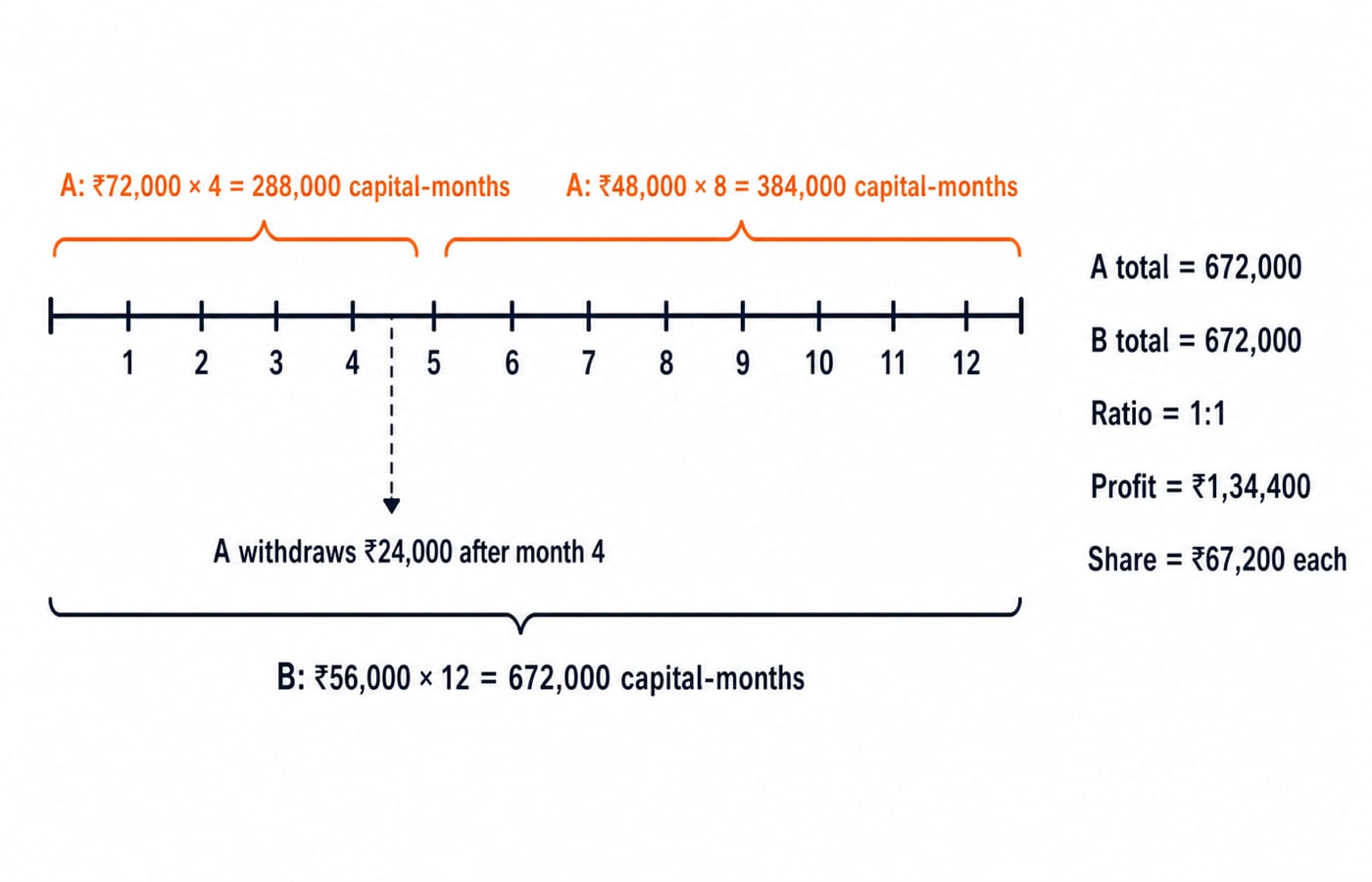
Do not multiply the withdrawn 24,000 rupees through the later months. It is the amount removed, not the amount left. Equally, do not keep 72,000 rupees active for all 12 months after the withdrawal.
Working-partner allowance comes before the profit split
A salary, allowance or commission is deducted before ratio sharing only when the question explicitly says that it is paid to a working partner in addition to the profit share. It is not another capital contribution.
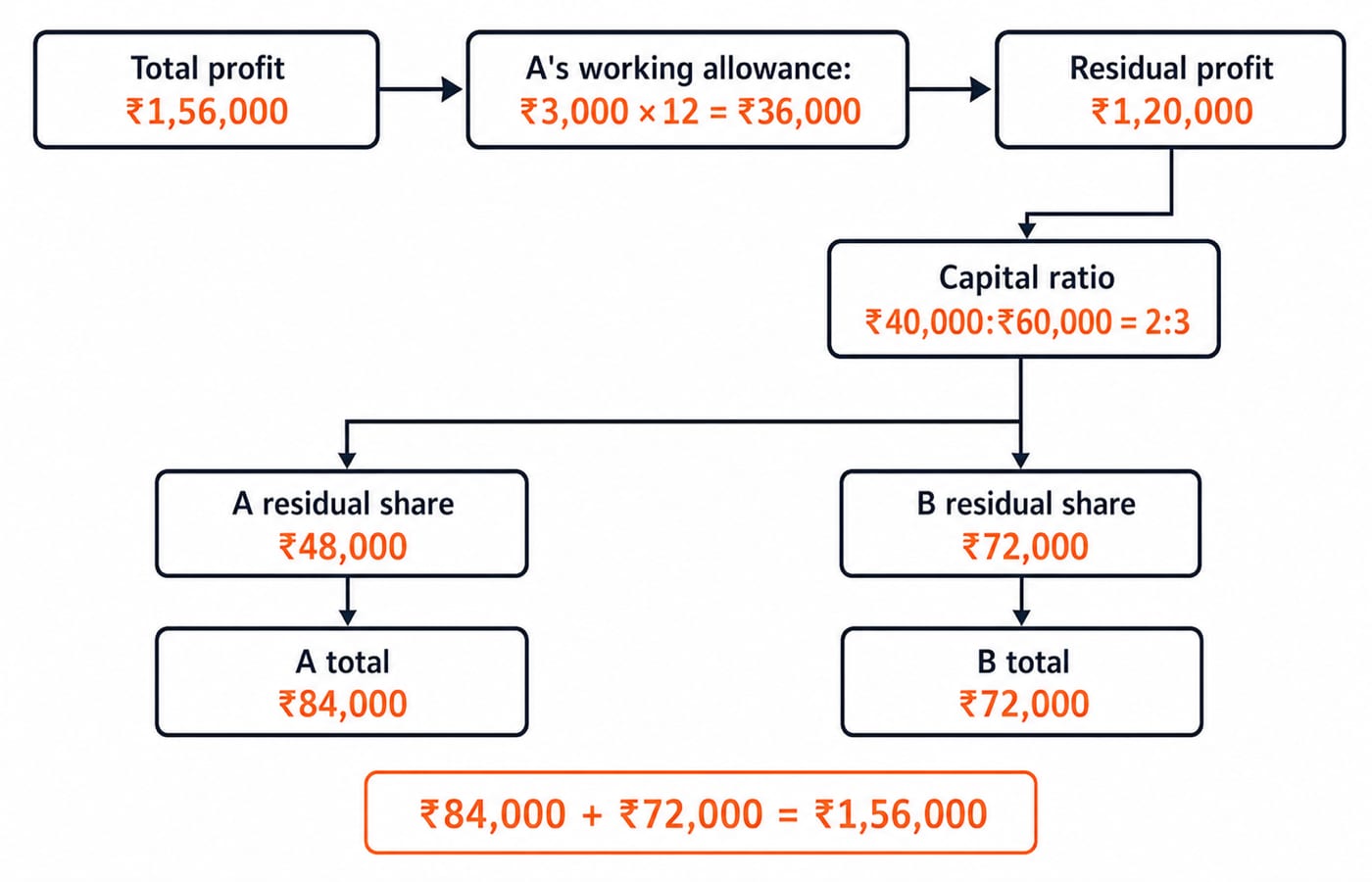
Take a total profit of 1,56,000 rupees. A receives a working allowance of 3,000 rupees per month, so the annual allowance is 3,000 × 12 = 36,000 rupees. The residual profit is 1,56,000 - 36,000 = 1,20,000 rupees.
A and B invested 40,000 rupees and 60,000 rupees for the same 12 months, giving a 2:3 ratio. Their residual shares are 2/5 × 1,20,000 = 48,000 rupees and 3/5 × 1,20,000 = 72,000 rupees. A finally receives 36,000 rupees + 48,000 rupees = 84,000 rupees; B receives 72,000 rupees. The total check is 84,000 rupees + 72,000 rupees = 1,56,000 rupees.
Reverse questions: find the missing capital or time
Reverse partnership questions use the same capital-time equation. A invests 60,000 rupees for 12 months. B joins after 4 months, invests x rupees for the remaining 8 months, and their profit ratio is 9:4.
(60,000 × 12):(x × 8) = 9:4
Therefore, 720,000:8x = 9:4. Cross multiplication gives 4 × 720,000 = 9 × 8x, so 2,880,000 = 72x and x = 40,000 rupees.
Do not stop at the algebra. With the recovered value, B's weight is 40,000 × 8 = 320,000. The ratio 720,000:320,000 reduces to 9:4, so the value is consistent. The same setup can find missing time, but the result must fit the calendar window stated in the question. An unknown capital belongs inside a capital-time weight, not directly inside the final currency share.
Partnership traps that give believable wrong answers
Ignoring time: A invests 20,000 rupees for 12 months and B invests 30,000 rupees for 6 months. Capital alone suggests 2:3, but the weights are
240,000:180,000 = 4:3. Write a capital-time row for every partner before reducing.Mishandling a capital change: After A withdraws 24,000 rupees from 72,000 rupees, the later balance is 48,000 rupees, not 24,000 rupees. Label each interval with the balance that remains invested.
Dividing gross profit too early: In the working-partner example, remove the 36,000-rupee allowance first. Split only the residual 1,20,000 rupees in the 2:3 ratio.
Mixing time units or rounding early: Convert all durations to one unit, reduce integer weights by a common factor and keep fractional shares exact until the final step. Then add every final receipt and confirm that the sum matches the stated profit.
How assessments vary the same partnership model
The wording changes, but most partnership questions use one of five forms: direct profit division, delayed entry, capital increase or withdrawal, a working-partner allowance, or a reverse calculation of capital or time.
Use this 20-second decision sequence:
Mark every date or month.
Build one capital-time weight for each interval in which the capital stays unchanged.
Handle any explicitly stated allowance.
Reduce the weight ratio and divide the residual profit.
Add the final receipts to check the total.
For practice depth, 120+ published KnowledgeGate questions are mapped to Mathematics and Aptitude > Partnership. This describes the available practice set, not the frequency or weight of the topic in any assessment.
Choose the next study plan by goal. Use SSC CGL Quant Strategy: High-Yield Topics and Weekly Plan for an SSC-oriented quant plan, or Bank PO Quant: High-Yield Topics First for a banking-oriented topic order.
Partnership aptitude: the short version and next step
Remember four rules: share ratio = capital × time; split a changing investment into intervals; remove an explicitly stated working allowance before sharing the residual; and check that final receipts add to total profit. The Aptitude for Placement course provides a structured route through aptitude, reasoning and verbal ability. Use the Aptitude Courses for Exams and Placements category when comparing the broader track. Next, solve one fixed-capital, one delayed-entry, one withdrawal and one working-partner problem with the same capital-time table.
Keep learning

Number System Concepts and Shortcuts: Solved Examples for Competitive Exams
Learn how to classify numbers, choose the right divisibility or prime-factor method, and verify remainders, factors, HCF, LCM, and unit digits.
Updated 22 Oct 20266 min readAptitude & Reasoning

Age Ratio-Based Problems: 12 Questions with Step-by-Step Solutions
Solve 12 age ratio-based questions from the KnowledgeGate practice bank. Each fresh solution shows how to form the equation, shift every age correctly, and verify the answer.
18 Oct 20267 min readAptitude & Reasoning

Mixture and Alligation: Rules, Shortcuts and Solved Examples for Exams
Learn how concentration, alligation and the retention factor solve the main mixture question types, with step-by-step examples and arithmetic checks.
Updated 14 Oct 20265 min readAptitude & Reasoning

Mental Ability Concepts and Shortcuts: Solved Examples for Competitive Exams
Learn a four-step reasoning process, then apply it to number patterns, mirror coding, directions, syllogisms, blood relations and ranking problems.
Updated 10 Oct 20267 min readAptitude & Reasoning