

Partial Order Relation: Poset Properties, Total Order, and a Worked Divisibility Example
Learn how to test reflexivity, antisymmetry, and transitivity, then turn an exact divisibility relation into a Hasse diagram and compare it with a total order.
KnowledgeGate Team
Exam prep & CS education
Updated 16 Nov 20266 min read

Reflexive, symmetric, antisymmetric, and transitive can feel like labels in a property checklist. But a poset question is really asking whether a relation creates a consistent notion of order, and whether every pair must be comparable. The worked divisibility relation can be written as ordered pairs, verified as a partial order, reduced to a Hasse diagram, and compared with a total order on the same set. For the wider preparation route, see the GATE category and Engineering Mathematics for GATE Exam.
Partial order relation and poset: the three required properties
A binary relation R on a set A is a subset of A x A. We write x R y when (x,y) belongs to R. Relations in Discrete Mathematics: Properties, Posets and Worked Examples connects these tests to matrices, closures, equivalence classes, and relation counting. The full 14-pair divisibility proof below adds Hasse reduction and a same-set total-order comparison.
A partial order must satisfy three conditions:
Reflexive:
(x,x)belongs toRfor everyxinA.Antisymmetric: if
x R yandy R x, thenx=y.Transitive: if
x R yandy R z, thenx R z.
When all three hold, (A,R) is a partially ordered set, or poset. "Partial" does not mean that only some properties hold. All three hold, but distinct elements may be incomparable. Under divisibility in the worked set, 2 and 3 are one such pair because neither divides the other.
Test a proposed relation without guessing from its name
Test mechanically. Check every diagonal pair (x,x) for reflexivity. Next, find whether any two distinct elements occur in both directions. Finally, follow each two-step path x R y and y R z, then look for the shortcut x R z. One counterexample rejects a property.
Let A={1,2,3} and R1={(1,1),(2,2),(3,3),(1,2),(2,1)}. It is reflexive and transitive. The paths 1 R1 2 R1 1 and 2 R1 1 R1 2 have their required diagonal pairs. But R1 is not antisymmetric: 1 R1 2 and 2 R1 1, while 1 != 2. Therefore, it is not a partial order.
On the same set, R2={(1,1),(2,2),(3,3),(1,2),(2,3)} is reflexive and antisymmetric, but not transitive.
Relation | Failed property | Exact witness |
|---|---|---|
| Antisymmetric |
|
| Transitive |
|
Worked example: prove divisibility is a partial order
Let A={1,2,3,6,12} and define x R y exactly when x divides y, written x|y. Before proving any property, list the complete relation:
R={(1,1),(1,2),(1,3),(1,6),(1,12),(2,2),(2,6),(2,12),(3,3),(3,6),(3,12),(6,6),(6,12),(12,12)}.
There are exactly 14 ordered pairs. We can count them by first coordinate: five begin with 1, three with 2, three with 3, two with 6, and one with 12. Thus, 5+3+3+2+1=14.
Reflexive: Every positive integer divides itself because
x=x * 1. Therefore,(1,1),(2,2),(3,3),(6,6), and(12,12)all appear.Antisymmetric: If positive integers
xandydivide each other, thenx=y. In the listed relation, no off-diagonal pair appears in both directions.Transitive: If
x|yandy|z, thenx|z. For the actual values,1|2|6gives1|6,2|6|12gives2|12, and1|3|12gives1|12. Each required shortcut pair is present.
All three properties hold, so (A,R) is a poset. The elements 2 and 6 are comparable because 2|6, and 3 and 12 are comparable because 3|12. By contrast, 2 and 3 are incomparable because neither 2|3 nor 3|2 is true. That incomparability is allowed in a partial order.
Convert the worked relation into its Hasse diagram
Reduce the 14 ordered pairs in three operations. First, remove the five reflexive loops. Second, remove arrowheads because upward placement records the direction. Third, remove edges already implied by transitivity. The exact transitive edges omitted are 1-6, 1-12, 2-12, and 3-12.
The five cover edges left are 1-2, 1-3, 2-6, 3-6, and 6-12. Place 1 at the bottom, 2 and 3 side by side on the next level, 6 above both, and 12 at the top. Height represents divisibility order inside A, not ordinary numerical spacing.
Now read the relation back from the diagram. An upward path from 2 through 6 to 12 confirms that 2 and 12 are comparable even without a direct edge. There is no upward path from 2 to 3 or from 3 to 2, confirming that they are incomparable.
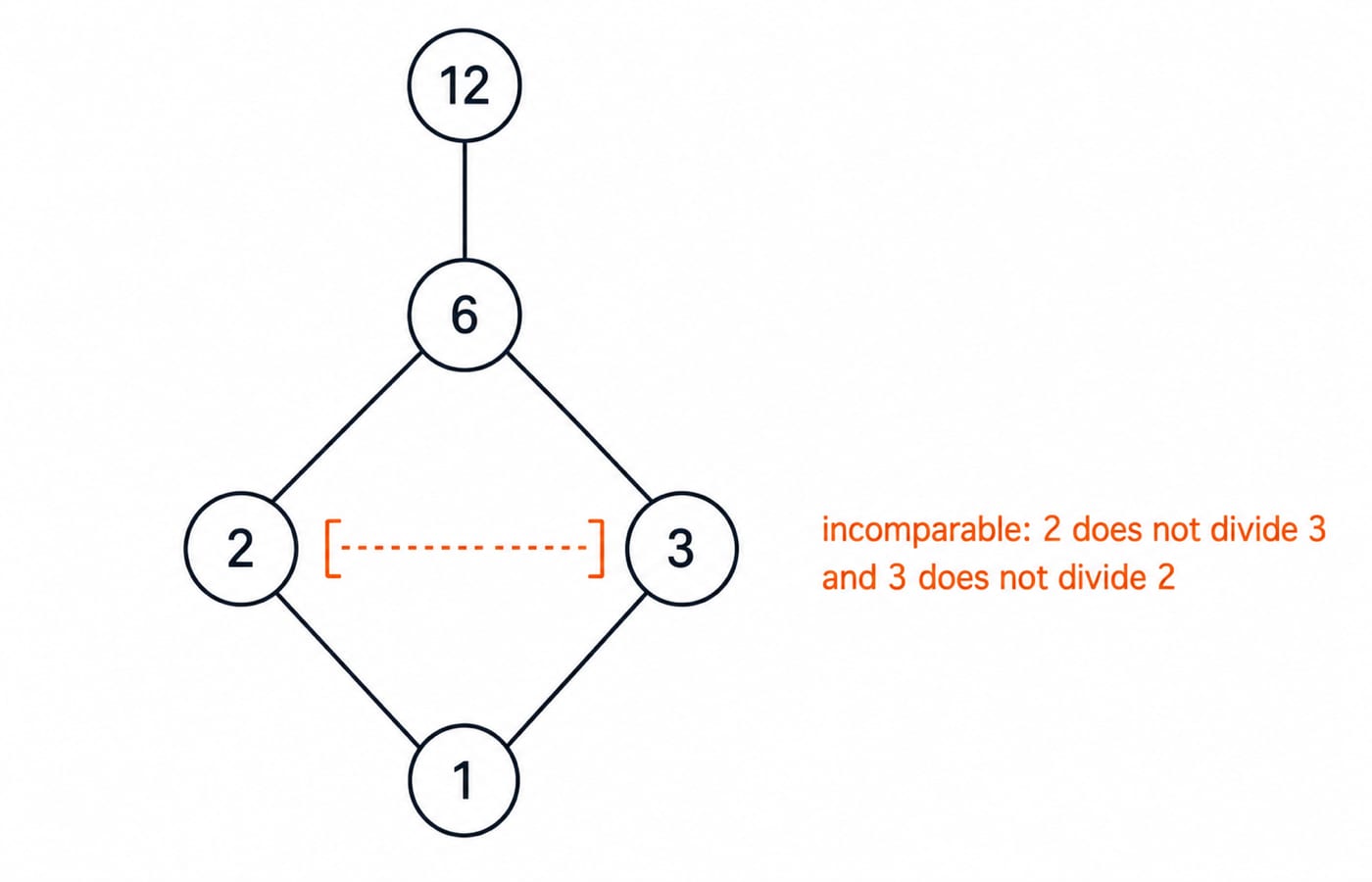
For joins and meets on the six-element divisor set D12, continue with Lattice in Discrete Mathematics: Definition, Formation, Join and Meet Worked Examples. The five-node diagram above instead isolates comparability: 2 and 3 remain incomparable under divisibility even though they form a chain under the usual less-than-or-equal relation.
Partial order versus total order on the same five values
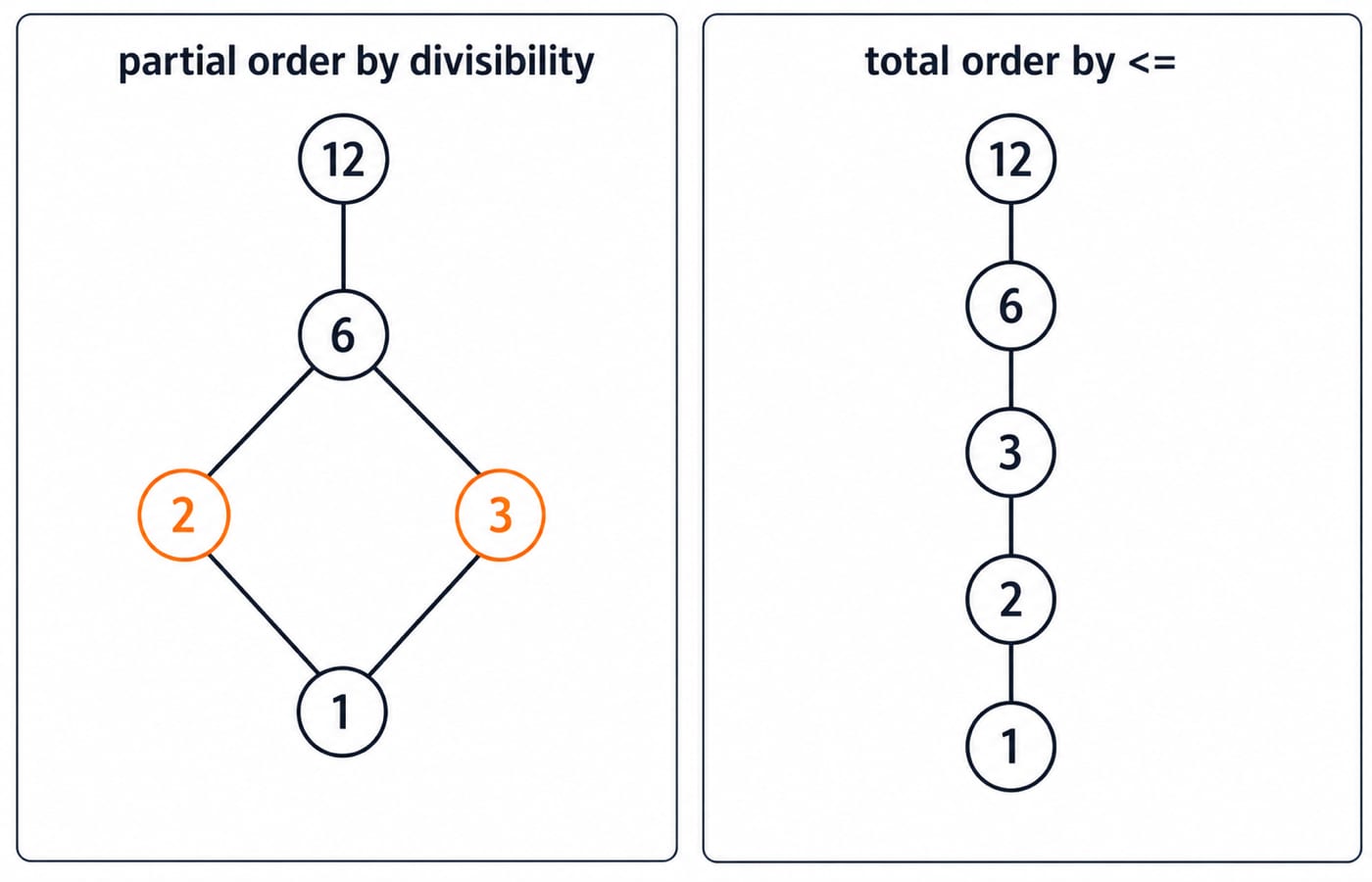
A total order is a partial order with one extra condition: for every x,y in the set, either x R y or y R x. In other words, every pair is comparable. This does not mean that every pair is related in both directions.
Keep A={1,2,3,6,12}, but replace divisibility with the usual <= relation. This relation is reflexive, antisymmetric, and transitive. It also gives the exact chain 1<=2<=3<=6<=12, so every pair is comparable. The decisive pair is 2,3: 2<=3 is true, although 2 and 3 were incomparable under divisibility. Therefore, (A,<=) is totally ordered, while (A,|) is only partially ordered.
Test | Divisibility (x divides y) | Usual |
|---|---|---|
Reflexive, antisymmetric, transitive | Passes all three | Passes all three |
Every pair comparable | Fails for | Passes |
Classification | Partial order | Total order |
The set did not change. The relation did, and the relation determines whether its order is partial or total.
Partial order traps: antisymmetry, strict order, and Hasse edges
Use an exact witness to avoid four common traps:
Mistake | Exact counterexample | Correction |
|---|---|---|
Antisymmetric means "never both ways" |
| Both directions are forbidden only for distinct elements |
Antisymmetric means asymmetric |
|
|
Every familiar order is a partial order |
|
|
Every comparable pair gets a Hasse edge | 2 divides 12, but 2 divides 6 and 6 divides 12 | A Hasse edge represents a cover, so the direct |
For a rapid check, a relation containing every diagonal pair plus (1,2) and (2,1) cannot be a partial order. Antisymmetry would require the false statement 1=2.
How partial order and poset questions are commonly framed
The same ideas can appear in four practice formats:
Choose which listed relation is a partial order.
Locate a missing transitive pair in a set or matrix.
Identify incomparable elements, or decide whether a poset is total.
Reduce a relation to its Hasse cover edges.
For a timed self-check, identify the five diagonal pairs in the 14-pair relation. Reject any mirrored off-diagonal pair. Verify 1|2|6, 2|6|12, and 1|3|12 with their shortcuts. Recover the covers 1-2, 1-3, 2-6, 3-6, 6-12, then explain why 2 and 3 prevent totality.
For adjacent practice across the broader relations cluster, use Set Theory and Relations MCQs: 12 Solved. Treat each answer as a claim needing evidence.
Partial order relation: the short version and next step
Keep this recall sequence:
Partial order means reflexive, antisymmetric, and transitive.
A poset is the set together with that relation.
Incomparable elements are allowed.
Total order adds comparability for every pair.
Divisibility on {1,2,3,6,12} is partial because 2 and 3 are incomparable, while usual <= on the same set is total. For the complete subject sequence and guided practice, continue with GATE Guidance by Sanchit Sir. Then rebuild both diagrams without looking and apply the three-property test to R1 and R2.
Go deeper with the full courseEngineering Mathematics for GATE Exam
Keep learning
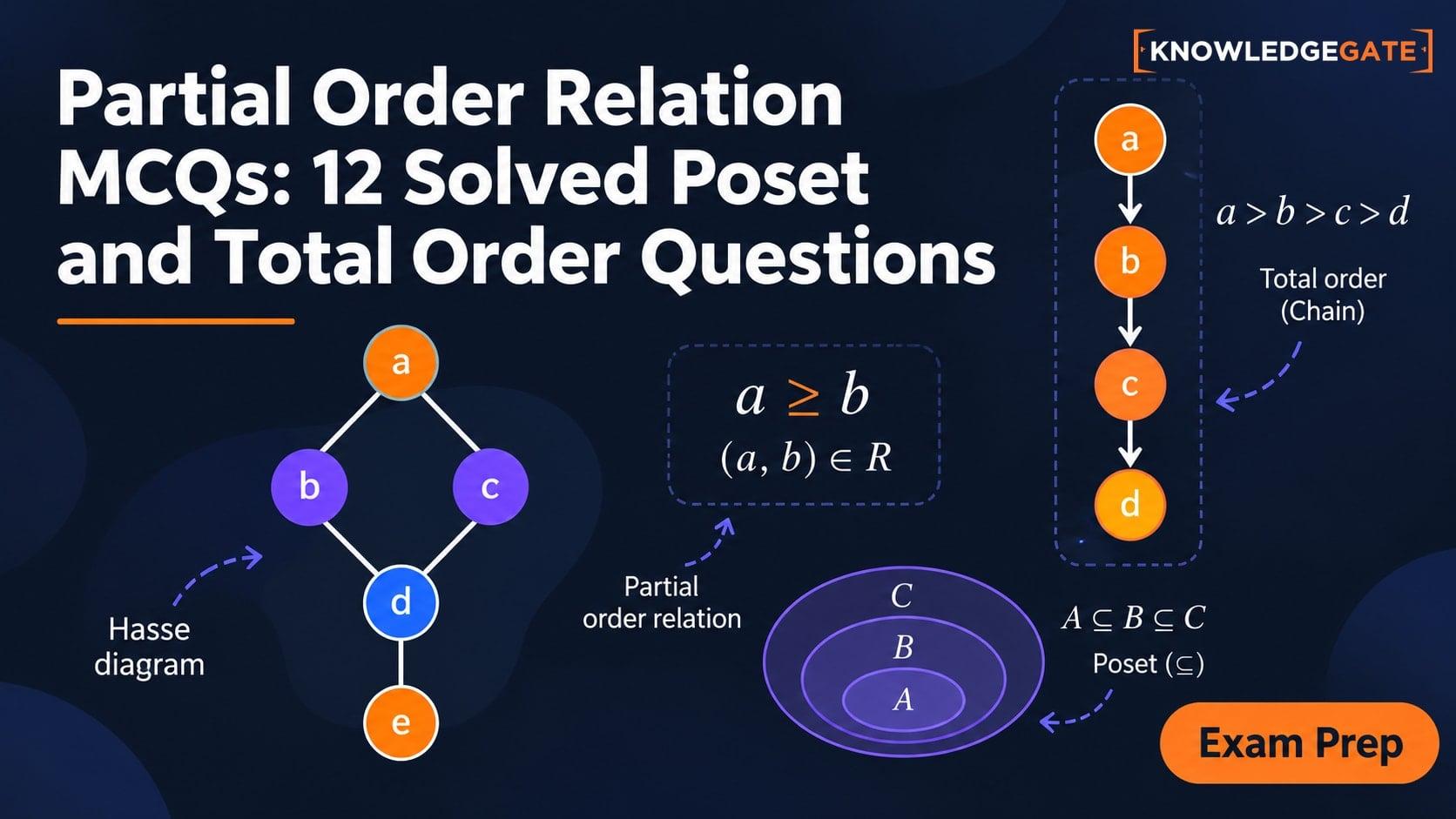
Partial Order Relation MCQs: 12 Solved Poset and Total Order Questions
Solve 12 published partial order questions with fresh explanations covering posets, total orders, lattices, recursive comparisons, linear extensions and counterexamples.
Updated 30 Oct 20267 min read50 viewsDiscrete Mathematics MCQs
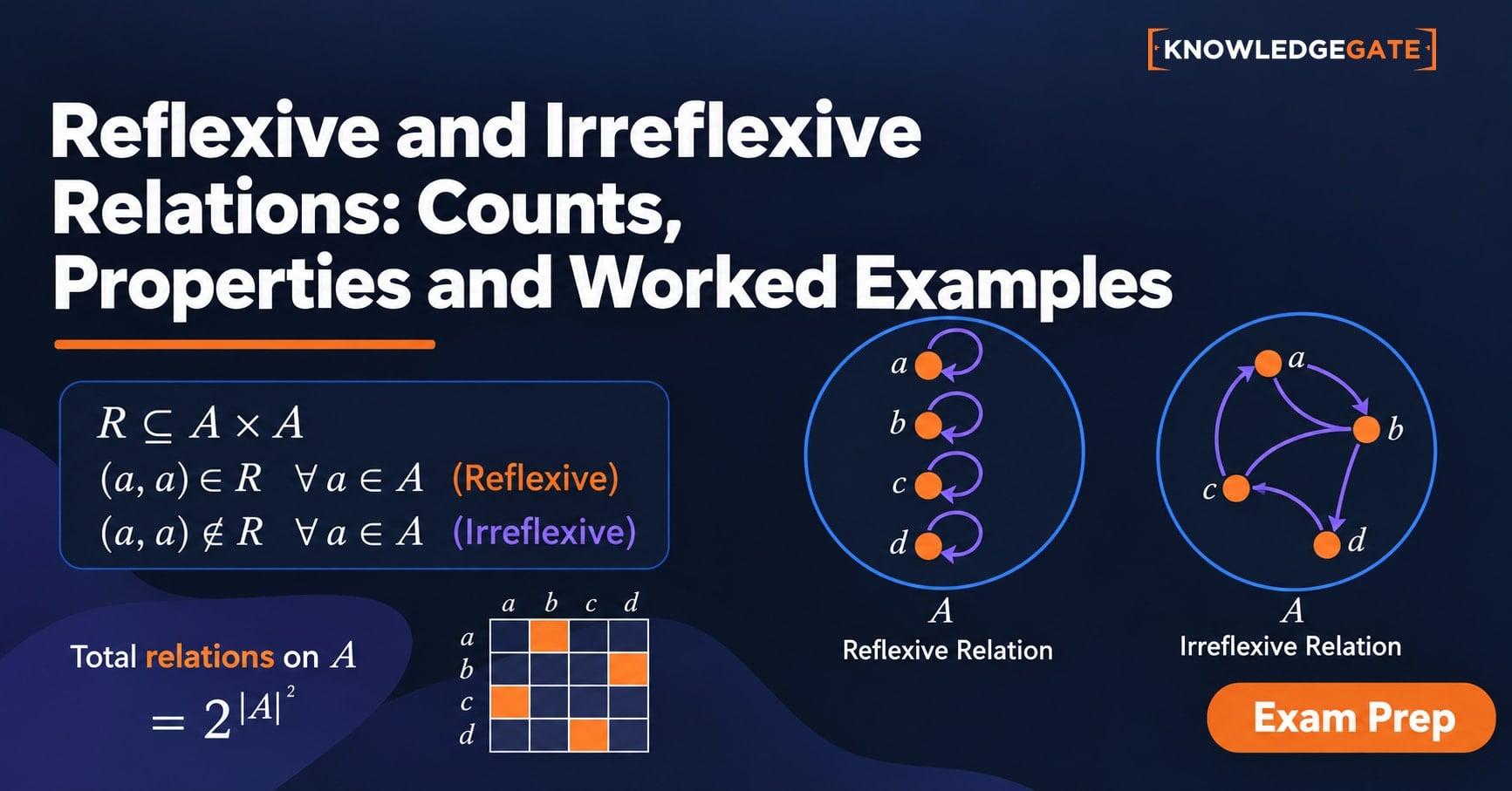
Reflexive and Irreflexive Relations: Counts, Properties and Worked Examples
Learn to classify a relation from its diagonal, count the possible relations on an n-element set, and avoid the common confusion between irreflexive and not reflexive.
Updated 17 Nov 20266 min readEngineering Mathematics

Transitive Relation MCQs: 12 Solved Questions on Definition, Count, Properties and Closure
Test transitivity by finding required shortcut pairs, decisive counterexamples and reachable paths. These 12 MCQs cover relation audits, properties and closure.
Updated 30 Oct 20268 min readDiscrete Mathematics MCQs

Symmetric, Antisymmetric and Asymmetric Relation MCQs: 11 Solved Questions
Solve 11 relation MCQs with clear tests for symmetry, antisymmetry and asymmetry. Each answer identifies the exact pair, loop or implication that decides it.
Updated 29 Oct 20268 min read169 viewsDiscrete Mathematics MCQs