Linked List Problems in Java: Reversal, Cycle Detection, and the Interview Classics Traced
Trace the pointers behind in-place reversal and Floyd's cycle algorithm, then reuse the same habits for other linked list interview problems.
KnowledgeGate Team
Exam prep & CS education
Updated 27 Aug 20266 min read
Linked list problems are rarely difficult because of the big idea. They are difficult because one overwritten pointer can cut off the unprocessed part of the list. In Java, the safest habit is to state what each reference owns before every assignment, especially when reversing links in place or moving two pointers at different speeds.
The Java node and three pointer rules
A minimal singly linked list node stores a value and a reference to the next node:
class Node {
    int val;
    Node next;

    Node(int val) {
        this.val = val;
    }
}
The final node points to null. That simple chain becomes easier to manipulate when you follow three rules.
Save
curr.nextbefore changing it. Otherwise, you can lose every node aftercurr.Use a dummy head for insertion or deletion near the front. It makes the original head behave like any other node.
Check the boundaries. An empty list, a one-node list, and the tail all bring
nullinto the logic.
These are not style preferences. They remove the most common failure modes from pointer code.
Iterative linked list reversal, fully traced
Reverse 1 -> 2 -> 3 -> 4 -> null with three references: prev, curr, and next. Before the loop, prev = null and curr = 1.
Node reverse(Node head) {
    Node prev = null;
    Node curr = head;

    while (curr != null) {
        Node next = curr.next;
        curr.next = prev;
        prev = curr;
        curr = next;
    }
    return prev;
}
Now trace every assignment rather than trusting the code by sight.
Step 1: save
next = 2. Set1.next = null. Moveprevto1andcurrto2. The reversed part is1 -> null.Step 2: save
next = 3. Set2.next = 1. Moveprevto2andcurrto3. The reversed part is2 -> 1 -> null.Step 3: save
next = 4. Set3.next = 2. Moveprevto3andcurrto4. The reversed part is3 -> 2 -> 1 -> null.Step 4: save
next = null. Set4.next = 3. Moveprevto4andcurrtonull. The reversed part is4 -> 3 -> 2 -> 1 -> null.
The loop stops because curr == null. At that moment, prev points to node 4, so it is the new head. Each node is visited once, giving O(n) time, and only three references are used, giving O(1) extra space.
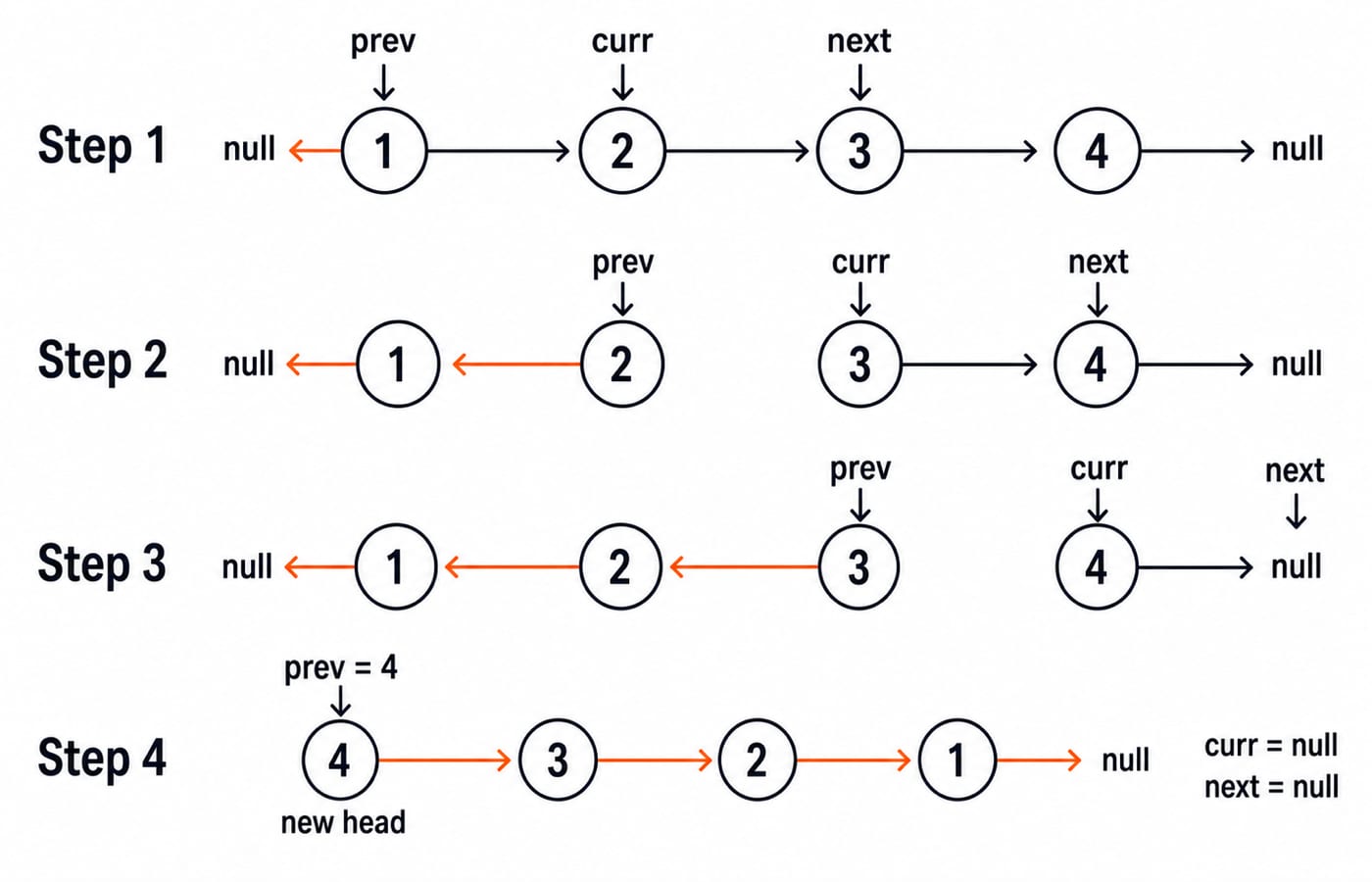
The line to protect is Node next = curr.next. Move it below curr.next = prev, and the reference to the remaining list is gone.
Fast and slow pointers for the middle and a cycle
Two pointers can encode distance without a counter. For the middle node, move slow one edge at a time and fast two. When fast reaches null or the tail, slow is at the middle; with the guard fast != null && fast.next != null, an even-length list selects the second of its two middle nodes. The same guard keeps both even and odd lengths safe.
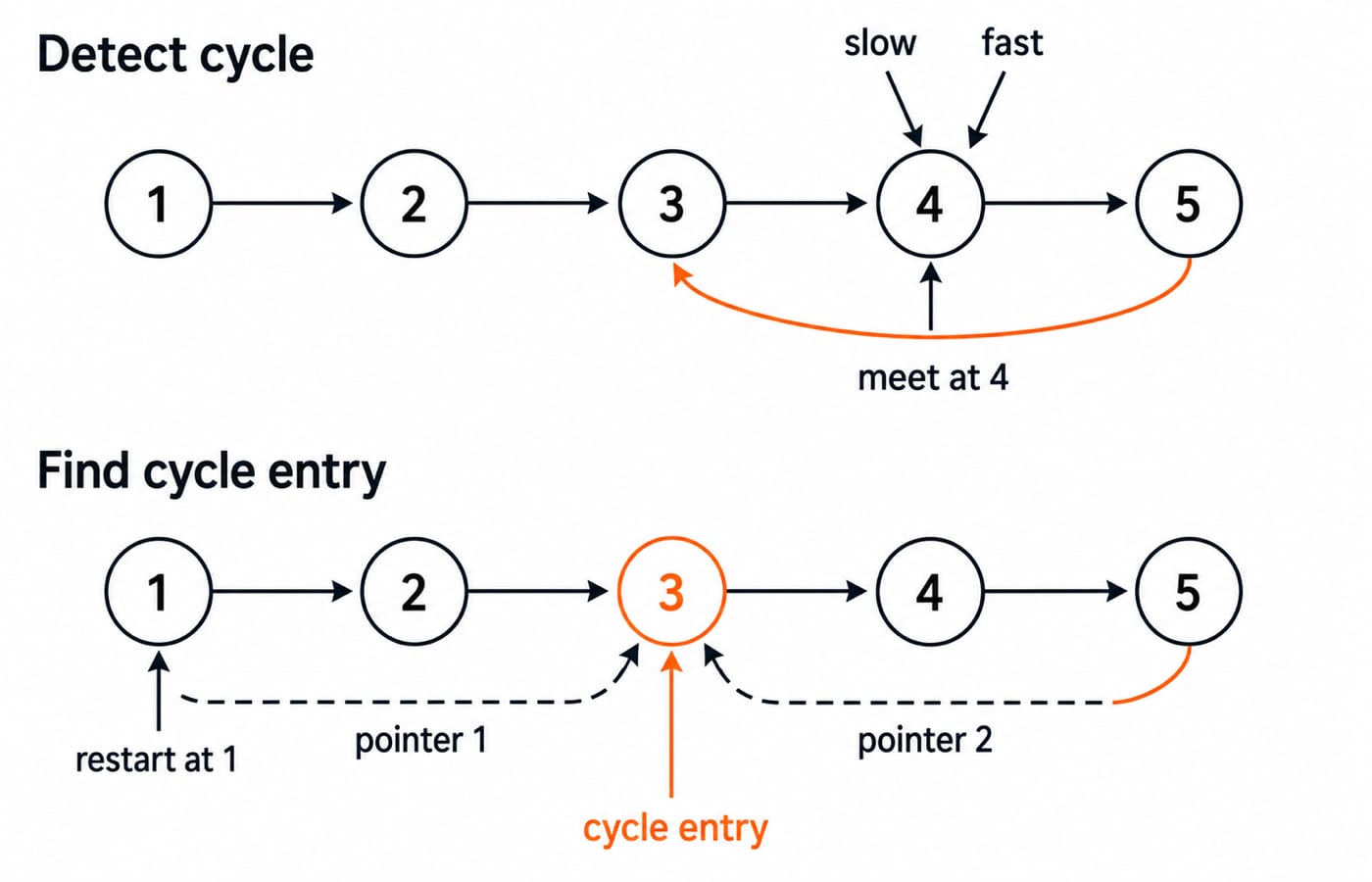
Floyd's cycle detection uses the same speeds on a list that may not end. Consider:
1 -> 2 -> 3 -> 4 -> 5, with node 5 pointing back to node 3.
The cycle is 3 -> 4 -> 5 -> 3. Start both pointers at node 1.
Iteration | slow moves to | fast moves to |
|---|---|---|
Start | 1 | 1 |
1 | 2 | 3 |
2 | 3 | 5 |
3 | 4 | 4 |
On iteration 3, fast travels 5 -> 3 -> 4. Both references now point to node 4, so a cycle exists.
To locate the entry, keep one pointer at the meeting node and reset the other to the head. Move both one edge per step:
(1, 4)becomes(2, 5).(2, 5)becomes(3, 3).
They meet at node 3, which is the cycle entry. Detection takes O(n) time and O(1) extra space, without modifying the list.
The same trace becomes a Java method that returns the cycle entry rather than only a boolean:
Node findCycleEntry(Node head) {
    Node slow = head;
    Node fast = head;

    while (fast != null && fast.next != null) {
        slow = slow.next;
        fast = fast.next.next;

        if (slow == fast) {
            Node fromHead = head;
            while (fromHead != slow) {
                fromHead = fromHead.next;
                slow = slow.next;
            }
            return fromHead;
        }
    }
    return null;
}
For the five-node example, slow and fast meet at node 4. From there, fromHead advances 1 -> 2 -> 3 while slow advances 4 -> 5 -> 3, so the method returns node 3. On an acyclic list, fast reaches null and the method returns null.
Other linked list classics and the trick behind each
Once reversal and two-speed movement are familiar, several interview questions become variations rather than new algorithms.
Merge two sorted lists
Create a dummy head and maintain a tail. Compare the first unmerged node from each list, attach the smaller one to tail, and advance that list. For 1 -> 4 and 2 -> 3 -> 5, the chosen tail values are 1 from the left, 2 from the right, 3 from the right, and 4 from the left; then append the remaining 5. The merged result is 1 -> 2 -> 3 -> 4 -> 5, and the dummy node avoids separate logic for choosing its first node.
Remove the nth node from the end
Start both references at a dummy head and advance the leader n + 1 edges before moving the leader and follower together. On dummy -> 1 -> 2 -> 3 -> 4 -> 5 with n = 2, the pair starts at (3, dummy) after those three lead moves, then becomes (4, 1), (5, 2), and (null, 3). The follower is now immediately before node 4, so follower.next = follower.next.next produces 1 -> 2 -> 3 -> 5. Counting n + 1 edges from the dummy removes the off-by-one ambiguity.
Check whether a list is a palindrome
Find the middle with fast and slow pointers, reverse the second half, and compare the two halves node by node. For 1 -> 2 -> 3 -> 2 -> 1, slow stops at 3; reversing the suffix changes 2 -> 1 into 1 -> 2, which matches the first two nodes. Equal pairs make the list a palindrome, and reversing the suffix again restores the caller's original list.
The DSA Interview Questions for Placements: The Patterns Freshers Must Know guide shows how this pattern sits beside arrays, stacks, trees, and graphs.
Traps to catch before you submit
Rewiring
curr.nextbefore savingnextloses the remaining chain.Dereferencing the head without checking it breaks on an empty list.
Omitting a dummy head creates fragile special cases for front insertion and deletion.
Using
fast.next.nextwithout both null checks breaks at the tail.Treating the nth-from-end gap casually creates an off-by-one error.
Returning
headafter reversal returns the old head, now the tail. Returnprev.
For coding rounds, the expected target for these core operations is usually linear time and constant auxiliary space. Practise that implementation standard in the DSA using Java course, then mix the patterns with broader Coding & Skills problems.
The short version and your next step
Save next before rewiring, use a dummy head when the front can change, and keep the fast-slow pattern ready. The two traces to remember are 1 -> 2 -> 3 -> 4 becoming 4 -> 3 -> 2 -> 1, and the cycle pointers meeting at 4 before locating entry 3.
The Data Structure practice bank offers over 1,500 questions, including over 140 on linked lists. Work through those traces alongside the Mera Placement Hoga bundle, and write the pointer positions on paper whenever an answer surprises you.
Keep learning
Tree Data Structure: Types, Traversals and a Worked BST Example
Build one nine-node binary search tree, classify its shape, trace four traversals, and work through insertion, search, deletion and complexity checks.
Updated 21 Oct 20266 min readDSA & Algorithms
Graphs in Data Structures: Complete Guide with BFS, DFS and Dijkstra Worked Examples
Learn graph terminology, representations and algorithm selection by tracing one unweighted graph with BFS and DFS, then solving a weighted graph with Dijkstra.
Updated 17 Oct 20266 min readDSA & Algorithms

Physical Security and Cryptography Basics: Controls, Keys and Worked Examples
Learn how physical and cryptographic controls work together, then apply them in a four-asset server-room model and a step-by-step toy RSA example.
Updated 13 Oct 20265 min readDSA & Algorithms
Stack Data Structure: Operations, Applications and Worked Examples
Build a stack from its LIFO rule, trace array and linked-list operations, evaluate a postfix expression, and practise recursion, applications, and common traps.
Updated 8 Oct 20265 min readDSA & Algorithms