Java Coding Interview Questions: Programs Asked in Service-Company Drives
Prepare the short Java programs that recur in fresher drives. Learn the core string, array, number and collections patterns, then trace an O(n) Two-Sum solution.
KnowledgeGate Team
Exam prep & CS education
Updated 1 Aug 20265 min read
Service-company drives such as TCS, Infosys, Wipro and Cognizant tend to reuse a fairly predictable set of short Java programs. The difficult part is not remembering every line. It is recognising when a clean O(n) solution can replace a nested O(n^2) scan while the interviewer is quietly checking your reasoning.
The programs fall into three groups: eight string routines, twelve array and number routines, and six collections and OOP judgement calls. One idea, a HashMap from value to index, carries the biggest jump in most of them, and Two-Sum is the cleanest place to watch it turn a nested scan into a single pass.
What service-company coding rounds test
Most fresher rounds test correctness on standard patterns, readable Java and basic complexity awareness. They are usually not looking for an exotic graph algorithm. They want a working program and a one-line explanation of why the approach is efficient.
That makes preparation manageable. Learn the patterns, write them without copying, test edge cases, and state time and auxiliary space after every answer. The Placement Preparation category helps you place this coding work beside aptitude and interview preparation.
String programs: the core eight
These eight are the string operations a fresher is asked to write and explain most often:
Reverse a string: traverse from the last character to the first, or use
StringBuilder.reverse()when library use is allowed.Check a palindrome: compare characters from both ends with two pointers until they meet.
Count vowels and consonants: normalise case, scan once, and classify only alphabetic characters.
Find the first non-repeating character: build a frequency map, then scan the original string again to preserve order.
Check two strings for anagrams: compare frequency counts after applying the same case and whitespace rules.
Count character frequency: update
Map<Character, Integer>with each character in one pass.Remove duplicate characters: add characters to a
LinkedHashSet, or track them in a set while building the answer.Check string rotation: for equal-length strings, test whether the second occurs inside
first + first.
Before coding, ask whether case, spaces and punctuation matter. That small clarification prevents a correct algorithm from solving the wrong version of the question.
Array and number programs: the core twelve
The next group repeats across written tests and live coding screens:
Maximum and minimum: keep two running values during one traversal.
Second largest: maintain the largest and second-largest distinct values without sorting.
Missing number: for values from 1 to n, compute
n * (n + 1) / 2and subtract the observed sum.Duplicate detection: use a
HashSet; the first value that cannot be added is a duplicate.Reverse an array: swap the left and right elements while moving two pointers inward.
Rotate an array: use reversal in three steps for O(n) time and O(1) extra space.
Maximum subarray: Kadane's algorithm keeps the best sum ending here and the best seen overall.
Move zeros to the end: compact non-zero values forward, then fill the remaining positions with zero.
Two-Sum: store each seen value and its index in a HashMap while looking for its complement.
Merge sorted arrays: advance one pointer in each array and append the smaller current value.
Frequency count: update a HashMap in one pass, then read counts without rescanning the array.
Fibonacci, prime and GCD: use an iterative Fibonacci loop, trial division up to the square root for primality, and Euclid's algorithm for GCD.
For clean versions of that last group, use Classic Programs in C, Java and Python. Do not just read the programs. Run each with a normal case, an empty or minimal case, and a case containing repeated values.
Worked example: Two-Sum from O(n^2) to O(n)
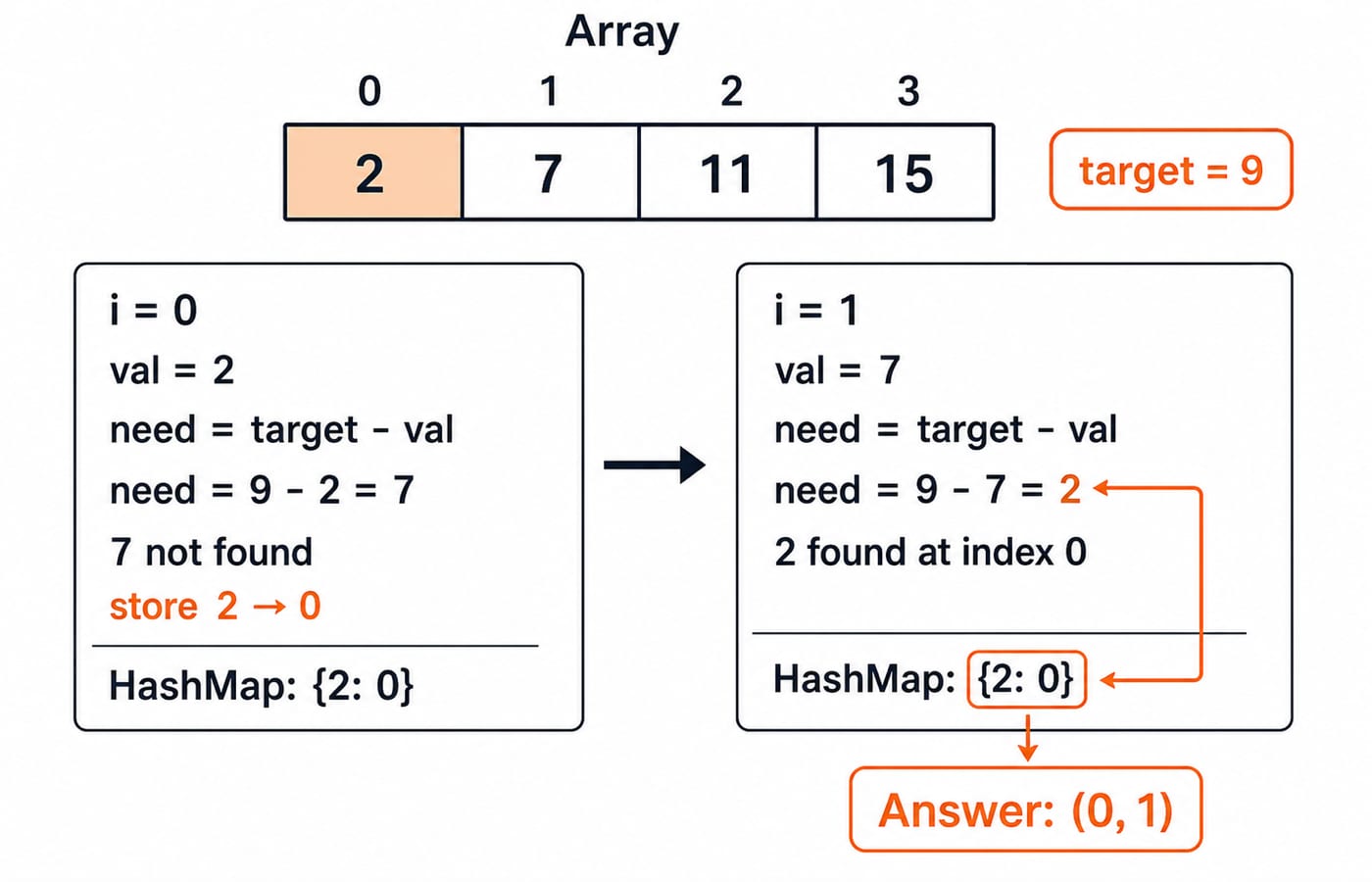
Problem: given the array [2, 7, 11, 15] and target 9, return the indices of two values whose sum is 9.
The naive method checks every pair. The first pair is (2, 7), and 2 + 7 = 9, so the answer is indices (0, 1). Two nested loops can examine a number of pairs proportional to n squared, giving O(n^2) time and O(1) auxiliary space.
The optimal method uses one pass and a HashMap from value to index:
At
i = 0,val = 2. Computeneed = 9 - 2 = 7. The map does not contain 7, so store{2: 0}.At
i = 1,val = 7. Computeneed = 9 - 7 = 2. The map contains 2 at index 0, so return(0, 1).
The result is indices (0, 1). Each element needs one expected constant-time lookup, so the solution takes O(n) time and O(n) space.
static int[] twoSum(int[] nums, int target) {
    Map<Integer, Integer> seen = new HashMap<>();
    for (int i = 0; i < nums.length; i++) {
        int need = target - nums[i];
        if (seen.containsKey(need)) {
            return new int[] {seen.get(need), i};
        }
        seen.put(nums[i], i);
    }
    return new int[] {-1, -1};
}
The ordering matters. Check for the complement before inserting the current value, especially when the target can be twice one value. Otherwise one array element may incorrectly match itself.
Collections and OOP in Java: the core six questions
Short exercises often test whether you can choose a Java feature, not merely write a loop.
Use a
HashMapfor counts and aHashSetfor fast membership or de-duplication.Explain that an array has fixed length, while an
ArrayListgrows and provides collection methods.Sort objects with a
Comparator, such as sorting employees by score and then by name.Reverse mutable text with
StringBuilderinstead of repeated string concatenation.Use
.equals()for string content;==compares whether references point to the same object.Explain autoboxing, and do not rely on
Integerreference equality because cached instances can make==appear inconsistent.
KnowledgeGate's programming-languages practice set runs past 1,200 questions, and the Java ones lean hard on exactly these choices: which structure to reach for, and what == actually compares.
Complexity awareness that wins the round
Finish every program with two sentences: one for time and one for auxiliary space. For a frequency map, say O(n) expected time and O(n) space. For two nested loops over the same input, say O(n^2) time. For an in-place two-pointer reversal, say O(n) time and O(1) extra space.
When asked, "Can you do better than O(n^2)?", name the bottleneck first. Then name the structure that removes it. A HashMap replaces repeated searching with expected constant-time lookup; sorting may permit a linear two-pointer scan after O(n log n) preprocessing. The DSA interview questions for placements guide develops these reusable patterns further.
Short version and next step
Know the string, array, number and collections patterns, but do not present them as memorised recipes. Explain the invariant, test an edge case, and volunteer the complexity. That is what turns a merely working answer into a convincing interview answer.
Write every program yourself in the Java Programming course, then rehearse a mixed set under time with the Mera Placement Hoga Anushasan bundle. Start with Two-Sum and the eight string problems, because together they force you to practise maps, sets, two pointers and precise edge-case handling.
Keep learning
Abstraction and Interfaces in Java: Abstract Classes, Contracts and Runnable Examples
Learn when Java needs an abstract class, when it needs an interface, and how both work together in one runnable charge-calculation program with exact outputs.
Updated 6 Oct 20266 min readJava
Wrapper Classes and Autoboxing in Java: Worked Examples and Null Traps
Learn why Java wrapper classes exist, how boxing and unboxing work, and where nulls, reference identity, and overload selection create surprises.
Updated 1 Oct 20265 min readJava
Synchronization in Java: Monitors, Race Conditions and Runnable Examples
Learn why Java threads lose updates, what each synchronized form locks, and how to build safe counters, inventory checks and condition-waiting code.
Updated 26 Sep 20266 min readJava
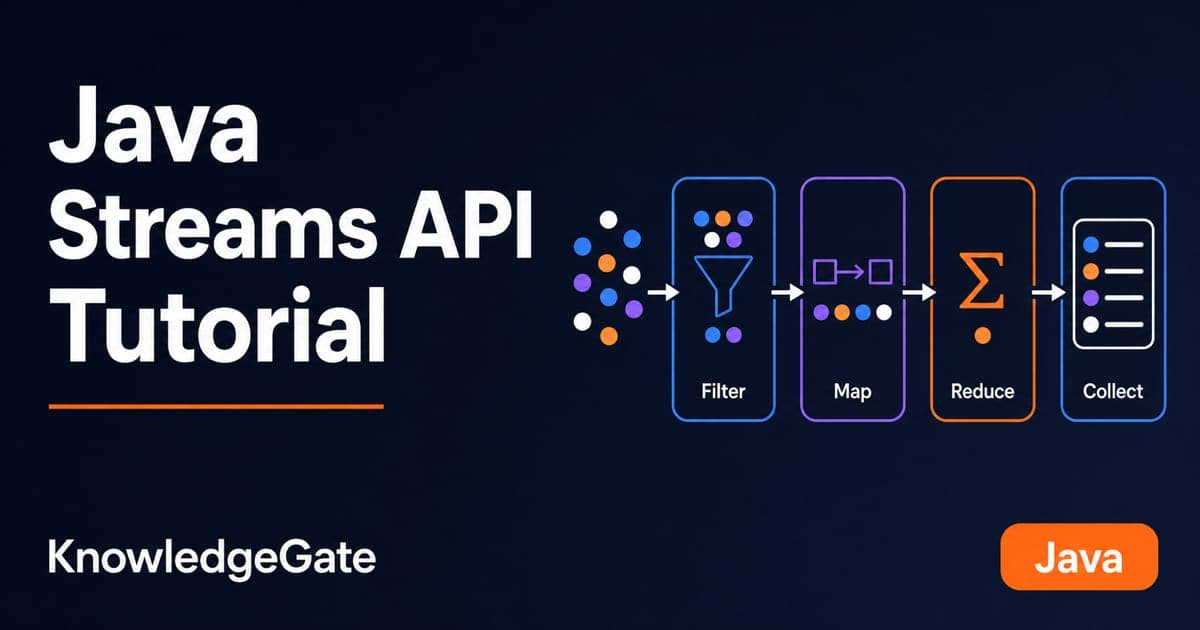
Java Streams API Tutorial: Filter, Map, Reduce and Collect with Runnable Examples
Learn Java streams from the source-to-terminal mental model, then trace operations, reductions and collectors through runnable examples and practice tasks.
Updated 24 Sep 20265 min readJava