IBPS SO IT Officer Operating Systems: professional knowledge topics
IBPS SO IT Officer Operating Systems: master processes, CPU scheduling, memory management, deadlock and process synchronization for the Mains PK paper.
KnowledgeGate Team
Exam prep & CS education
Updated 18 Jul 20266 min read164 views
Operating Systems is one of the most predictable scoring areas in the IBPS SO IT Officer Mains, because the same handful of ideas (processes, scheduling, memory, and deadlock) come up again and again. The catch is that they are computed, not recalled. The marks go to whoever can run a scheduling table, turn a logical address into a physical one, and test a resource state for safety without hesitating.
Operating Systems for IBPS SO IT: the five areas that matter
An operating system manages the hardware and gives programs a clean interface to it. For the exam, five areas matter: process management, CPU scheduling, process synchronization, memory management, and deadlock handling. Each one is computed rather than recalled, which is what makes them dependable marks once you have practised them.
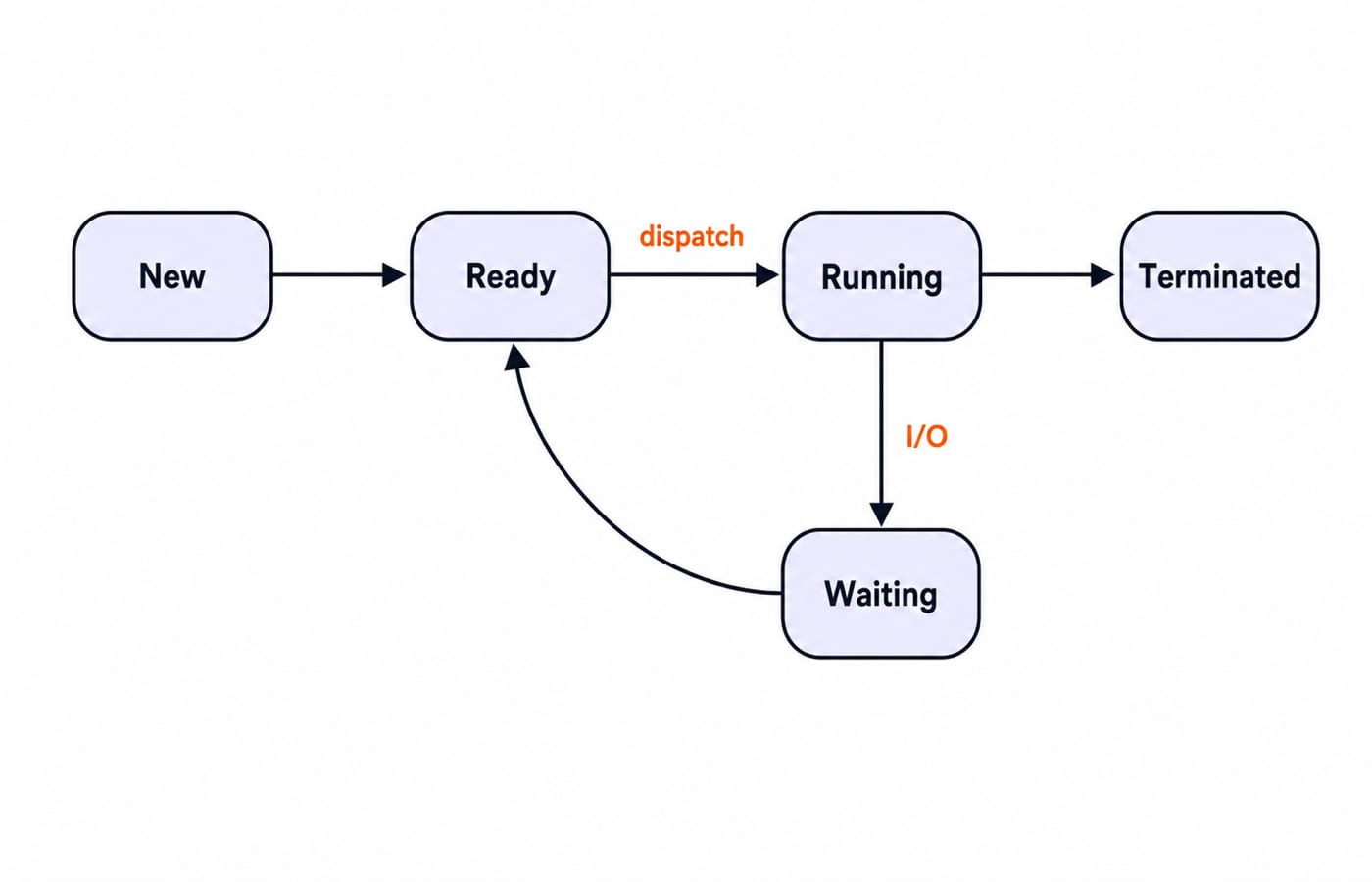
Start with the process, a program in execution. A process moves through states: new, ready, running, waiting, and terminated. The kernel keeps a Process Control Block for each one, holding its program counter, registers, and scheduling information. A thread is a lighter unit of execution inside a process that shares the process's memory.
CPU scheduling: the algorithms and a worked example
When several processes are ready, the scheduler decides who runs next. Know the standard algorithms and what each optimises:
FCFS (First Come First Served): simple, non-preemptive, but suffers the convoy effect where a long job delays short ones.
SJF (Shortest Job First): optimal average waiting time, but needs to know burst lengths in advance.
SRTF: the preemptive version of SJF.
Round Robin: each process gets a fixed time quantum, which gives fairness and good response time.
Priority scheduling: highest priority runs first, with the risk of starvation for low-priority jobs.
Three processes arrive at time 0 in the order P1, P2, P3 with burst times 24, 3, and 3.
P1 runs 0 to 24, P2 runs 24 to 27, P3 runs 27 to 30.
Waiting times are 0, 24, and 27, so the average waiting time is 51 divided by 3, which is 17.
Now reorder as P2, P3, P1 (as SJF would): waiting times become 0, 3, and 6, averaging 3. The same three jobs, a very different average, which is exactly why the scheduling algorithm matters and why the exam keeps asking you to compute these.
Two definitions to keep separate: turnaround time is completion time minus arrival time, while waiting time is turnaround time minus the burst time. Many numericals hinge on getting that distinction right.
Process synchronization: the critical section
When processes share data, their access must be coordinated or results become inconsistent. The section of code that touches shared data is the critical section, and a correct solution must guarantee three things: mutual exclusion (only one process inside at a time), progress (a waiting process is not blocked unnecessarily), and bounded waiting (no process waits forever).
A semaphore is the classic tool, an integer with two atomic operations, wait (P) which decrements and may block, and signal (V) which increments and may wake a process. A binary semaphore behaves like a lock (a mutex). The producer-consumer and reader-writer problems are the standard scenarios, and questions often ask what value a semaphore holds after a given sequence of wait and signal calls.
Memory management: paging and the address translation idea
Memory management decides where each process lives in RAM. Paging removes the need for contiguous allocation by splitting logical memory into fixed-size pages and physical memory into equal-size frames. A page table maps each page to a frame.
A logical address splits into a page number and an offset. The page number indexes the page table to find the frame; the frame number and the offset combine into the physical address. A TLB (Translation Lookaside Buffer) caches recent translations so the page table need not be read every time.
Now translate an address by hand.
A 16-bit logical address space has 65,536 byte addresses. With 4 KB pages, each page holds 4,096 bytes.
Since 4,096 is 2 to the power 12, the offset takes 12 bits, and the remaining 4 bits identify one of the 16 pages.
For logical address 8460, divide by 4096. The quotient gives page number 2 and the remainder gives offset 268.
Suppose page 2 maps to frame 5. The physical address is 5 times 4096 plus 268, which is 20,748.
The rule to carry into the exam: divide by the page size to get the page number and offset, then swap the page number for its mapped frame number.
Internal fragmentation is wasted space inside an allocated page; external fragmentation is free memory scattered in unusable gaps, which paging largely eliminates. Mixing those two up is a common way to lose an easy mark. Virtual memory with demand paging lets a process run with only some pages in RAM, and a page fault brings a missing page in from disk.
Deadlock: the four conditions and safe states
A deadlock is when a set of processes are each waiting for a resource held by another in the set, so none can proceed. Four conditions, the Coffman conditions, must all hold at once:
Mutual exclusion: a resource is held in non-shareable mode.
Hold and wait: a process holds one resource while requesting another.
No preemption: a resource is released only voluntarily.
Circular wait: a closed chain of processes each waiting on the next.
Handling splits three ways. Prevention makes one condition structurally impossible, for example requiring resources to be requested in a fixed order to break circular wait. Avoidance stays in safe states using advance information, which is what the Banker's algorithm does. Detection and recovery lets deadlock happen, then finds and breaks the cycle. A state is safe if some ordering lets every process finish; every deadlock is unsafe, but not every unsafe state is a deadlock.
Safety is a check you can run on paper. Take one resource type with 12 instances shared by three processes.
P0 has a maximum claim of 10 and holds 5, so it still needs 5. P1 claims 4 and holds 2, needing 2. P2 claims 9 and holds 2, needing 7.
Held instances total 9, so 3 are available.
Only P1's remaining need of 2 fits inside 3, so P1 runs first. When it finishes it returns its 2, leaving 5 available.
P0 needs exactly 5, so it runs next and returns all 10, leaving 10 available.
P2 needs 7, which 10 covers. The order P1, P0, P2 lets everyone finish, so the state is safe.
Change one number and the answer flips. Grant P2 a third instance before the check: 10 are now held, 2 are available, and P2's need rises to 6. P1 can still finish and return its 2, but 4 available covers neither P0's 5 nor P2's 6, so nobody else can proceed and the state is unsafe. One instance is the whole difference, which is why the paper likes granting a request and asking you to re-run the check.
How Operating Systems is tested in the IBPS SO IT Mains
The Professional Knowledge paper draws on this exact core, and OS is one of its richest areas: our question bank carries close to 2,000 Operating Systems questions. Expect numericals, a scheduling table asking for average waiting or turnaround time, a paging address-translation calculation, and quick conceptual questions on the Coffman conditions or safe states.
How many questions the section carries, the timing, and any negative marking change from cycle to cycle, so take those from the official notification on ibps.in before you plan your attempt.
Your next step
OS marks come from hand-solving, so read each idea once, then compute until scheduling tables and page-table lookups feel routine.
Prepare the core paper in the IBPS SO IT Officer Mains course, which sets these topics in the banking-IT context.
To sequence all three stages together, the IBPS SO IT Officer Scale-1 bundle covers Prelims, Mains, and Interview.
Drill algorithms on the CPU scheduling learn module and address translation on the memory management learn module.
Wider banking-IT preparation lives in the Banking and Insurance category.
Compute two scheduling problems, one page-table lookup, and one Banker's safe sequence by hand. After that, Operating Systems stops being a topic and becomes a stack of marks you can rely on.
Keep learning
Critical Section in Process Synchronization: Race Conditions and Correctness Worked Step by Step
See how two sensible updates to x can finish at 6, 7, or 8. The worked trace connects race conditions to mutual exclusion, progress, bounded waiting, and safe synchronization choices.
Updated 21 Oct 20266 min readOperating Systems
System Calls and Dual Mode in OS: Mode-Bit Trace, Worked Example and Exam Traps
Follow one read() call across the user-kernel boundary, calculate its stated overhead, and learn the distinctions that make system-call questions easier.
Updated 17 Oct 20265 min readOperating Systems
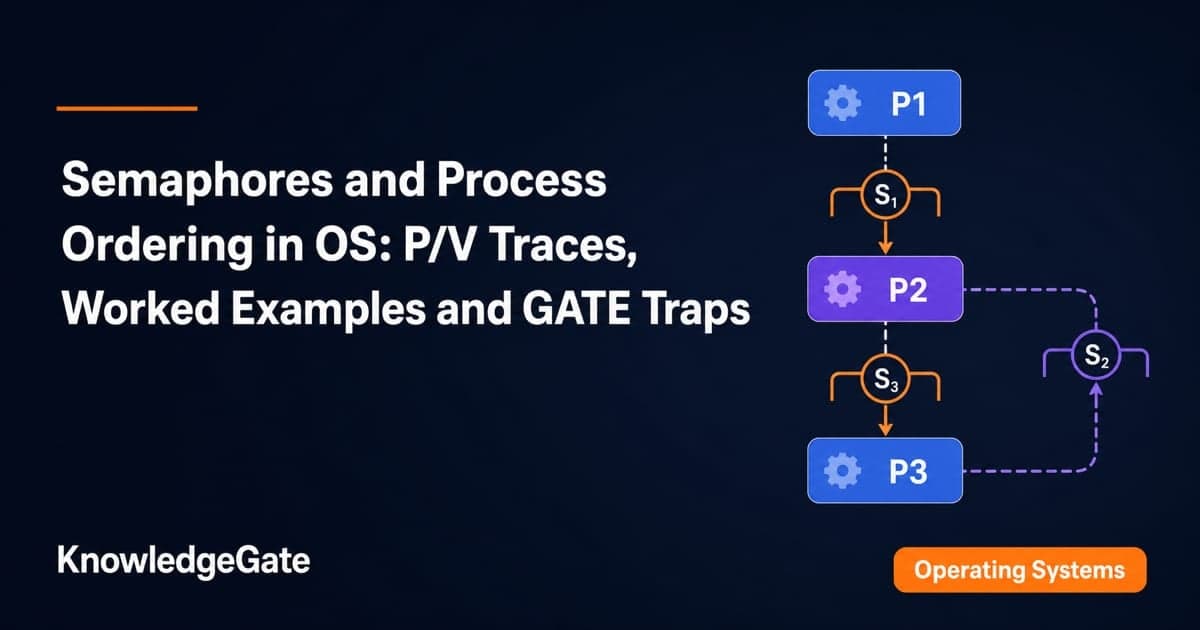
Semaphores and Process Ordering in OS: P/V Traces, Worked Examples and GATE Traps
Learn one consistent semaphore convention, then trace ordering constraints, shared-variable updates, bounded-buffer permits, rendezvous, and deadlock step by step.
Updated 13 Oct 20265 min readOperating Systems
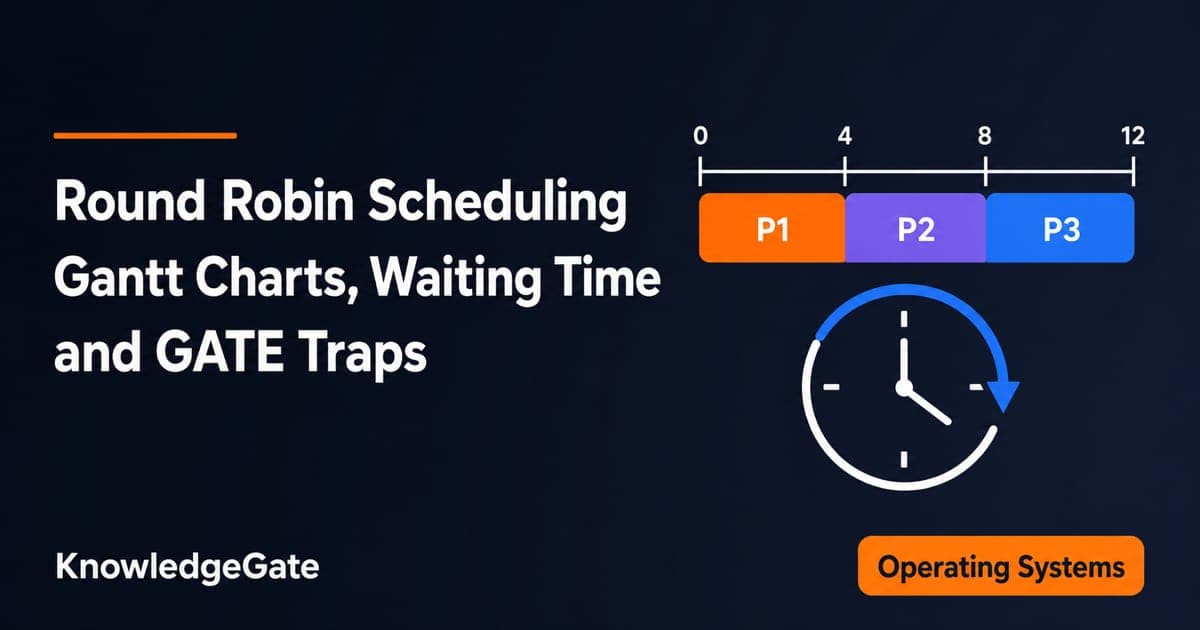
Round Robin Scheduling Explained: Gantt Charts, Waiting Time and GATE Traps
Learn a fixed Round Robin queue convention, trace staggered arrivals, calculate CT, TAT, WT and RT, and see how quantum size and context-switch cost change results.
Updated 9 Oct 20265 min read64 viewsOperating Systems