Grammar in Theory of Computation: Complete Guide with Worked Examples
Learn how grammars generate languages, classify all four Chomsky types, convert a regular grammar to an NFA, detect ambiguity, and use CNF step counts.
KnowledgeGate Team
Exam prep & CS education
Updated 1 Aug 20266 min read
"Which type of grammar is this?" looks easy until productions mix directions or a short string has extra parse trees. Machines recognise languages; grammars generate them. A grammar is judged entirely by the shape of its productions: that shape fixes its Chomsky type, the machine that accepts the language it generates, and whether one string can carry two parse trees.
What a grammar is and the language it generates
A grammar is a four-tuple G = (V, T, P, S):
Vis the set of variables, also called nonterminals.Tis the set of terminals.Pis the set of productions.Sis the start symbol.
Exam questions use capitals for nonterminals, lowercase letters for terminals, and ε for the empty string. Consider G1: S -> aSb | ab.
It derives aaabbb in three production steps:
S => aSb => aaSbb => aaabbb
Thus L(G1) = {a^n b^n | n >= 1}. In general, L(G) contains all terminal-only strings derivable from S. GATE switches freely between generators and recognisers.
The Chomsky hierarchy by production shape
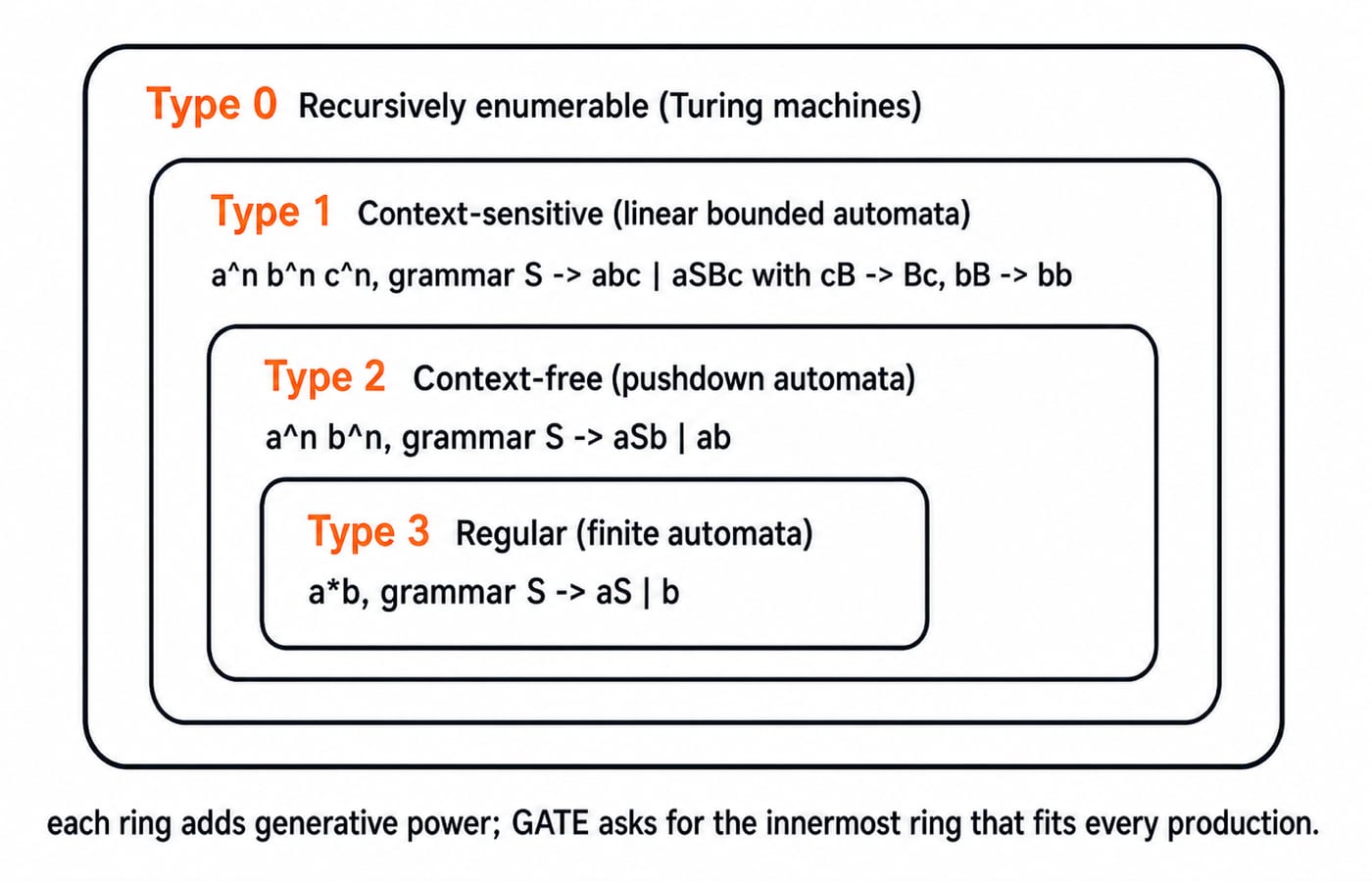
Check every production, then name the most restrictive type that fits them all. Chomsky Hierarchy for GATE works that inspection through four boundary grammars, one per type.
Type | Allowed production shape | Language class | Equivalent machine |
|---|---|---|---|
Type 3 | Right-linear | Regular | Finite automaton |
Type 2 | One nonterminal on the left, | Context-free | Pushdown automaton |
Type 1 | Non-contracting, so | Context-sensitive | Linear bounded automaton |
Type 0 |
| Recursively enumerable | Turing machine |
The strict containment is Type 3 inside Type 2 inside Type 1 inside Type 0.
G_a: S -> aS | bis right-linear, hence Type 3. It generatesa*b.G1has one nonterminal on each left side, hence Type 2. It is not Type 3 becausea^n b^nneeds unbounded matching, which no fixed set of states can track.G_chasS -> abc | aSBc,cB -> Bc, andbB -> bb. Its left sides can contain several symbols, but no rule contracts the string. It is Type 1 and generates{a^n b^n c^n | n >= 1}.
For n = 2, the complete derivation is:
S => aSBc => aabcBc => aabBcc => aabbcc
This takes four steps, using cB -> Bc and then bB -> bb at the end.
Regular grammars and finite automata
Take G2: S -> aS | bS | aA; A -> b. It generates all strings over {a, b} ending in ab, written (a+b)*ab. For an NFA, make one state per nonterminal plus a final state F. Convert B -> xC into B -x-> C, and B -> x into B -x-> F.
The states are S, A, and F; transitions are S -a-> S, S -b-> S, S -a-> A, and A -b-> F. Two a moves leave S, so this valid machine is nondeterministic. Subset construction converts it to an equivalent DFA, worked through in the DFA versus NFA guide.
In reverse, p -x-> q becomes p -> xq, and each final state q receives q -> ε.
Do not mix directions. G3: S -> aA | ε; A -> Sb looks linear but generates {a^n b^n | n >= 0}. Type 3 must stay entirely right-linear or left-linear.
Derivations, parse trees, and ambiguity
A sentential form is an intermediate derivation string. Leftmost and rightmost derivations expand the corresponding nonterminal first. Each parse tree fixes exactly one of each.
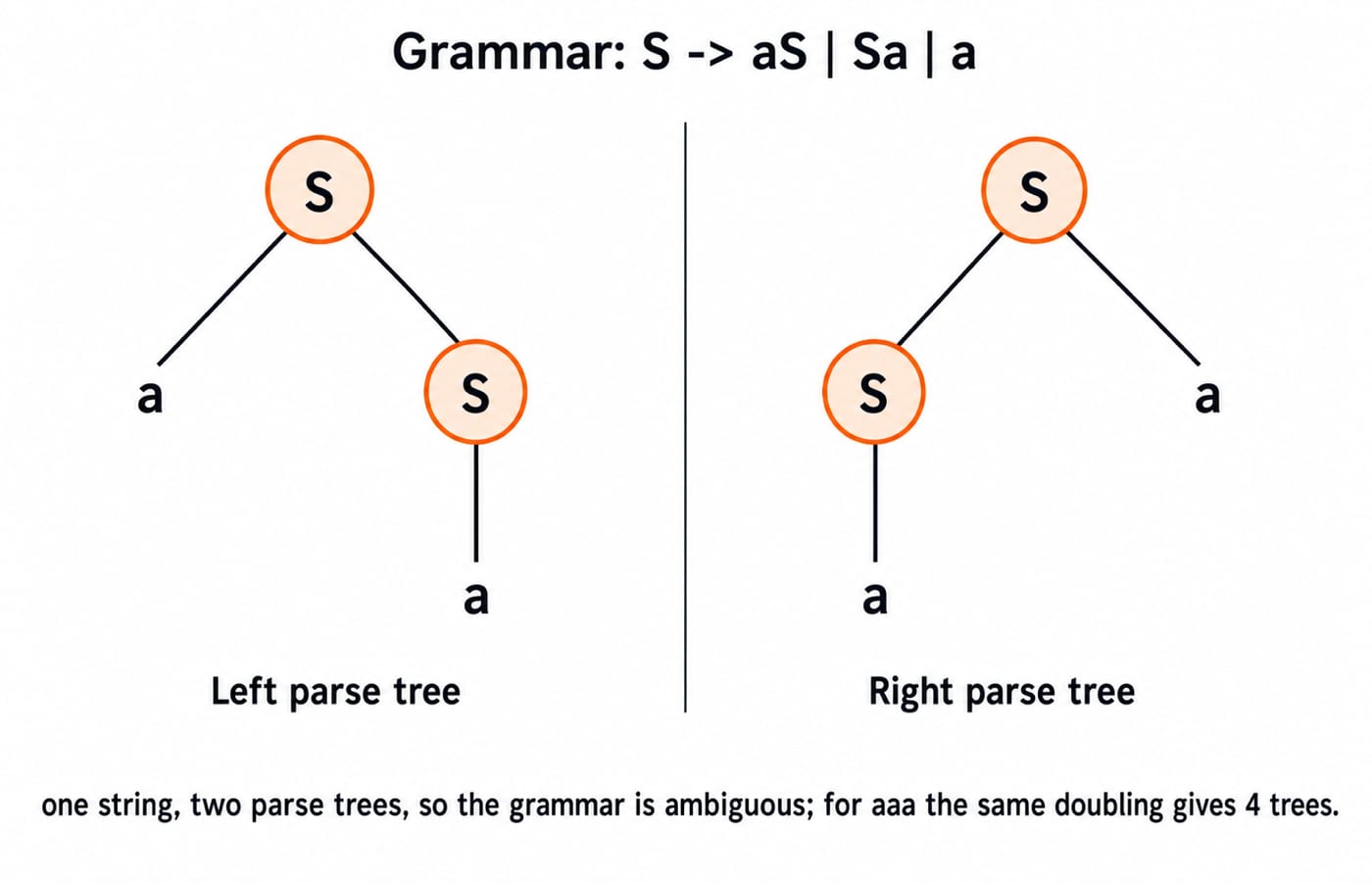
G4: S -> aS | Sa | a generates a^n for n >= 1, but is ambiguous. For aa, the root can use S -> aS or S -> Sa, with the remaining S producing a. These are two trees.
For aaa, root rule aS contributes two trees and Sa contributes two, totalling 2 + 2 = 4. If t(n) counts trees for a^n, then t(1) = 1 and t(n) = 2t(n-1), so t(n) = 2^(n-1).
G5: S -> aS | a generates the same language unambiguously. Ambiguity belongs to a grammar, not automatically to its language. CFG ambiguity is undecidable in general, but two trees for one string settle a small example.
Chomsky and Greibach normal forms
In Chomsky Normal Form, every production is A -> BC or A -> a. Convert G1 to:
A -> a
B -> b
X -> SB
S -> AX | AB
For aabb, a complete derivation is:
S => AX => aX => aSB => aABB => aaBB => aabB => aabb
The seven steps match 2n - 1 for n = 4. In general, CNF needs n - 1 binary steps and n terminal steps. Thus length-6 aaabbb takes 2(6) - 1 = 11 steps in CNF, but only three in the original G1. Never use this count outside CNF.
In Greibach Normal Form, each right side starts with a terminal followed by variables. Here S -> aSB | aB; B -> b works. Normal forms support fixed-shape proofs and CYK. FIRST, FOLLOW, left recursion, and LL or LR parsing are Compiler Design topics that build on these forms.
Traps that cost marks
Choosing Type 2 for a regular grammar: By containment it fits, but the expected most restrictive class is Type 3.
Treating mixed linear rules as regular:
G3shows that mixing left and right forms can generate the non-regular languagea^n b^n.Ignoring contraction in Type 1: A shorter right side breaks the rule, except
S -> εwhenSnever appears on a right side.Confusing trees and derivations:
aaunderG4has two trees and two derivations because each form has one nonterminal. With several nonterminals, expansion orders can create more unrestricted derivations than trees.Using
2n - 1outside CNF:aaabbbtakes three steps inG1and 11 only after the CNF conversion.Reversing containment: Every regular language is context-free, not the other way around.
How GATE and interviews test grammar
Grammar and the Chomsky hierarchy sit within Theory of Computation and connect to Compiler Design. Check the conducting institute's official GATE 2026 site for the current syllabus and brochure, not remembered marks or rules.
Recent GATE papers have used five shapes: classify a grammar, identify L(G), count trees or CNF steps, convert between a regular grammar and finite automaton, or select a grammar for a language. KnowledgeGate has around 90 Grammar questions within around 1,000 Theory of Computation questions, plus around 250 on pushdown automata and CFGs. Use the Theory of Computation Context-Free Grammars MCQs for solved practice.
Interviews ask why regular expressions cannot handle arbitrary nesting, how to write G1, or how to classify a small language. A finite automaton has finitely many states and no stack, so it cannot match an unbounded number of opening symbols against closing ones, which is why nesting needs a context-free grammar and a pushdown automaton.
The short version and the next step
G = (V, T, P, S), andL(G)contains every terminal string derivable fromS.The strict hierarchy runs Type 3 inside Type 2 inside Type 1 inside Type 0.
Regular grammars convert directly to finite automata, but mixed left and right linearity is unsafe.
Two trees for
aaproveG4ambiguous;aaahas four.In CNF, a length-
nstring takes exactly2n - 1derivation steps.
Learn the subject in sequence with GATE Guidance by Sanchit Sir, then practise classification and step counting against the clock. The wider GATE CS Exam Preparation Courses and Test Series category connects this topic to the rest of the preparation plan.
Keep learning
Linear Bounded Automata: Tape Limits, a Worked LBA Trace and Exam Traps
See exactly what an LBA bounds, where it sits in the language hierarchy, and how a six-cell marking machine accepts aabbcc while rejecting three near misses.
Updated 4 Oct 20266 min readTheory of Computation
Decision Properties in Theory of Computation: DFA Tests, CFG Boundaries and Turing Machine Undecidability
Learn an algorithm-first way to classify membership, emptiness, finiteness, inclusion, equivalence and universality for DFAs, CFGs and Turing machines.
Updated 29 Sep 20266 min readTheory of Computation
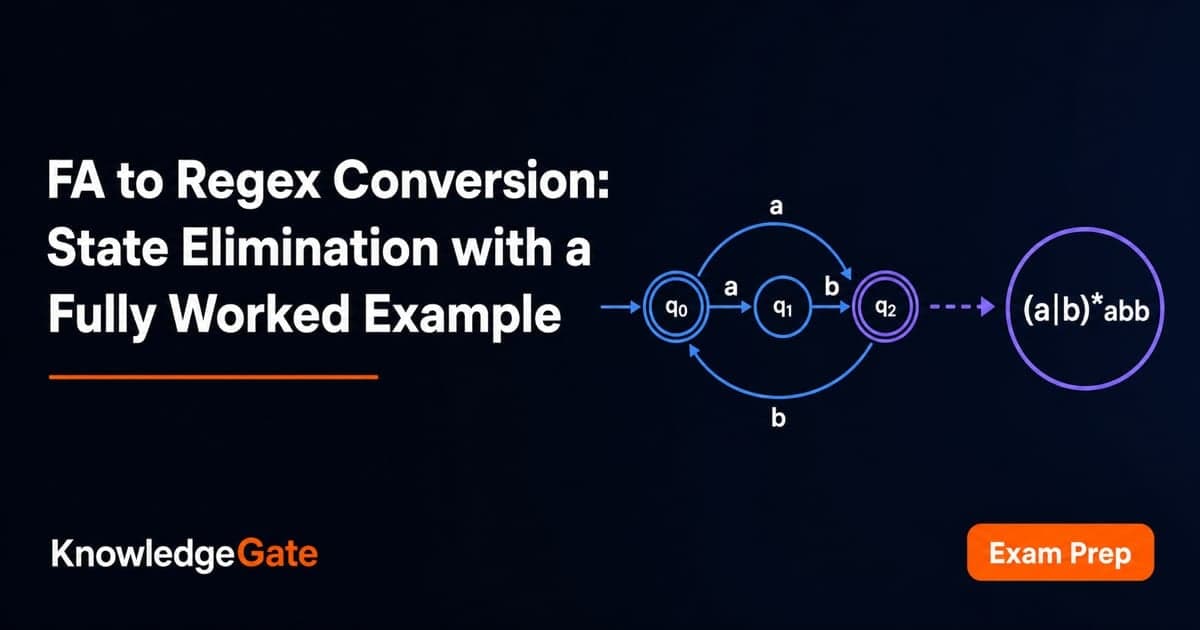
FA to Regex Conversion: State Elimination with a Fully Worked Example
Learn a mechanical state-elimination method for converting a finite automaton to a regular expression, then verify the result with a second order and short strings.
Updated 25 Sep 20265 min readTheory of Computation
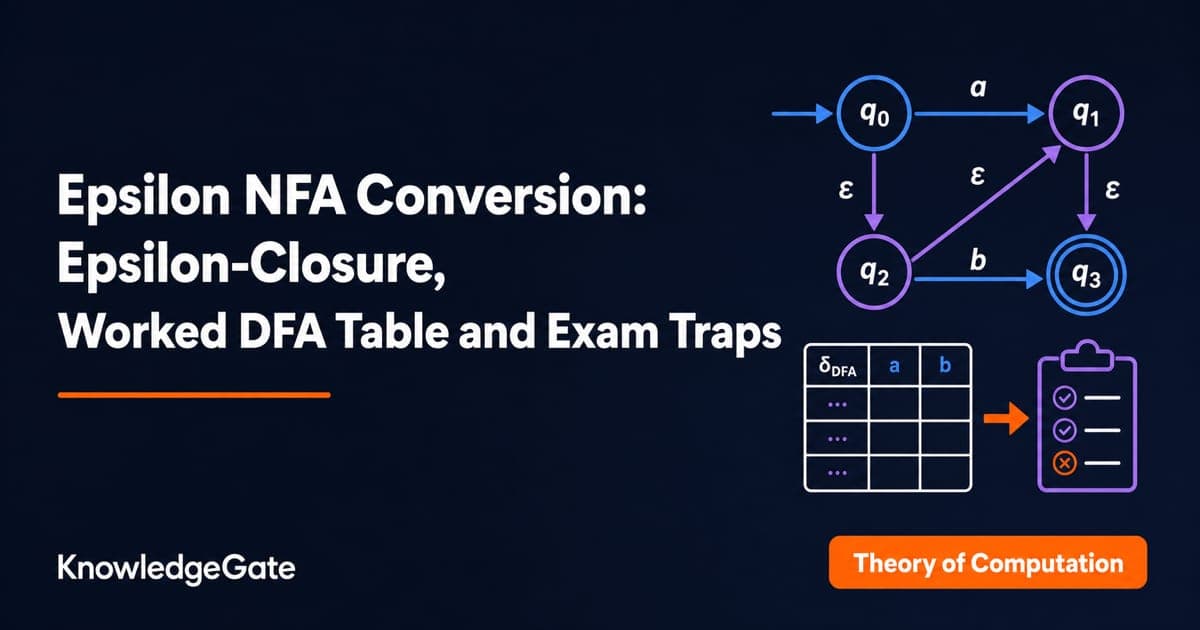
Epsilon NFA Conversion: Epsilon-Closure, Worked DFA Table and Exam Traps
Learn a mechanical epsilon-NFA conversion method through one four-state machine, complete set traces, a reachable-subset DFA table, and epsilon elimination.
Updated 24 Sep 20266 min readTheory of Computation