Fresher Resume Projects: Turn Academic Work into Proof
Turn one academic project into three defensible resume bullets by tracing every claim to your own decision, measurement, and repository evidence.
KnowledgeGate Team
Exam prep & CS education
Updated 26 Aug 20265 min read
With little or no work experience, academic projects may carry the evidence burden on your fresher resume. Yet "made a website using React and Node.js" records activity, not ability. Turn project notes into bullets that show the problem, your contribution, a technical decision, and reproducible proof. The Campus Lab Ticket Tracker and its numbers are examples only. Replace them with evidence from your repository.
What a fresher project entry has to prove
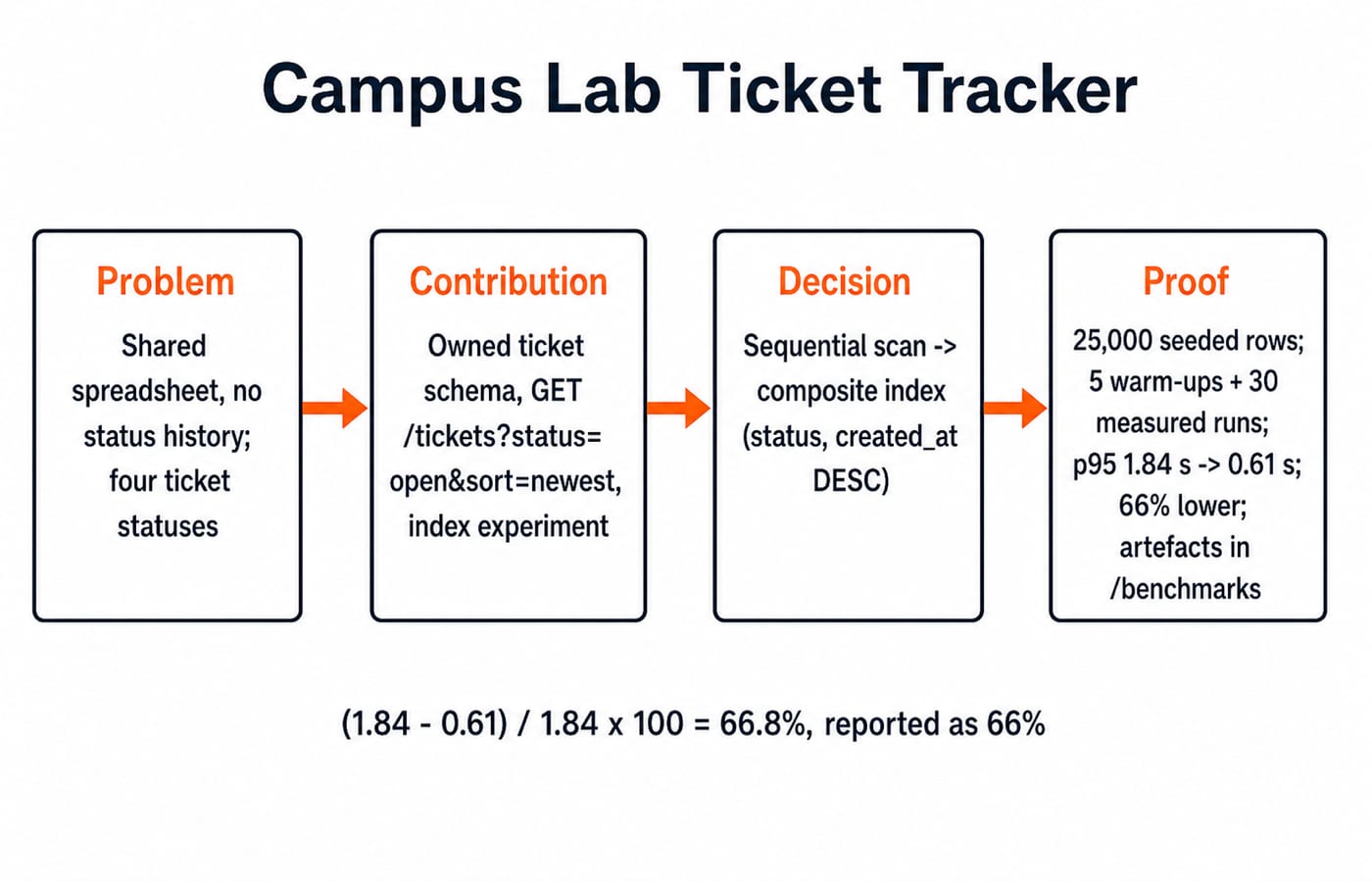
Follow a four-part proof chain: Problem -> Contribution -> Decision -> Proof. The problem identifies who or what needed help. The contribution isolates what you personally owned. The decision records the alternative or trade-off behind your choice. The proof points to an artefact or repeatable measurement. Mention a tool only when it explains the decision or implementation.
"Worked on the backend" is a responsibility. "Owned the ticket-list endpoint, selected the index after reading the query plan, and preserved a 30-run benchmark" is proof. The Resume & Interview Preparation hub provides the wider context.
Label classroom or synthetic scale, separate team output from personal work, and never present an estimate as a production result.
Build the evidence sheet before writing bullets
Fill six rows from the repository before polishing sentences. Use exact nouns and values, not "fast", "scalable", or "user-friendly".
Evidence field | Illustrative Campus Lab Ticket Tracker entry |
|---|---|
Problem | Shared spreadsheet had no ticket-status history |
Users or test context | 25,000 seeded ticket rows across four statuses |
My scope | Ticket-table schema, |
Decision and rejected alternative | Composite index selected after comparison with separate indexes |
Measured result | Local p95 changed from 1.84 s to 0.61 s |
Evidence location |
|
This illustrative two-week, four-member project used React, Express, and PostgreSQL. The complete fresher resume structure and first-screen checklist covers the whole resume. Keep this sheet focused on the project section.
Worked example: turn vague notes into a defensible claim
The weak source text is: "Developed a complaint management system using React, Node.js and PostgreSQL. Worked in a team of four. Improved database performance and user experience."
The first sentence gives tools but no named problem. The second gives team size but no personal boundary. The third names neither a decision nor test conditions, and "improved" has no evidence.
For the illustrative experiment, the list endpoint filters status = 'open' and sorts created_at DESC. The first plan used a sequential scan. The candidate compared separate indexes with CREATE INDEX idx_tickets_status_created_at ON tickets (status, created_at DESC);. The composite index matched the equality filter and sort order, so it was selected.
In the same local Docker setup, the candidate ran 5 unmeasured warm-ups and 30 measured requests for each index configuration against 25,000 seeded rows. Recorded p95 response time changed from 1.84 s to 0.61 s. The calculation is (1.84 - 0.61) / 1.84 x 100 = 66.8%. The resume rounds down to 66%. This is a local synthetic benchmark, not production traffic or evidence of 25,000 real users.
Write the project header and three proof bullets
Use this illustrative header:
Campus Lab Ticket Tracker | React, Express, PostgreSQL | GitHub | Demo
Include GitHub and Demo only when both links work and expose no secrets or personal data. Otherwise, remove them. Keeping the stack in the header lets each bullet spend its space on reasoning and evidence.
Built a campus lab ticket tracker to replace spreadsheet-based fault reporting with role-based tracking across four ticket statuses in a two-week, four-member project.
Owned the PostgreSQL ticket schema and
GET /tickets?status=open&sort=newest; chose a composite(status, created_at DESC)index after the baseline plan showed a sequential scan.Reduced local p95 response time from 1.84 s to 0.61 s, or 66%, across 30 baseline and 30 indexed measurements on 25,000 seeded rows; kept the seed script, query plans, and raw benchmark results in the repository.
Bullet 1 carries the problem and project scope. Bullet 2 marks the personal contribution and technical decision. Bullet 3 reports the result with its test conditions and evidence trail. Together, they show exactly what the candidate can defend without adding another technology or result.
Use proof that survives a follow-up question
Connect every claim to something another person can inspect.
Claim | Evidence |
|---|---|
25,000 seeded rows |
|
1.84 s to 0.61 s p95 |
|
Composite index | Migration plus before and after |
The illustrative commands are npm run seed -- --rows 25000 and npm run bench -- --runs 30. Substitute your repository's real commands.
Without user analytics, proof can be automated tests, fixed datasets, latency under stated conditions, fixed defects, supported inputs, or a working demo. Write 18 passing API tests across six routes only when the report shows those values. Never relabel classroom users, seeded records, GitHub stars, or team output as personal impact. If no commit, artefact, log, report, or reproducible demo supports it, soften the claim or remove the number.
Five project-bullet traps and their repairs
Tool salad: Technologies are easy to remember, but a long list hides the work. Move the stack to the project header.
Team-credit inflation: A team result may sound stronger, but it collapses under "what did you build?" Name the endpoint, schema, or module you owned.
Fake precision: A rough impression becomes a percentage. Keep only numbers reproduced from saved evidence.
Feature inventory: Login, dashboard, and CRUD form a catalogue without a problem or decision. Select one consequential flow and explain it.
Orphan metric: "66% faster" omits the baseline, sample, and environment. Preserve
1.84 s to 0.61 s, 30 runs, 25,000 seeded rows, local Dockerin the evidence sheet, then compress it honestly in the resume.
After these repairs, review broader placement-preparation mistakes separately.
Once the three bullets are final, use Resume-Based Interview Questions: Predict Every Follow-Up to turn each claim into likely technical and behavioural questions. Finish the evidence sheet first; interview rehearsal is a separate step.
Short version and next step
Use this formula: Project context + personal contribution + technical decision + reproducible proof. In five minutes, check for one named problem, one clear ownership boundary, one reasoned choice, one evidence trail, and no claim you cannot defend aloud.
For structured practice, the Interview & Resume Preparation Course covers resume building, technical and HR interview training, one-to-one resume review, and mock interviews. Audit one academic project with the evidence sheet, then rewrite only its strongest three bullets.
Keep learning
Advanced DP Interview Questions and Answers: Four Worked Patterns
Work through four advanced dynamic programming patterns with exact states, transitions, reconstructions, proof hooks, and interview-ready explanations.
Updated 21 Oct 20266 min readInterview Corner
Algorithm Interview Questions and Answers: Cross-Concept DSA Problems
Practise cross-concept DSA questions with defensible answers, complete dry runs and the follow-ups that change which algorithm you should choose.
Updated 17 Oct 20266 min readInterview Corner
Backtracking Technique Interview Questions and Answers: Trace, Prune and Explain
Learn to explain backtracking through exact traces, safe pruning, clean state restoration, N-Queens constraints, complexity derivation and interview follow-ups.
Updated 12 Oct 20266 min readInterview Corner

Algorithm Analysis Interview Questions and Answers: Big-O, Loops and Recurrences
Learn how to answer algorithm analysis interviews by defining the input, counting real work, tracing recurrences, and defending time-space tradeoffs.
Updated 8 Oct 20266 min readInterview Corner