

Enhanced and Specialized Data Models in DBMS: EER and Object Models Worked Step by Step
Build a partial-overlapping PERSON hierarchy, test its EER constraints, and translate the same four identities into relations and persistent objects.
KnowledgeGate Team
Exam prep & CS education
Updated 15 Nov 20266 min read
An ordinary ER diagram handles entities and relationships well, but it becomes awkward when one real object has several roles, inherits role-specific attributes, or carries behaviour as well as state. The enhanced entity-relationship vocabulary defines the constraints for a four-person university dataset, and the same case can be represented through relations and persistent objects.
1. Enhanced and specialized data models: what is actually being enhanced
The ER model provides entities, attributes, relationships, cardinality, and participation. The enhanced ER model, usually called EER, adds superclass and subclass structure, inheritance, specialization, generalization, completeness and disjointness constraints, shared subclasses, and union categories. An object-oriented database model is related but different. It persists objects described through object identity, state, behaviour, classes, and inheritance.
"Enhanced" does not name one storage engine, and "specialized" does not promise better speed. Temporal, spatial, multimedia, and distributed databases address other specialised needs. Keep that boundary clear while studying DBMS as part of broader computer science fundamentals.
The organising question is simple: are you doing conceptual modelling, logical table design, or persistent object storage? One mini-world can appear at all three levels, but each level needs different notation and decisions.
2. Specialization, generalization, inheritance, and aggregation
Specialization is top-down. Start with PERSON(pid, name), then create STUDENT and EMPLOYEE subclasses because some people need additional properties or relationships. Generalization is bottom-up. Start with separate STUDENT and EMPLOYEE types, notice that both repeat pid and name, and lift those common properties into PERSON. Both directions can produce the same hierarchy. The difference is the direction of reasoning.
Every subclass member is also a superclass member. It inherits the superclass key and common attributes, then may add attributes, methods, or relationship participation. Inheritance does not create a second independent person record.
Aggregation is a separate abstraction. Suppose WORKS_ON(P103, PR7, hoursPerWeek=6) is treated as the higher-level ASSIGNMENT A7 so MANAGER M2 can monitor it. The design has aggregated a relationship and its participants into one unit. It has not split a superclass or merged subclasses, so aggregation is not a top-down subclass operation.
3. EER constraints: disjoint or overlapping, total or partial
EER specialization has two independent axes. Disjoint means one superclass entity may join at most one listed subclass, while overlapping permits membership in more than one. Total means every superclass entity joins at least one listed subclass, while partial permits a superclass-only entity. Common notation writes d or o inside the specialization circle. A double line from the superclass marks total completeness, while a single line marks partial completeness.
Membership can also be predicate-defined or user-defined. A predicate-defined rule derives membership from a stored condition. A user-defined rule records the choice explicitly. One single-valued discriminator naturally suits a disjoint split, but cannot represent an overlapping person who holds two roles at once.
Do not swap intersection and union constructs. TEACHING_ASSISTANT subset-of STUDENT intersection EMPLOYEE is a shared subclass, so a member such as P103 inherits from both superclasses. OWNER subset-of PERSON union COMPANY is a category whose instances can come from distinct types, such as person P101 or company C7.
4. EER worked example: classify four people and test every constraint
Start with this superclass table:
pid | name |
|---|---|
P101 | Asha |
P102 | Bharat |
P103 | Charu |
P104 | Dev |
The subclass rows are:
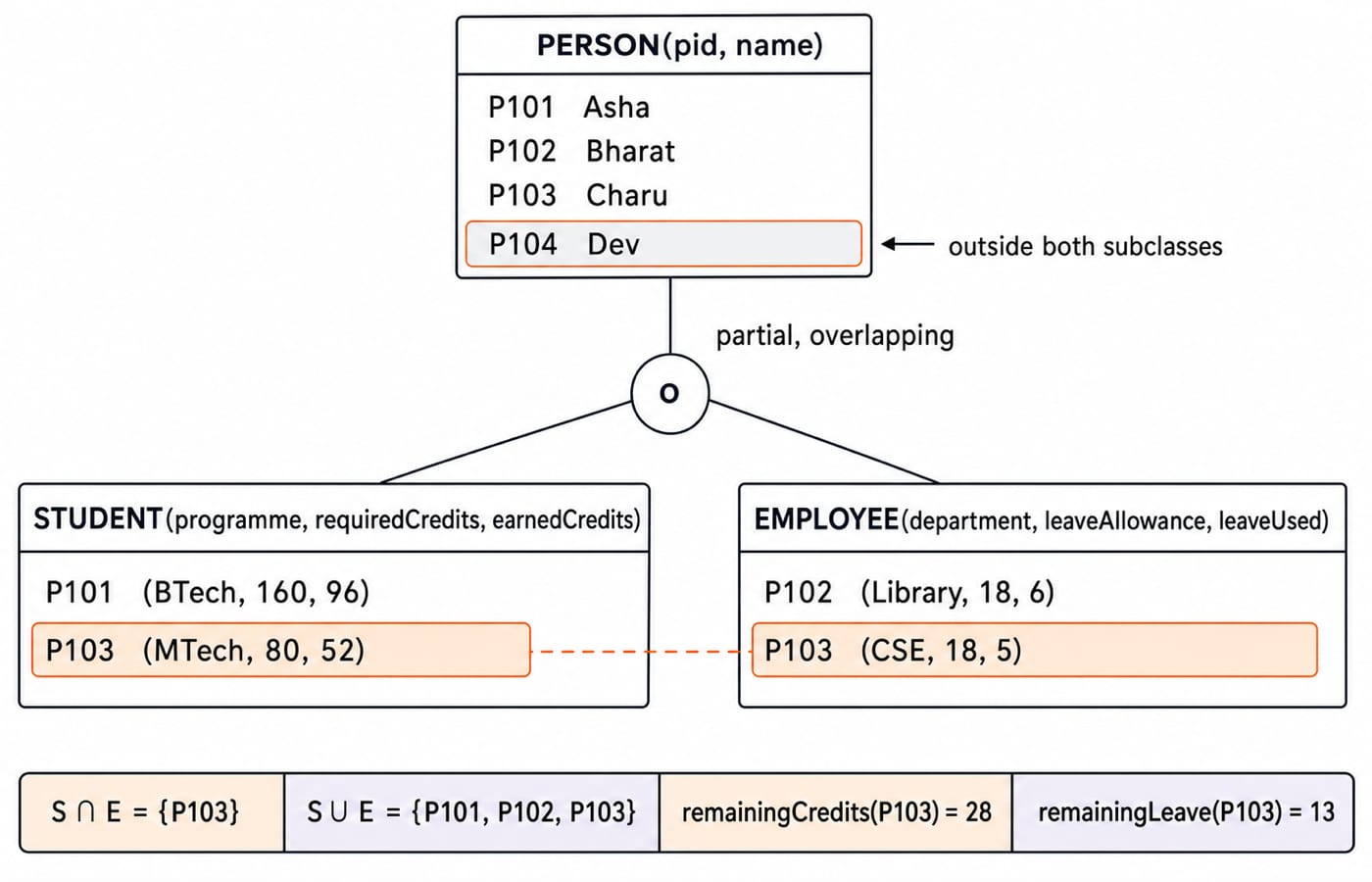
STUDENT(P101, BTech, requiredCredits=160, earnedCredits=96)STUDENT(P103, MTech, requiredCredits=80, earnedCredits=52)EMPLOYEE(P102, Library, leaveAllowance=18, leaveUsed=6)EMPLOYEE(P103, CSE, leaveAllowance=18, leaveUsed=5)
Now compute the membership sets step by step:
S={P101,P103}, so|S|=2.E={P102,P103}, so|E|=2.S intersection E={P103}, so the intersection size is 1.|S union E|=|S|+|E|-|S intersection E|=2+2-1=3.
Because P103 belongs to both subclasses, the actual specialization is overlapping. Because the union contains only P101, P102, and P103, just 3 of 4 people are classified. P104 remains only a PERSON, so the specialization is partial. A proposed disjoint rule fails on P103; a proposed total rule fails on P104.
This single calculation tests both axes independently instead of guessing the constraint label from the drawing.
Inherited behaviour uses the same identity. For P103, remainingCredits()=80-52=28 and remainingLeave()=18-5=13. For P101, remainingCredits()=160-96=64. Every subclass row reuses pid as its inherited identifier, so P103 is one person with two valid roles, not three independent records.
5. Map the EER example to relations and to persistent objects
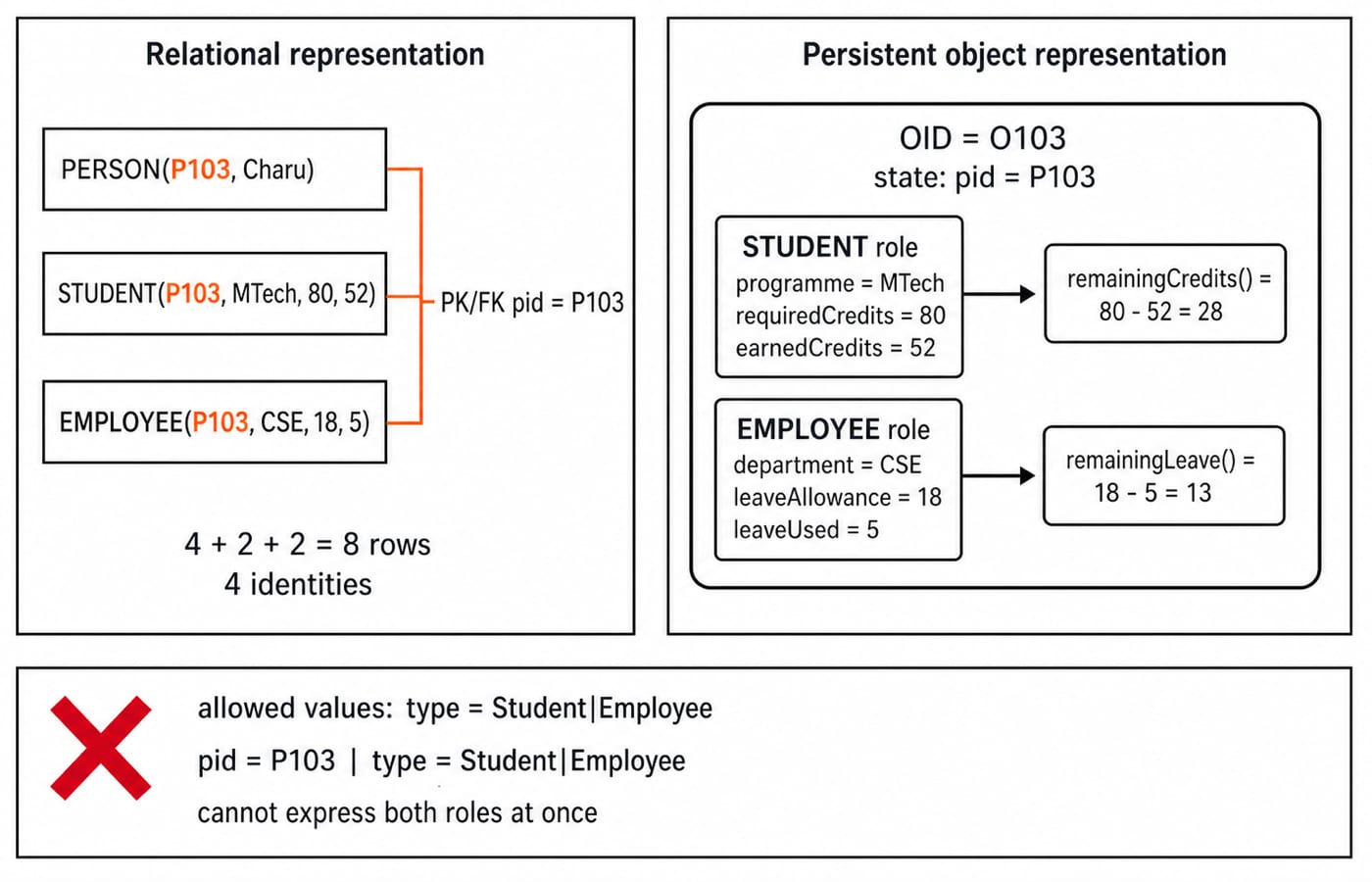
The safe superclass-plus-subclass mapping uses PERSON(pid PK, name) with 4 rows, STUDENT(pid PK/FK, programme, requiredCredits, earnedCredits) with 2, and EMPLOYEE(pid PK/FK, department, leaveAllowance, leaveUsed) with 2. That is 4+2+2=8 stored rows across three tables but only 4 person identities. P103 appears in all three through one key. The ER model to relational mapping guide covers the wider mapping rules.
Test alternatives against the actual values. One table with a single-valued type restricted to Student or Employee cannot encode P103 in both roles. Boolean flags can encode P103=(isStudent=1,isEmployee=1) and P104=(0,0), but role-specific columns become nullable. Subclass-only tables lose partial member P104 unless a separate superclass representation remains.
A foreign-key check also prevents a subclass row from pointing at a person that does not exist.
The object-oriented form can use persistent object OID=O103 with pid=P103, name=Charu, student component (MTech,80,52), employee component (CSE,18,5), and methods returning 28 and 13. Renaming Charu does not change identity O103. Object-oriented modelling associates behaviour with a type. It does not prove that method code is physically duplicated inside every object.
6. Relational, object-oriented, object-relational, and semi-structured models compared
model | primary unit | identity | behaviour | best fit for this example |
|---|---|---|---|---|
Relational | Tuple | Declared key | Queries or applications | Three linked relations |
Object-oriented | Object | Object identity | Class methods | One dual-role object |
Object-relational | Extended table | Keys or references | SQL plus type features | Richer typed tables |
Semi-structured | JSON record | Record identifier | Application logic | Flexible nested fields |
JSON may hold varying nested fields but does not enforce EER constraints. For P103, relations expose keys and joins; one object groups both roles; object-relational systems keep tables and SQL while adding user-defined types, collections, references, or inheritance.
No model always wins. Workload, queries, integrity, and support decide. Sound design avoids inconsistency, keeps queries understandable, and supports efficient access. These goals do not justify unexplained denormalised duplication.
7. Enhanced data model traps and how exams frame them
Fix the central traps in answer-first form:
Specialization is top-down; generalization is bottom-up; aggregation abstracts a relationship.
Overlap and total are independent.
A subclass member is a superclass member.
Shared subclass means intersection; category means union.
Object identity is not current attribute values.
Five checks from the values have direct answers: partial-overlapping; P103 is the only intersection member; union size 2+2-1=3; one discriminator cannot store both roles; renaming Charu leaves OID=O103 unchanged. For model choice, methods and complex state suggest an object model, but object databases do not always beat relational databases for structured analytical queries.
Exam questions in this area take a few recognisable forms: direction terminology, valid specialization operations, logical schema goals, and true or false statements on object databases. Work each form against your own values instead of memorising one drawing. Use DBMS interview questions for freshers for explanation-style practice.
8. Enhanced and specialized data models: the short version and next step
Use EER to express roles and constraints. Map it to relations when keys and joins define the logical design. Choose object-oriented or object-relational features when persistent identity, complex state, and associated behaviour carry real value. Our verdict is four people, three classified, and one overlapping member, so the hierarchy is partial-overlapping.
For a structured route through DBMS and the wider CS foundation, use Zero to Hero, Complete CS Course. Then redraw PERSON, recompute 2+2-1=3, map P103 into three relations, and explain in one sentence why aggregation is not specialization.
Keep learning
DBMS Data Models, Architecture and Components MCQs: 12 Solved Questions
Test whether you can separate data models, abstraction levels, catalogs, schemas and metadata. These 12 MCQs include concise explanations and a diagnostic review plan.
Updated 29 Oct 20267 min read158 viewsDBMS MCQs
Gaussian Mixture Models: Build Soft Clusters with EM Step by Step
See how a two-component GMM turns four observations into fractional memberships, then uses those responsibilities to update its weights, means, and variances.
Updated 1 Nov 20266 min readML & Data Science
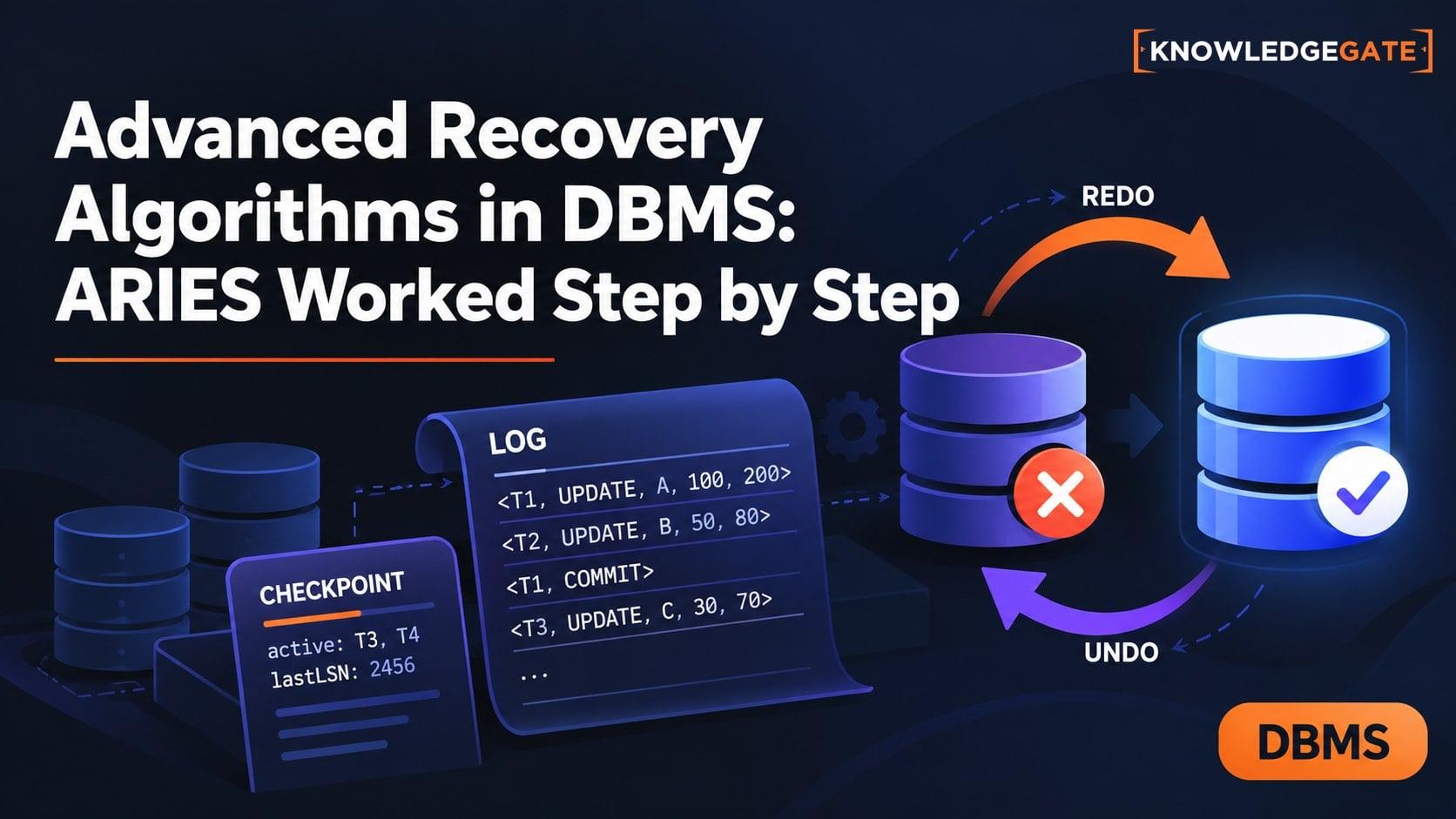
Advanced Recovery Algorithms in DBMS: ARIES Worked Step by Step
Work through one ARIES crash from checkpoint analysis to repeating history and logged undo. Every pageLSN, recLSN, loser transaction and CLR is traced.
Updated 30 Oct 20265 min readDBMS

Join Operations in DBMS: Inner, Left, Right and Full Outer Joins Worked Step by Step
Trace one pair of small tables through INNER, LEFT, RIGHT and FULL OUTER JOIN. See which unmatched rows survive, where NULL appears and how duplicate keys change counts.
Updated 30 Oct 20266 min read93 viewsDBMS