Encapsulation MCQs: 12 Solved OOP Questions with Explanations
Practise 12 real encapsulation questions and learn how to separate bundling, data hiding, abstraction, security, and the main OOP pillars.
KnowledgeGate Team
Exam prep & CS education
Updated 7 Aug 20267 min read

Encapsulation questions look easy because the familiar phrase is simply “bundling data and methods”. The difficulty begins when the options mix encapsulation with abstraction, data hiding, inheritance and security, and one wrong keyword map costs the mark. Four wordings do most of the damage: the bare definition, data hiding offered as a synonym, security offered as the benefit, and the three-pillar list. Two minutes on the refresher below settles all four, so every answer that follows is reasoned rather than remembered.
What Encapsulation Actually Means
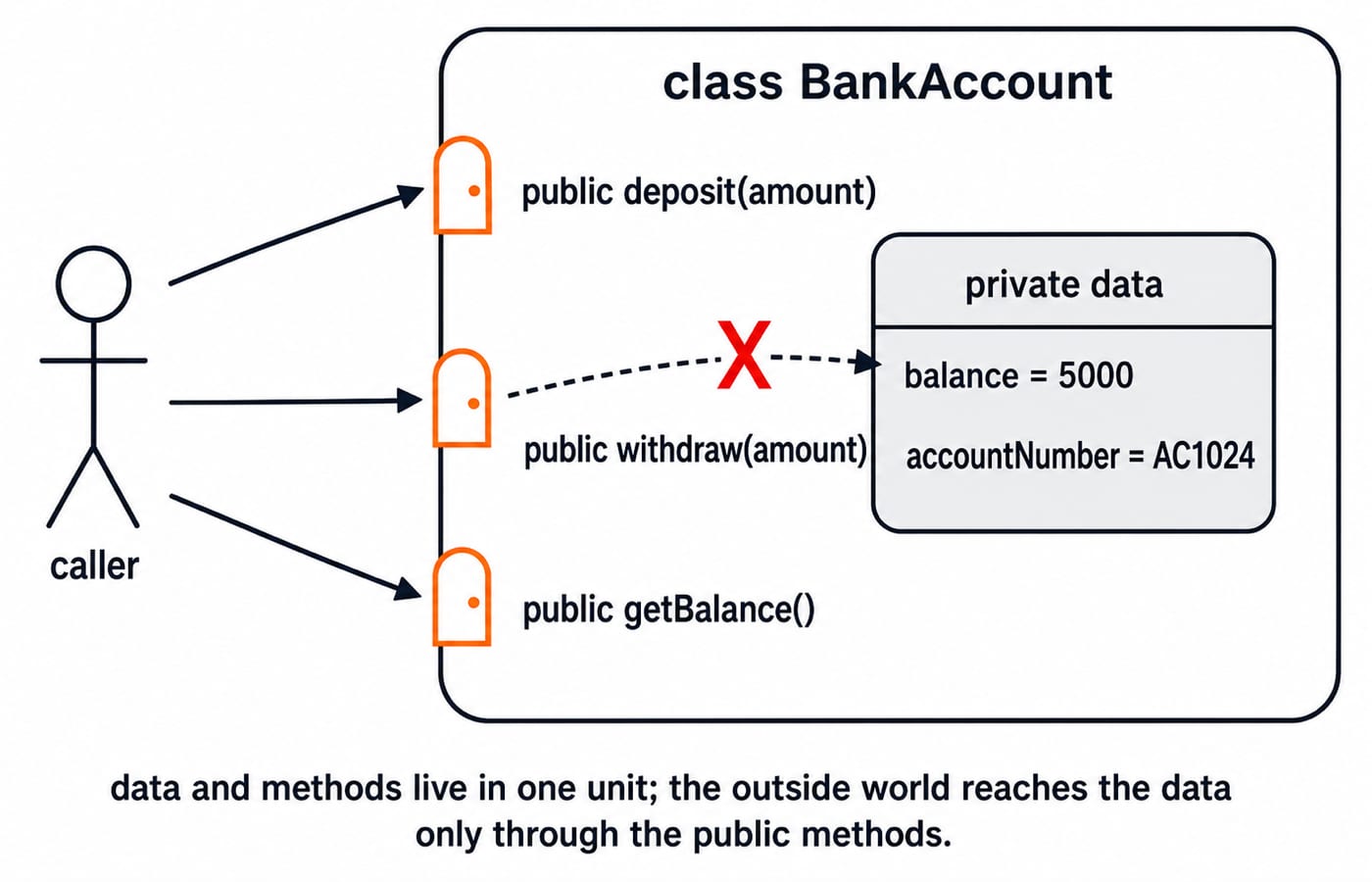
Encapsulation is the wrapping of data, meaning variables or fields, and the methods that operate on that data into one unit, usually a class. It also controls how code outside the class can reach that data.
Keep these three ideas separate:
Encapsulation packages data and methods together and restricts direct access. It tells you how state is organised and protected.
Data hiding is the access-control part of encapsulation. Private fields and public getters or setters are typical tools. Many MCQ keys use data hiding and encapsulation as interchangeable terms.
Abstraction hides implementation detail. It lets the user focus on what an object does without needing to know how it does it.
Consider a BankAccount class with private fields balance = 5000 and accountNumber = "AC1024". Outside code cannot directly set balance = -9999. It must call public methods such as deposit(amount), withdraw(amount), or getBalance(), and withdraw(amount) can reject an invalid debit. The data and the rules that protect it remain together inside one class.
Encapsulation MCQs 1 to 6: Definition and Keyword Questions
Q1. Which of the following refers to the wrapping of data and its functionality into a single individual entity?
A. Modularity
B. Abstraction
C. Encapsulation
D. More than one of the above
E. None of the above
Answer: C. Encapsulation
“Wrapping of data and its functionality into a single entity” is the textbook definition of encapsulation. Modularity splits a system into independent parts, while abstraction hides detail.
Q2. In object-oriented programming, by wrapping up characteristics and behavior into one unit, we achieve
A. Data abstraction
B. Data encapsulation
C. Data hiding
D. All of these
Answer: B. Data encapsulation
Characteristics are data, and behavior is methods. Wrapping both into one unit is data encapsulation. Data hiding is tempting, but it describes access restriction rather than the wrapping step.
Q3. What is encapsulation in OOP?
A. The ability to inherit properties from multiple classes
B. The process of creating objects
C. The bundling of data and methods that operate on the data
D. The use of abstract classes only
Answer: C. The bundling of data and methods that operate on the data
Option A describes inheritance, B describes instantiation, and D points towards abstraction. Option C gives the exact definition.
Q4. What is Encapsulation in Java?
A. The ability of one class to inherit the properties of another class.
B. The ability of an object to take many forms.
C. Integrating data (variables) and code (methods) into a single unit.
D. The ability to overload methods.
Answer: C. Integrating data (variables) and code (methods) into a single unit.
Option A is inheritance, B is polymorphism, and D is overloading. Encapsulation is the single-unit integration shown by the BankAccount model. If you are still building the Java foundation under this idea, the Java Course: Concepts, MCQs and Coding Questions runs Core and Advanced Java and carries its own object-oriented programming section.
Q5. Which of the following features of object-oriented programming is used to secure the data?
A. Inheritance
B. Polymorphism
C. Function overloading
D. Encapsulation
Answer: D. Encapsulation
Private fields with controlled public methods protect data, so encapsulation is the security-giving feature. Inheritance and polymorphism reuse or extend behavior, but they do not protect state.
Q6. What does encapsulation help to achieve in Object-Oriented Programming?
A. Code Reusability
B. Code Optimization
C. Security
D. Code Compilation
Answer: C. Security
This asks for the benefit rather than the definition. Reusability is strongly associated with inheritance, while encapsulation provides data security and protection.
Encapsulation MCQs 7 to 12: Hiding, Distinctions and Pillars
Q7. Encapsulation supports which concept?
A. Dynamic binding
B. Information hiding
C. Multiple inheritance
D. Method overloading
Answer: B. Information hiding
Encapsulation restricts direct access to internal state, which supports information hiding. Dynamic binding and overloading concern polymorphism, while multiple inheritance concerns inheritance.
Q8. Data hiding is otherwise known as
A. Polymorphism
B. Encapsulation
C. Inheritance
D. Abstraction
Answer: B. Encapsulation
Many exam keys treat data hiding and encapsulation as the same term because private fields are the visible face of encapsulation. For this wording, learn the expected key: data hiding means encapsulation.
Q9. Which OOP principle ensures that data cannot be accessed directly without defined methods?
A. Abstraction
B. Encapsulation
C. Polymorphism
D. Inheritance
Answer: B. Encapsulation
“Cannot be accessed directly” and “defined methods” describe encapsulation's gatekeeping. In the BankAccount model, withdraw() is the controlled route for changing balance.
Q10. Abstraction and encapsulation are fundamental principles that underlie the object oriented approach to software development. What can you say about the following two statements? I. Abstraction allows us to focus on what something does without considering the complexities of how it works. II. Encapsulation allows us to consider complex ideas while ignoring irrelevant detail that would confuse us.
A. Neither I nor II is correct.
B. Both I and II are correct.
C. Only II is correct.
D. Only I is correct.
Answer: D. Only I is correct.
Statement I correctly defines abstraction as focusing on what something does, not how it works. Statement II describes abstraction again because ignoring irrelevant detail is not the definition of encapsulation. Encapsulation means bundling plus access control, so only I is correct.
Q11. There are three main concepts that any language needs to support to be an object-oriented language. Which of the following is one of them? I. Encapsulation II. Inheritance III. Polymorphism
A. I and II
B. II and III
C. I and III
D. I, II and III
Answer: D. I, II and III
Encapsulation, inheritance, and polymorphism form the three pillars named here. Abstraction is often added as a fourth principle, but all three listed statements are correct, so the answer is D.
Q12. In C++, what does a class hold?
A. Array
B. Data
C. Data and functions
D. More than one of the above
E. None of the above
Answer: C. Data and functions
A class encapsulates data members and member functions. “Data” alone is the near-miss because it leaves out the methods half of the single unit.
The Traps These Questions Set
Encapsulation versus data hiding: The terms can be synonyms in an MCQ key, as Q8 shows, but data hiding is strictly the access-control part. If a stem says wrapping or bundling into one unit, choose encapsulation. If it says restricting direct access, inspect the offered terms carefully.
Encapsulation versus abstraction: Abstraction hides the how. Encapsulation binds and guards the data. Q10 becomes easy once that sentence is clear.
Benefit keyword swap: Encapsulation's headline benefit is security or data protection, as Q5 and Q6 show. Reusability is the familiar benefit of inheritance.
“More than one” or “All of these” bait: Choose a combined option only when every included statement is genuinely correct. Similar-sounding words are not enough.
How Exams Test Encapsulation
GATE-style papers, UGC NET, TCS or CoCubes placement rounds, and teaching-recruitment CS papers keep to three shapes: definition recognition, benefit keywords, and a “spot the wrong statement” item like Q10. Lock four maps in memory: bundling means encapsulation, data hiding can point to encapsulation, security is the main benefit, and encapsulation belongs with inheritance and polymorphism in the three-pillar list.
To meet these wordings in their original papers, work through the UP LT Grade CS encapsulation previous-year questions module. For the wider coding and DSA track these placement rounds draw on, use the Coding & DSA Courses for Placements category.
The Short Version and What To Practise Next
Encapsulation puts data and methods in one class, then makes outside code reach the data through controlled public methods. Its main benefit is security. Do not swap it with abstraction in Q10 or forget one of the three pillars in Q11.
For more solved practice in the same format, work through Graph MCQs: 10 Solved BFS, DFS, Connectivity (GATE), then take encapsulation into the other two pillars with OOPs Concepts in Java: Worked Interview Questions. After that, return to the OOP set and explain each answer without looking at the key. That is the quickest check that the keyword map is actually yours.
Keep learning

Ecosystem Fundamentals MCQs: 10 Solved Questions on Meaning and Ecological Organisation
Solve 10 ecosystem MCQs with clear explanations of ecological organisation, productivity, sustainability, environmental ethics, energy balance and conservation.
8 Sep 20268 min readMCQ Practice
Architectural and Component Design MCQs: 12 Solved Questions
Solve 12 bank MCQs on software architecture, component roles, repositories, MVC, DFDs, structure charts and UML, each with a direct worked explanation.
Updated 6 Sep 20268 min readMCQ Practice
C++ Constructors MCQs: 12 Solved Object-Initialization Questions
Solve 12 published C++ constructor questions by tracing object creation, copy semantics, arrays, access, virtual rules, and dynamic allocation.
Updated 5 Sep 20267 min readMCQ Practice
Clipping Algorithms MCQs: 11 Solved Cohen-Sutherland and Cyrus-Beck Questions
Solve 11 clipping questions with fresh explanations, checked outcodes, line classifications, boundary intersections and a practical revision routine.
Updated 3 Sep 20268 min readMCQ Practice