Classes and Objects MCQs: 12 Solved OOP Questions with Explanations
Solve 12 classes and objects MCQs, check each explanation, and use a worked Java trace to separate instance state, constructors, overloading and nested classes.
KnowledgeGate Team
Exam prep & CS education
20 Oct 20267 min read
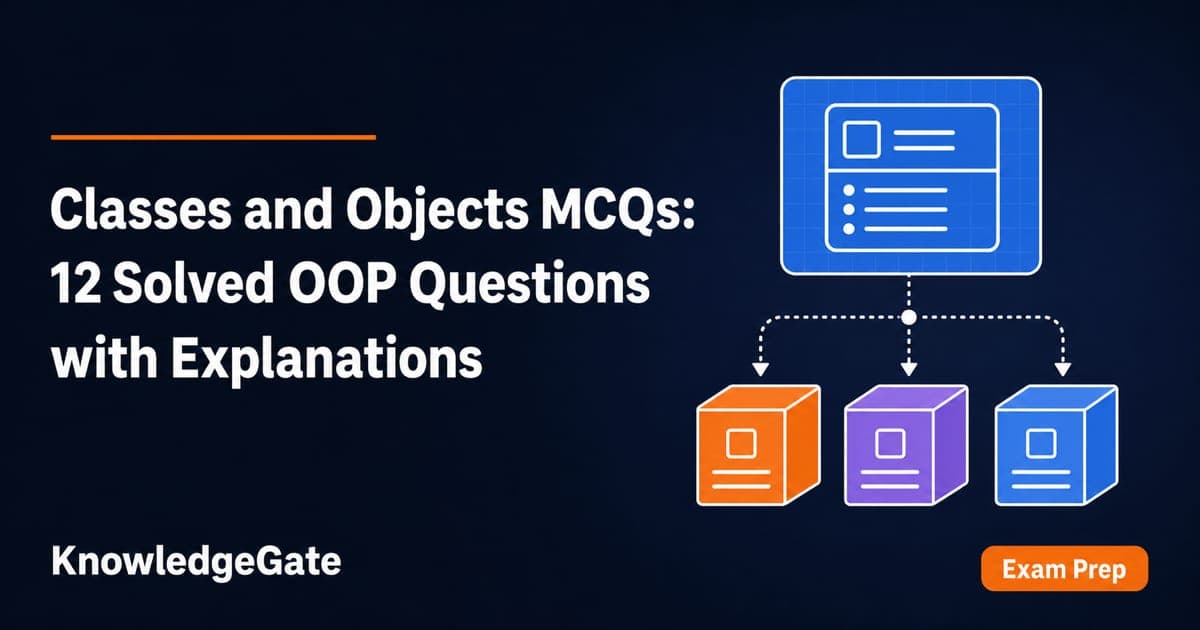
Common mix-ups include blueprint versus instance, constructor versus method, and static versus inner class. OOP language boundaries distinguish object-oriented concepts from language features. Find related practice under Coding & DSA Courses for Placements. Choose before reading each explanation.
Questions 1, 3 and 12 open the matching bank item. The remaining questions use the Class and Objects lesson hub because their public question pages do not currently resolve.
Classes and objects: the six distinctions to recall first
Distinction | What to remember |
|---|---|
Class | Blueprint for objects. |
Object | Runtime class instance. |
Instance field | Separate per object. |
Constructor | Initializes an object. |
Overloading | Same name, different parameters. |
Static nested class | Needs no enclosing object. |
new creates an instance; its constructor sets the starting state.
Student s1 = new Student("Meera", 82) and s2 = new Student("Arun", 74) share one class but hold separate state. Changing s1.score to 87 leaves s2.score at 74.
Classes and objects MCQs 1-4: methods, Java support and constructors
Question 1, Bihar STET 2025
In OOP, what is method overloading?
A. Creating multiple constructors
B. Using multiple inheritance
C. Defining multiple methods with the same name but different parameters
D. Inheriting multiple methods from a parent class
Correct answer: C.
Overloading keeps the name but changes the parameter list, as in deposit(int amount) and deposit(int amount, int bonus). The compiler selects a signature from the arguments. Constructors can be overloaded too, but A does not define method overloading.
Question 2, Beltron Programmer 2025
How does Java support application development in the Object-Oriented paradigm?
A. By compiling directly to machine code
B. By enabling multiple inheritance using classes
C. By providing features like classes, interfaces and inheritance
D. By using only functions without classes
Correct answer: C.
Java uses classes for object definitions, interfaces for contracts and inheritance for reuse. A class cannot extend multiple classes, although it may implement multiple interfaces. Therefore B is false, while A and D do not describe its object model.
Question 3, Beltron Programmer 2025
In the context of object-oriented programming, which of the following options accurately describes a constructor in a class?
A. A method that returns a value and must be explicitly called to initialize variables
B. A predefined static block executed before any method or field of the class
C. A member function that shares the class name and is automatically invoked during object creation
D. A special function used to allocate memory dynamically for class instances
Correct answer: C.
In Java and C++, a constructor shares the class name, has no ordinary return type and runs during object creation. In new Student("Meera", 82), allocation and initialization are related, but the constructor is not just a memory-allocation function. D is too broad.
Question 4, RSSB 2022
Match the following:
List I
(i) A method used to create an instantiation of a class
(ii) A signal that stops normal program execution
(iii) A graphical image usually stored in a file
(iv) Converting one type of value to another
List II
(a) Bitmap
(b) Type casting
(c) Exception
(d) Constructor
A. (i)-b, (ii)-c, (iii)-d, (iv)-a
B. (i)-c, (ii)-d, (iii)-b, (iv)-a
C. (i)-a, (ii)-b, (iii)-c, (iv)-d
D. (i)-d, (ii)-c, (iii)-a, (iv)-b
Correct answer: D.
Instantiation maps to constructor, disrupted flow to exception, a stored graphical image to bitmap, and value conversion to type casting. The tuple (i)-d, (ii)-c, (iii)-a, (iv)-b appears only in D. Check every match, not just one familiar pair.
Nested class MCQs 5-8: static, inner and anonymous classes
Question 5, UGC NET 2016
It is possible to define a class within a class termed as nested class. There are _____ types of nested classes.
A. 2
B. 3
C. 4
D. 5
Correct answer: A.
Java's broad split has two branches: static nested classes and non-static inner classes. Member, local and anonymous classes sit within the inner-class branch, explaining why you may recall a larger number. They are not extra peers.
Question 6, Hexaware 2024
Which statement is true about a static nested class?
A. You must have a reference to an instance of the enclosing class in order to instantiate it.
B. It does not have direct access to non-static members of the enclosing class.
C. Its variables and methods must be static.
D. It must extend the enclosing class.
Correct answer: B.
A static nested class has no implicit outer-object reference, so it cannot directly read an outer instance field. It may have instance members; nesting creates no inheritance. Outer.Nested n = new Outer.Nested() makes A false.
Question 7, Hexaware 2024
public class MyOuter {
    public static class MyInner {
        public static void foo() { }
    }
}
Which statement, if placed in a class other than MyOuter or MyInner, instantiates the nested class?
Assume no import statement for MyInner exists in that other class.
A. MyOuter.MyInner m = new MyOuter.MyInner();
B. MyOuter.MyInner mi = new MyInner();
C. MyOuter m = new MyOuter(); MyOuter.MyInner mi = m.new MyInner();
D. MyInner mi = new MyOuter.MyInner();
Correct answer: A.
Outside MyOuter without an import, both type and constructor need MyOuter.MyInner. Since MyInner is static, it needs no outer instance; m.new MyInner() is for a non-static inner class. B and D leave one use unqualified.
Question 8, Hexaware 2025
Which of the following correctly constructs an anonymous inner class instance?
A. Runnable r = new Runnable() { };
B. Runnable r = new Runnable(public void run() { });
C. Runnable r = new Runnable { public void run(){}};
D. System.out.println(new Runnable() {public void run() { }});
Correct answer: D.
The expression needs new Runnable() plus a class body implementing run(). D meets both conditions, and its object is valid for println(Object). A leaves run() unimplemented, B puts a method inside constructor parentheses, and C omits the parentheses.
OOP language MCQs 9-12: classification, modularity and concept boundaries
Question 9, UGC NET 2014
The pure object oriented programming language with extensive metadata available and modifiable at run time is
A. Small talk
B. C++
C. Java
D. Eiffel
Correct answer: A.
The intended language is Smalltalk, written as Small talk in the source option. Its object model and reflective environment fit pure object orientation and runtime-modifiable metadata. Java retains primitives and static members, while C++ is multi-paradigm.
Question 10, DSSSB 2023
Which of the following languages are object-oriented programming languages?
Languages:
i) LISP
ii) Java
iii) C++
iv) Simula
v) SQL
vi) C
A. i, ii, iii and iv only
B. ii, iii and iv only
C. i, ii, iii, iv, v and vi
D. i and ii only
Correct answer: B.
Here Java, C++ and Simula are object-oriented. LISP is primarily functional, SQL is a query language and C is procedural. The surviving indices are ii, iii and iv, so B follows. Multi-paradigm capabilities do not alter the intended classification.
Question 11, BPSC 2023
Among the following, which statement is correct about the modularity?
A. Modularity means hiding the parts of the program
B. Modularity refers to dividing a program into subsequent small modules or independent parts
C. It refers to overloading the program’s part
D. More than one of the above
E. None of the above
Correct answer: B.
Modularity divides a program into smaller units with clear responsibilities and interfaces. Hiding internals is information hiding, while overloading shares a name across distinguishable declarations. Only B defines modularity, so D cannot apply.
Question 12, BPSC 2024
Which among the following doesn’t come under OOP concept?
A. Data hiding
B. Platform independent
C. Message Passing
D. More than one of the above
E. None of the above
Correct answer: B.
Data hiding and message passing describe object-oriented state and interaction. Platform independence is an implementation or runtime property, not a defining OOP concept. Java combines both, creating the association trap behind B.
Classes and objects worked trace: one blueprint, two instances and one nested helper
Trace the output:
public class Account {
    static int objectsCreated = 0;
    int balance;

    Account(int opening) {
        balance = opening;
        objectsCreated++;
    }

    void deposit(int amount) { balance += amount; }
    void deposit(int amount, int bonus) { balance += amount + bonus; }

    static class Audit {
        static int doubled(int value) { return 2 * value; }
    }

    public static void main(String[] args) {
        Account a = new Account(1000);
        Account b = new Account(2500);
        a.deposit(500);
        b.deposit(200, 50);
        System.out.println(a.balance + " " + b.balance + " "
                + Account.objectsCreated + " " + Account.Audit.doubled(7));
    }
}
The output is 1500 2750 2 14.
a:1000 + 500 = 1500.b:2500 + 200 + 50 = 2750.Two constructor calls make
objectsCreated = 2.doubled(7) = 2 × 7 = 14; noAccountobject is needed.
Classes and objects traps these 12 MCQs expose
Trap | Where to revisit it |
|---|---|
Blueprint versus instance | Opening |
Overloading versus inheritance | Q1 |
Constructor versus allocation | Q3 and Q4 |
Static nested versus inner | Q5 to Q8 |
OOP concept versus language feature | Q9 to Q12 |
Classify each stem as definition, syntax, ownership or classification, then reject options that switch levels.
Use OOP for Teaching CS Exams: Classes and Inheritance to rebuild classes, independent object state and inheritance from worked examples. Then String Handling in Java: Pool, Immutability, Interview Questions carries object-state reasoning into reference identity and immutability. Constructors initialize objects, static nesting removes the outer-instance requirement, and platform independence remains a language or runtime property rather than an OOP concept.
Classes and objects: the next practice step
Use a three-pass retest. First, sort Q1-Q12 into definition, syntax, ownership or classification. Second, explain each rejected option in one sentence. Third, change the trace: set a's opening balance to 1200 and call b.deposit(300, 25); predict 1700 2825 2 14 before running it. For sequenced practice, use the Java Course: Concepts, MCQs & Coding Questions.
Keep learning
Programming Language Syntax MCQs: 12 Solved Questions on Grammar, Tokens and Semantics
Solve 12 MCQs on syntax, tokens, pseudocode, C grammar and runtime behaviour. Each explanation identifies the rule and applies it.
Updated 16 Oct 20268 min readProgramming Languages Survey

Imperative Programming Structure and Flow Control MCQs: 12 Solved Questions
Test whether you can trace changing state, choose the right loop, read a flowchart, and follow event-driven or exceptional control paths through 12 solved MCQs.
12 Oct 20267 min readProgramming Languages Survey
Static vs Dynamic Binding MCQs: 11 Solved Questions on Scope, Aliasing and Dispatch
Solve 11 binding questions from GATE and UGC NET papers by tracing lexical scope, runtime call chains, declared types and shared storage cells. Each answer shows why the tempting shortcuts fail.
Updated 8 Oct 20267 min readProgramming Languages Survey
TypeScript vs C# Typing: Structural Compatibility, Nominal Identity, Generics and Runtime Checks
Follow one User/Admin example through TypeScript and C# to predict assignments, generic conversions, branded IDs, and JSON behaviour at runtime.
Updated 3 Oct 20266 min readProgramming Languages Survey