eLitmus pH Test: The Percentile System, Negative Marking, and the Hard DI Section
A practical guide to reading an eLitmus percentile, controlling attempts under negative marking, and preparing for the DI-heavy Problem Solving section.
KnowledgeGate Team
Exam prep & CS education
Updated 22 Jul 20266 min read

You have an eLitmus pH test coming up, but two parts of the result still feel unclear. A percentile sounds like a percentage until you see the scorecard, and every senior warns you not to guess without explaining the damage. Both come back to the same fact: the pH score is a rank against everyone else who sat the paper, not marks out of a total, so a wrong answer costs you position and not only marks. The Data Interpretation sets are usually where that position is won or lost.
eLitmus pH test: what it is and which sections it tests
The eLitmus pH test is a hiring assessment that companies can use to shortlist candidates. Its broad sections are Quantitative Aptitude, Verbal Ability, and Problem Solving. The last of these carries the demanding Data Interpretation and logic sets that many candidates find harder to manage under time pressure.
Do not treat every employability test as the same paper with a different logo. Platforms vary in their modules, score reporting, difficulty, and the way employers use results. The full AMCAT, CoCubes and eLitmus comparison helps you place the pH test beside its closest alternatives. If AMCAT is also on your list, the AMCAT exam modules guide shows the contrast in preparation more closely.
Exact section marks, test duration, and scoring rules can change. Read the current instructions on the official eLitmus site and in your test communication before building a mock strategy around any fixed figure.
The percentile system, explained with a worked illustration
A percentage answers, "What fraction of the available marks did I earn?" A percentile answers, "How did I rank against the other candidates?" These are different measurements.
Suppose, purely as an illustration, that 10,000 candidates take the test. In Quant, 900 candidates score higher than you.
Total candidates = 10,000.
Candidates not above your score = 10,000 - 900 = 9,100.
Relative position = 9,100 / 10,000 = 0.91.
Illustrative percentile = 0.91 x 100 = about 91.
You can therefore describe the result as roughly the 91st percentile. The exact platform calculation may handle ties and ranking details differently, but the central idea remains: this is a comparison with the cohort, not marks out of 100.
Section percentiles matter separately. A recruiter can care about balanced performance and look for strength in each section, rather than only one combined result. A candidate with excellent Quant and a weak Problem Solving percentile may therefore look different from a candidate whose three section percentiles are consistently strong.
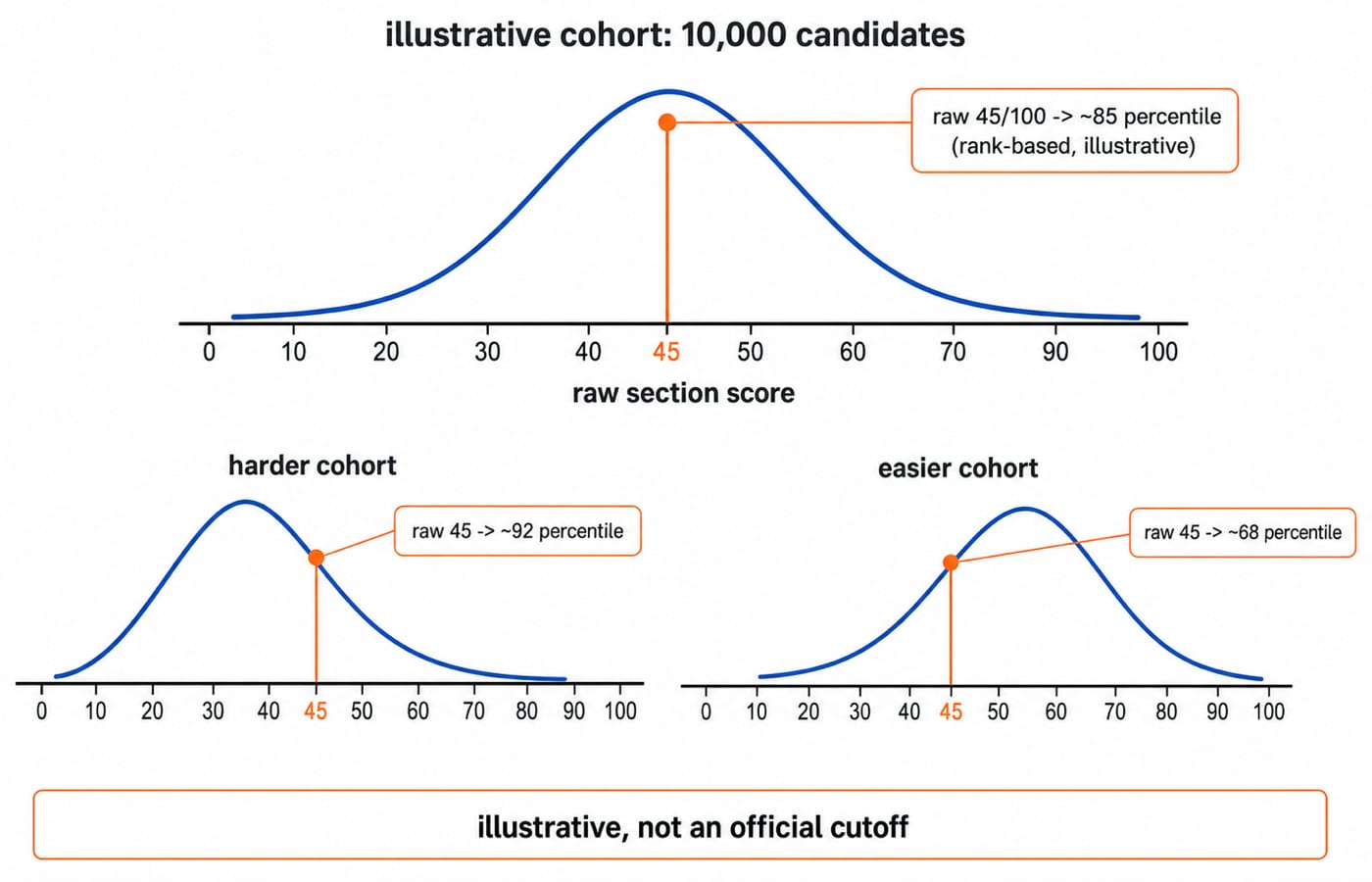
Raw marks alone cannot tell you the percentile. An illustrative raw score of 45 out of 100 might map to about the 85th percentile when a section is difficult for the cohort. The same raw score might map much lower when most candidates find the section easy. Likewise, 70 raw marks do not guarantee an exceptional percentile. Rank depends on the full score distribution.
Negative marking, and why blind guessing sinks you
When wrong answers carry a deduction, attempting every question is not automatically brave or efficient. An extra attempt is useful only when the probability of being correct justifies the downside.
Take five multiple-choice questions with four options each. If you know nothing and choose randomly, the chance of a correct answer is 1/4 and the chance of a wrong answer is 3/4.
Expected correct answers = 5 x 1/4 = 1.25.
Expected wrong answers = 5 x 3/4 = 3.75.
Check: 1.25 + 3.75 = 5 total attempts.
Now put a penalty on each wrong answer. If a correct answer earns one scoring unit and a wrong answer loses p units, the expected result is:
1.25 - 3.75p
That expectation becomes negative whenever p is greater than 1/3. For example, at an illustrative penalty of 0.5 unit, the expected result is 1.25 - (3.75 x 0.5) = 1.25 - 1.875 = -0.625 unit, so five blind guesses cost you more than half a mark. One-third is the number to remember: put the deduction your own test actually applies into that expression, and you know at once whether a blind attempt is worth making.
The practical response is selective attempting. If you eliminate two options in a four-option question, your probability changes materially. If you cannot eliminate anything, flag it and move. Accuracy beats impressive-looking attempt counts.
The hard DI and Problem Solving section
Problem Solving is where dense Data Interpretation, multi-condition logic, and unfamiliar set formats can consume time. A set may use a table, chart, or several linked statements, then ask multiple questions from the same information. Cryptarithmetic and logic puzzles add another layer because they demand structure before calculation.
Use three rules:
Scan the complete set first. Identify what is given, what must be derived, and whether the sub-questions share useful calculations.
Set a time boundary. A difficult set should not be allowed to take the time meant for several clearer questions.
Abandon without guilt. If two careful passes produce no useful entry, leave the set and return only if time remains.
The goal is not to defeat the hardest set in the paper. It is to collect the most reliable score from the paper you receive.
Quant and Verbal, briefly
Quant preparation should cover arithmetic, number theory, probability, permutations, and geometry basics. Do not stop at formula recall. Mixed practice teaches you which method to choose when the chapter name is not printed above the question.
Verbal preparation needs reading comprehension, grammar, and vocabulary in context. Read for the writer's claim, tone, and evidence rather than matching isolated words from the passage.
For volume practice, KnowledgeGate's question bank carries about 8,000 quantitative-aptitude questions you can use for Quant and DI drilling. Work through them to diagnose error types: concept gap, calculation error, poor selection, or time pressure. Only the first of those is fixed by reading more theory.
How to prepare and target section percentiles
Start with untimed Quant accuracy. Once you can explain why each answer is correct, add timed DI sets and record both completion time and accuracy. Then move to full mocks using the current negative-marking rule. This order builds skill before it tests discipline.
A simple review sheet needs four columns: section, attempted, correct, and reason for every wrong or skipped question. After three mocks, patterns appear. You may discover that your percentile problem is not weak mathematics but staying too long on one DI set.
Set the target section by section rather than as one overall number. Each section carries its own percentile, so a strong showing built almost entirely on Quant can still read as unbalanced. Decide in advance the lowest percentile you are willing to accept in your weakest section, and protect the practice time that section needs before you spend anything extra on your strongest one.
The Placement Preparation category helps place eLitmus work alongside aptitude, company tests, and interview preparation. It is useful when eLitmus is one stage of a wider placement season.
The short version and next step
Percentile is rank, not marks. Wrong answers can make blind coverage costly, and the DI-heavy Problem Solving section rewards set selection as much as raw ability. Build Quant accuracy, practise timed DI, and rehearse selective attempts in full mocks.
For a structured track, use the eLitmus Preparation Course. Before the real test, confirm the exact marks, duration, and deduction ratio on the official eLitmus website, then make your final attempt plan from those current rules.
Keep learning

Resume Checklist: What Must Be Included and What Must Be Left Out
3 Oct 20264 min readPlacement Preparation
LDAP Explained: DNs, Bind, Search Filters, and a Developer Login Flow
Build one LDAP mental model from directory tree to login. Trace a service bind, escaped user search, password-verifying user bind, and group-based role check.
Updated 13 Aug 20265 min readPlacement Preparation

Group Discussion Rounds for Placements: How GD Is Scored and How to Prepare Topics
Speaking more is not the same as scoring more in a GD. Learn what panels observe, how to prepare topic notes, and how to practise useful contributions.
11 Aug 20266 min readPlacement Preparation

Off-Campus Placement Strategy for 2026 Graduates: Drives, Portals and Referrals That Work
Turn off-campus hiring into a weekly operating system that keeps drives, portals, referrals, follow-ups, and skill preparation moving together.
9 Aug 20267 min readPlacement Preparation