Construct a Binary Tree from Traversals
Use inorder splits and preorder roots to rebuild a binary tree, then learn the BST shortcut and the cases where traversal data is not unique.
KnowledgeGate Team
Exam prep & CS education
Updated 20 Jul 20265 min read
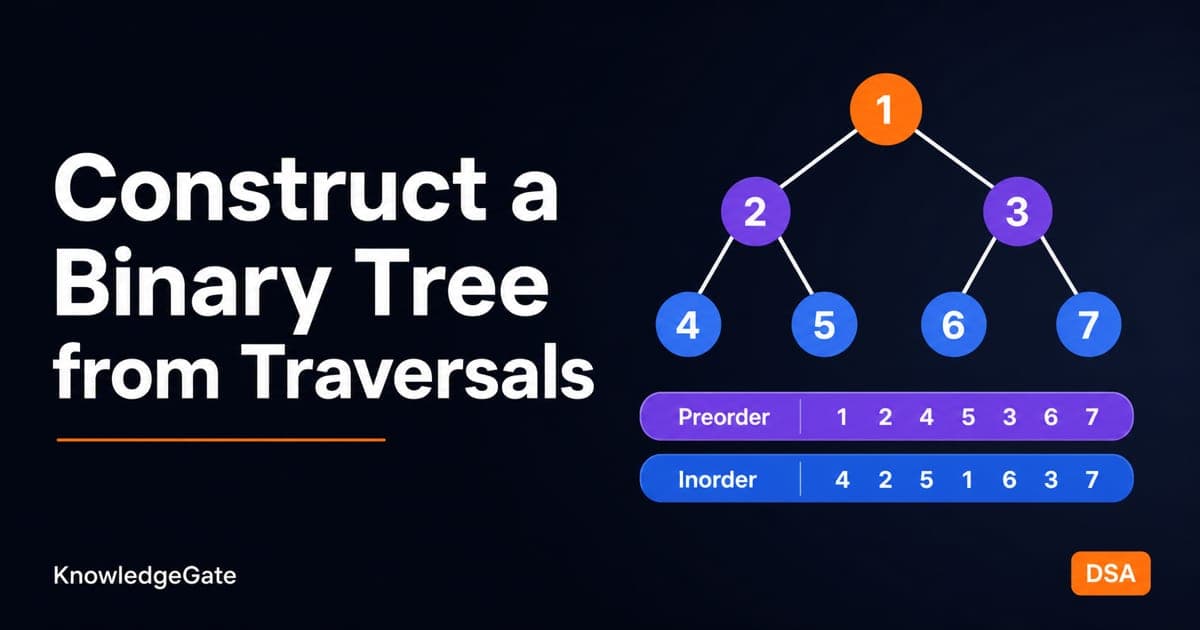
Traversal reconstruction questions reward a fixed procedure, not a lucky sketch. Find the root, split the inorder sequence, and recurse on the two pieces. If you preserve the segment boundaries, left and right subtrees cannot get mixed.
One question comes before any of that: does the given traversal pair determine a unique tree at all?
Related reading: tree traversal MCQs and binary search trees.
Which traversal pairs determine a unique binary tree?
Assume all node labels are distinct. A general binary tree is uniquely determined by these pairs:
Given traversals | Unique general binary tree? | Reason |
|---|---|---|
Inorder + preorder | Yes | Preorder gives each root; inorder splits left and right |
Inorder + postorder | Yes | Postorder gives each root; inorder splits left and right |
Inorder + level order | Yes | Earliest level-order node in each inorder segment is its root |
Preorder + postorder | No, in general | A single child may be left or right |
Preorder + postorder for a full tree | Yes | Every internal node has two children, removing the single-child ambiguity |
Inorder is the indispensable traversal in the first three pairs because it places the entire left subtree before the root and the entire right subtree after it. Preorder identifies a root before its descendants. Postorder identifies it after its descendants. Together with the inorder split, either supplies all the recursive boundaries.
Why do preorder and postorder fail for a general tree? Preorder A, B and postorder B, A describe both a tree where B is A's left child and one where B is A's right child. Neither traversal records the missing side.
For a wider revision of terminology and properties, see binary trees and binary search trees.
Worked reconstruction from preorder and inorder
Given:
Preorder: D, B, A, C, F, E, G
Inorder:  A, B, C, D, E, F, G
There are seven distinct nodes. Rebuild the tree step by step.
Step 1: choose the overall root. The first preorder element is D, so D is the root. In inorder, everything left of D belongs to the left subtree and everything right belongs to the right subtree:
Left inorder:  A, B, C
Root:          D
Right inorder: E, F, G
The left segment has three nodes, so the next three preorder elements form the left subtree's preorder. The remaining three form the right subtree's preorder:
Left preorder:  B, A, C
Right preorder: F, E, G
Step 2: build the left subtree. Its first preorder element is B. Splitting left inorder A, B, C around B gives A on the left and C on the right. Therefore A is B's left child and C is B's right child.
Step 3: build the right subtree. Its first preorder element is F. Splitting right inorder E, F, G around F gives E on the left and G on the right. Therefore E is F's left child and G is F's right child.
The final tree is:
        D
      /   \
     B     F
    / \   / \
   A   C E   G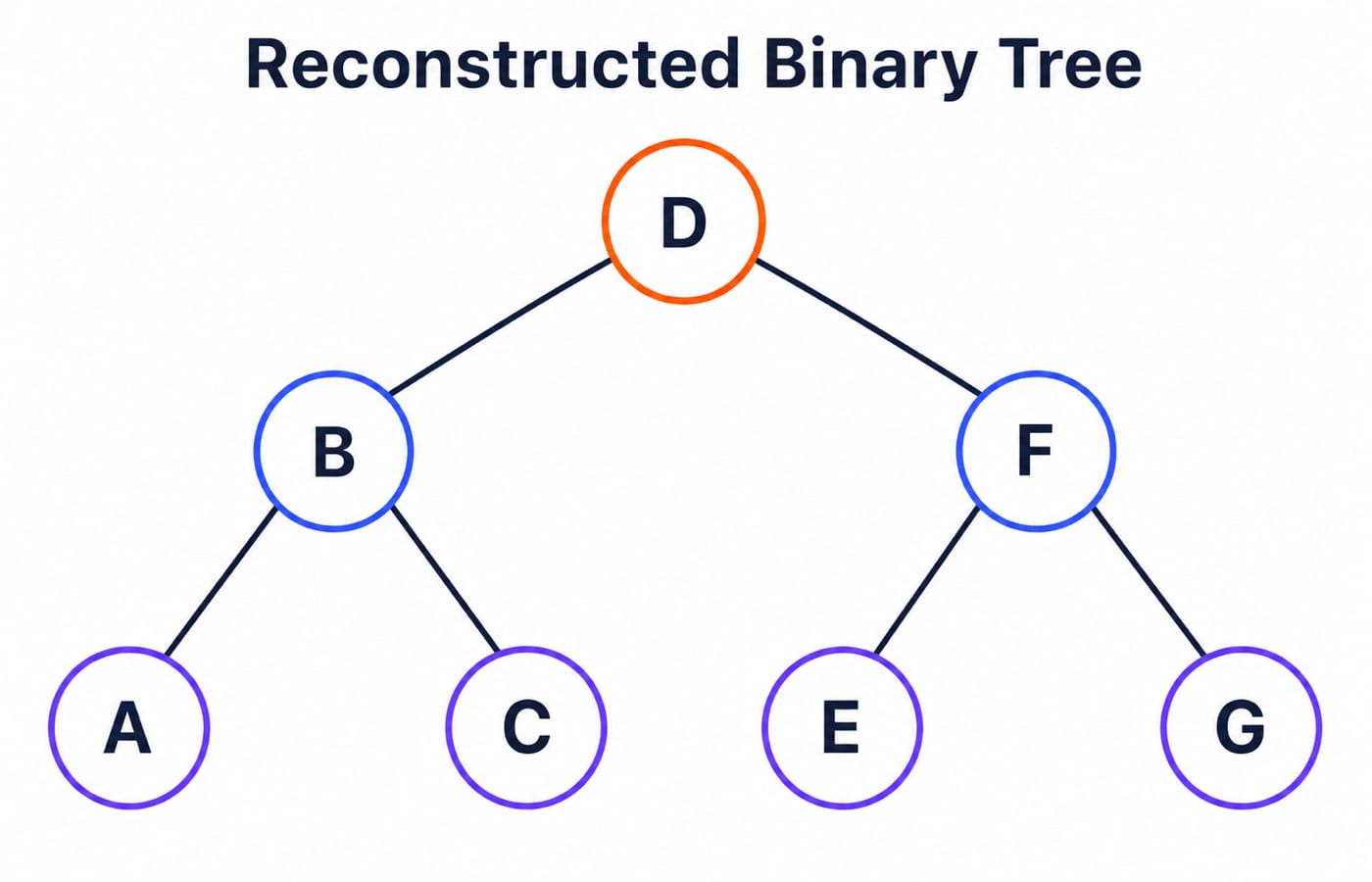
Verify the result twice. Its preorder is root, left, right: D, B, A, C, F, E, G. Its inorder is left, root, right: A, B, C, D, E, F, G. Both exactly match the input.
An implementation can use an inorder index map so each root position is found in constant time. With careful segment indices, the full reconstruction then takes linear time. In a hand-solved question, writing the paired segments gives the same protection against boundary mistakes.
The BST shortcut: preorder alone can be enough
A binary search tree adds an ordering rule: every key in the left subtree is smaller than the root, and every key in the right subtree is larger. For distinct keys, its inorder traversal is therefore the sorted key sequence. That means preorder alone determines the BST.
Take this preorder:
40, 30, 20, 35, 60, 50, 70Start with root 40. Values below 40, 30, 20, 35, form the left-subtree segment. Values above 40, 60, 50, 70, form the right-subtree segment. In the left segment, 30 is the root, with 20 below it and 35 above it. In the right segment, 60 is the root, with 50 below it and 70 above it.
The result has 40 at the root; children 30 and 60; and leaves 20, 35, 50, and 70. Its sorted inorder is 20, 30, 35, 40, 50, 60, 70, confirming the BST property.
The shortcut depends on the BST ordering rule. Preorder alone does not uniquely identify an unrestricted binary tree. Practise that distinction with the tree-focused data structures questions.
Counting trees when only one traversal is given
If a fixed preorder, postorder, or inorder sequence of n distinct labels is the only information, the number of possible binary-tree structures is the nth Catalan number:
C_n = (1 / (n + 1)) x binomial(2n, n)For n = 3:
C_3 = (1 / 4) x binomial(6, 3)
    = (1 / 4) x 20
    = 5
So one traversal of three distinct nodes is consistent with five binary-tree structures. The labels occupy each structure in the order required by the given traversal. The number of BSTs on three distinct keys is also five, but the constraint doing the work is different: there the ordering rule decides which key sits at each position, while here the given traversal does. Same count, different reason.
How GATE tests traversal reconstruction
Questions may ask for the root of a subtree, a node's parent, the resulting postorder, or the number of possible trees. The most common traps are assuming preorder plus postorder is always unique, consuming the wrong number of preorder items for a subtree, and applying the BST shortcut to an ordinary binary tree.
Duplicate labels need extra information because locating a root value in inorder may no longer give a unique split. Unless a question defines duplicate handling, the standard reconstruction result assumes distinct labels.
When a question carries more nodes than you can track in your head, write index positions above the inorder sequence. The segment sizes then come straight off the indices, left size equals root index minus segment start, instead of a recount. Use the GATE CS preparation category to place tree reconstruction within the larger preparation plan.
The short version
Use preorder or postorder to select a root, use inorder to divide left from right, and recurse with matching segment sizes. Preorder plus postorder is not enough for a general tree, but it works for a full tree. For a BST with distinct keys, preorder alone works because inorder is sorted.
After rebuilding the worked tree without looking, use the GATE Test Series for timed traversal and counting questions. Verify every answer by generating the traversals from your final tree.
Keep learning
Tree Data Structure: Types, Traversals and a Worked BST Example
Build one nine-node binary search tree, classify its shape, trace four traversals, and work through insertion, search, deletion and complexity checks.
Updated 21 Oct 20266 min readDSA & Algorithms
Graphs in Data Structures: Complete Guide with BFS, DFS and Dijkstra Worked Examples
Learn graph terminology, representations and algorithm selection by tracing one unweighted graph with BFS and DFS, then solving a weighted graph with Dijkstra.
Updated 17 Oct 20266 min readDSA & Algorithms

Physical Security and Cryptography Basics: Controls, Keys and Worked Examples
Learn how physical and cryptographic controls work together, then apply them in a four-asset server-room model and a step-by-step toy RSA example.
Updated 13 Oct 20265 min readDSA & Algorithms

Stack Data Structure: Operations, Applications and Worked Examples
Build a stack from its LIFO rule, trace array and linked-list operations, evaluate a postfix expression, and practise recursion, applications, and common traps.
Updated 8 Oct 20265 min readDSA & Algorithms