

Character Pointer and String Interview Questions in C: Answers with Memory Traces
Prepare clear C interview answers about character pointers, strings, array decay, const, lifetime, capacity, and operator precedence using exact memory traces.
KnowledgeGate Team
Exam prep & CS education
Updated 21 Nov 20265 min read
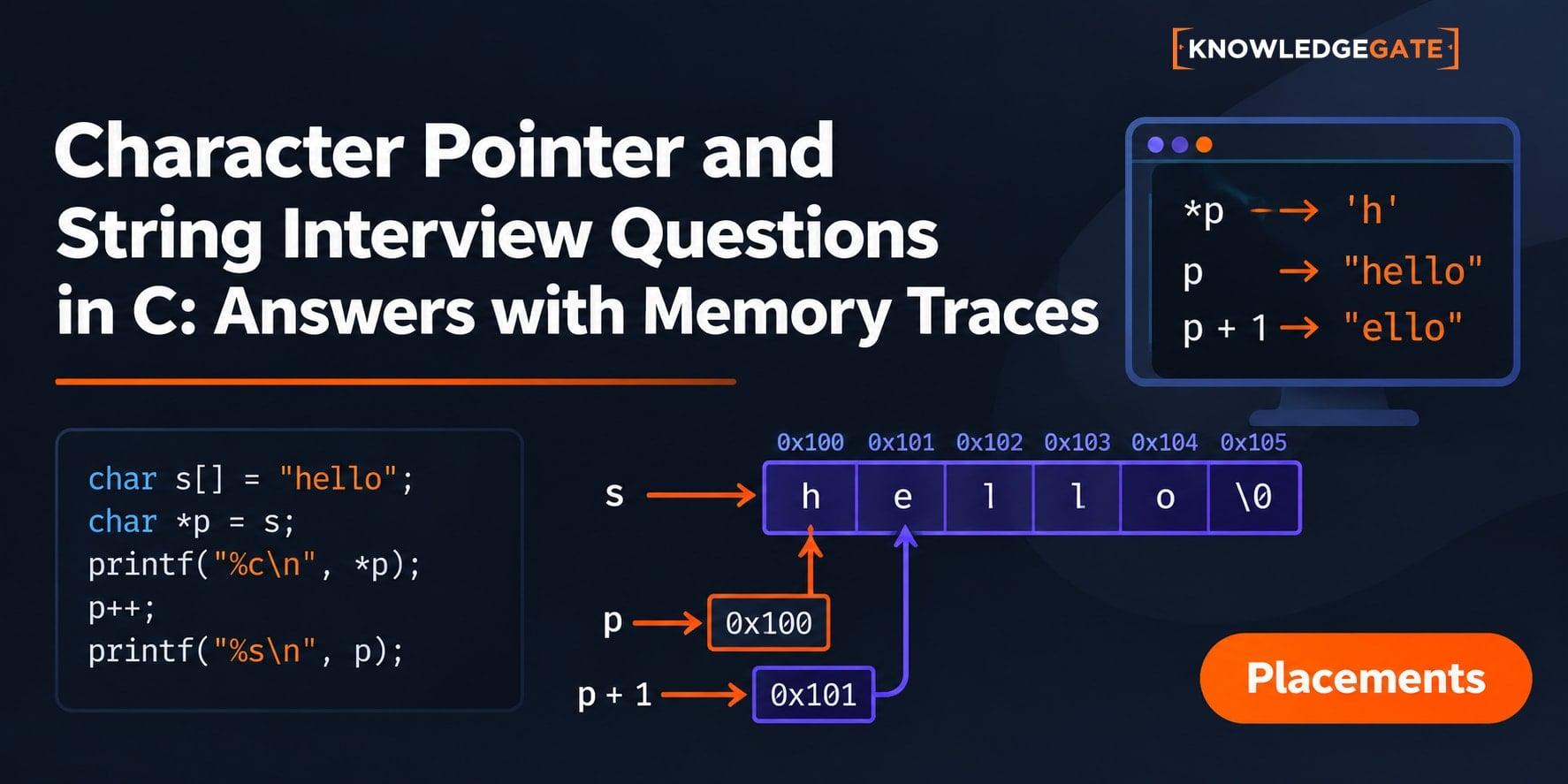
In a short C program, char *p, char text[], a string literal, and a null terminator can look interchangeable. They differ in ownership, modifiability, lifetime, and what sizeof measures. In a writable array, word changes from CODE to COAE at pointer offset 1, with lengths 4 and 3; operator precedence changes abc to acc.
Character pointers and C strings: the precise interview definition
What is a string in C? A C string is a sequence of char values terminated by the first \0; C has no separate built-in string type. char text[] = "CAT"; has four elements: 'C', 'A', 'T', and '\0'. Thus strlen(text) is 3, while sizeof text is 4 in the declaring scope.
Declaration | What exists | Characters changeable? | Pointer retargetable? |
|---|---|---|---|
| A writable four-element array | Yes | No pointer exists |
| A pointer to a literal | Not through | Yes |
| A pointer into the writable array | Yes | Yes |
An array may decay to a pointer but is not one. See Strings in C: Declaration, Input & Worked Examples for declaration and input foundations.
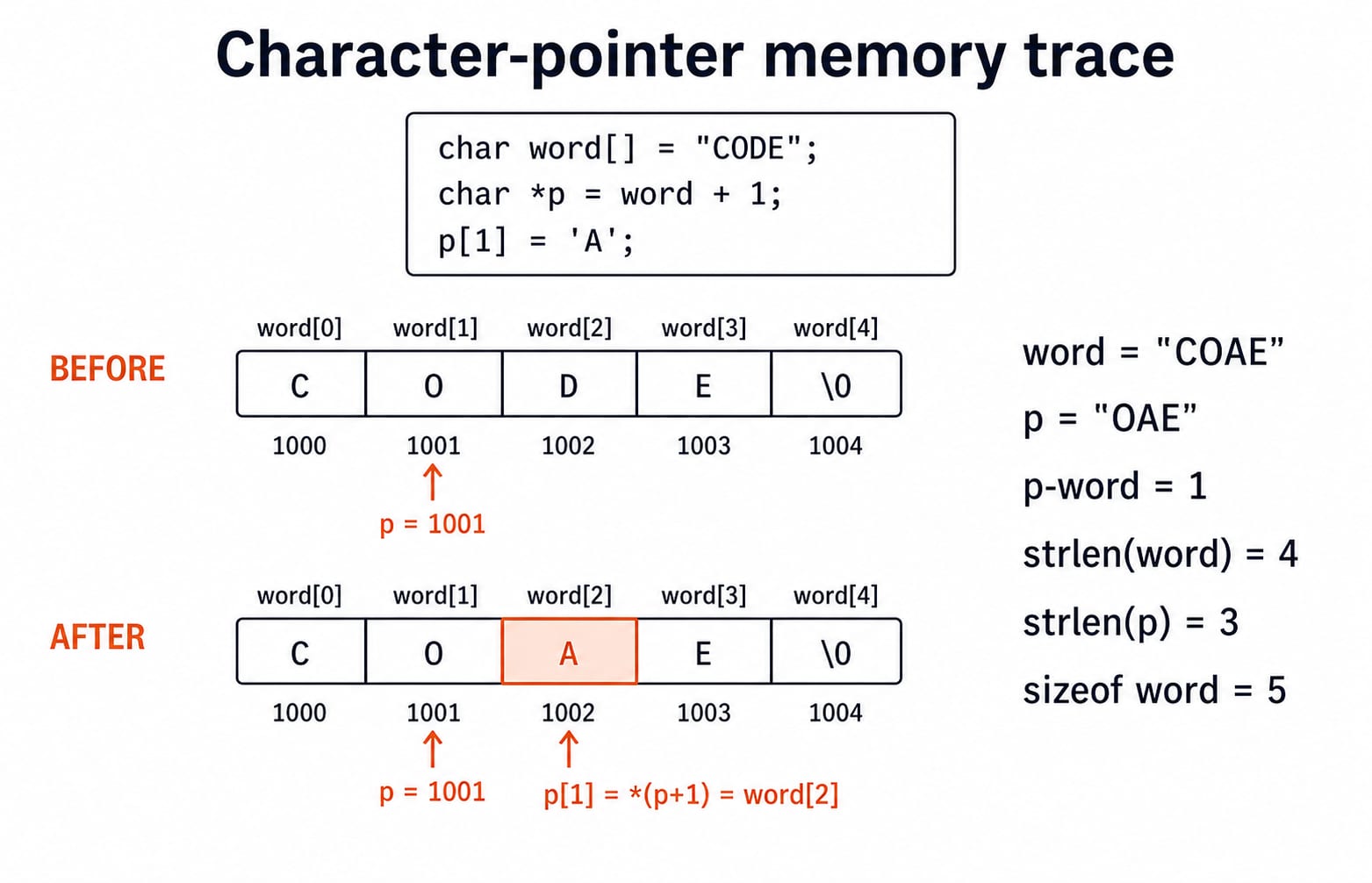
Character-pointer memory trace: work CODE into COAE
Consider a writable array:
char word[] = "CODE";
char *p = word + 1;
p[1] = 'A';
word[0] through word[4], at conceptual addresses 1000 through 1004, hold 'C', 'O', 'D', 'E', and '\0'. p stores 1001 and points at 'O'.
p[1] is *(p + 1), one char step to 1002 (word[2]). Replacing 'D' with 'A' makes "COAE".
Afterwards, *p is 'O' and p - word is 1 element. word prints COAE; p from word[1] prints OAE. Terminator distances give strlen(word) = 4 and strlen(p) = 3. Five cells give sizeof word = 5.
The addresses are invented; one-byte increments follow sizeof(char) = 1. Mutation is valid because word is an array copy, not a literal.
String literals, modifiability, and lifetime: three model answers
Can I modify a string through char *p? Only if its target is writable. char a[] = "CAT"; a[0] = 'B'; validly produces "BAT". char *p = "CAT"; p[0] = 'B'; tries to modify a literal, causing undefined behaviour. Otherwise, use const char *p = "CAT";.
How long does the pointed string live? It follows the target object. A literal has static storage duration, so const char *label(void) { return "OK"; } may return its pointer. Automatic char temp[] = "OK"; expires when its function returns; returning temp leaves a dangling pointer. A pointer never extends its target's lifetime.
Does const char *p make the pointer constant? No. It prevents modification through p, not retargeting. char *const p = buffer cannot be retargeted. const char *const p = "CAT" permits neither operation.
sizeof, strlen, NULL, and array decay: exact output answers
Assume a 64-bit platform with sizeof(char *) = 8, then declare char desk[] = "desk"; const char *view = desk;. The elements d, e, s, k, and \0 give sizeof desk = 5 and strlen(desk) = 4. Because view is a pointer, sizeof view = 8; its four visible characters give strlen(view) = 4. Pointer size is implementation-dependent, while sizeof(char) is always 1.
void inspect(char s[]) adjusts the parameter to char *s. Under our assumption, sizeof s is 8, not the caller's array capacity. Pass length or capacity explicitly. Arrays and Strings in C: Decay, sizeof and 2D Addresses develops this rule.
NULL represents a null pointer constant; \0 is the integer-zero character terminating a C string. A null pointer targets no object. A pointer to "" is non-null and targets an array beginning with \0.
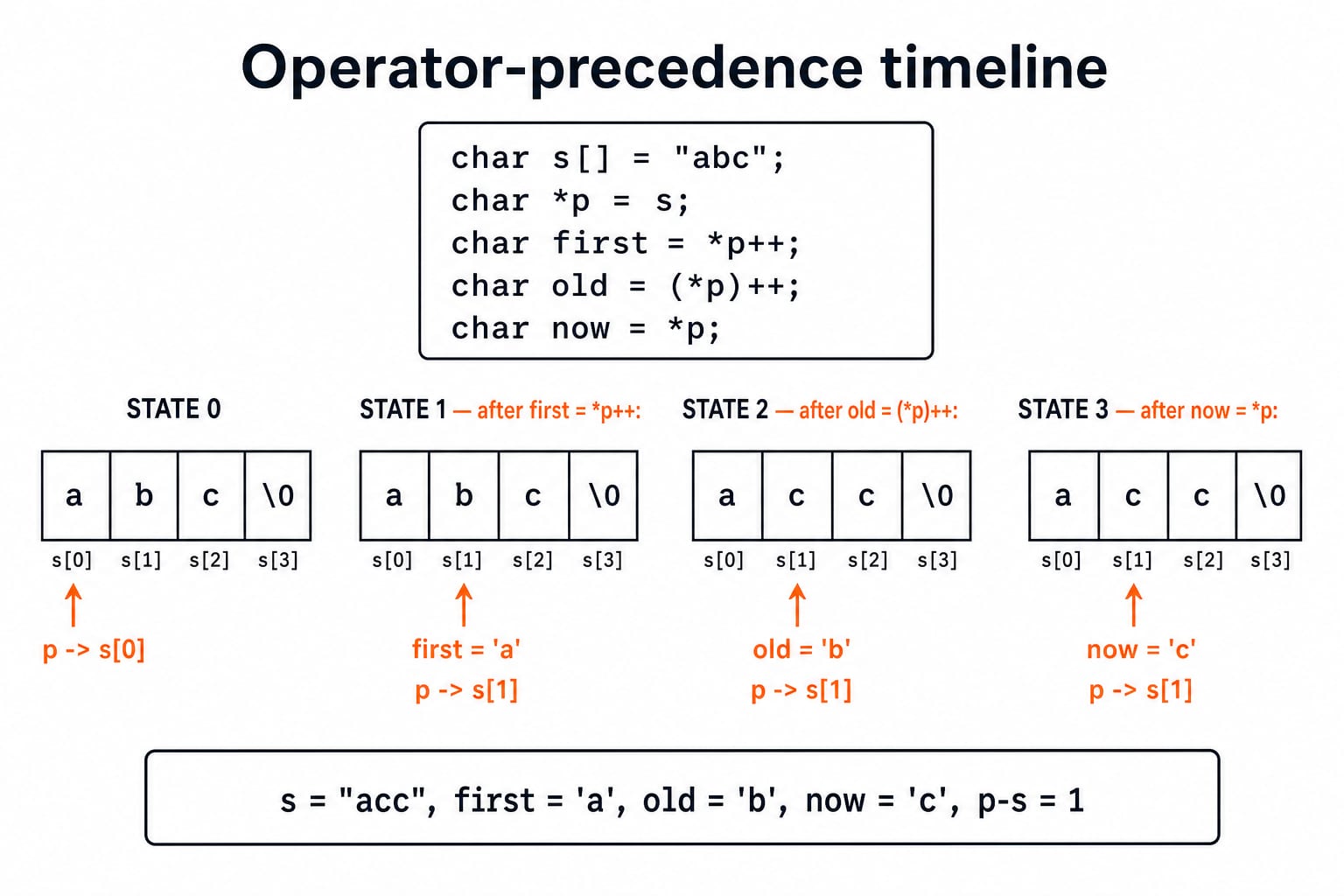
Pointer-operator precedence: trace abc into acc
Parse each expression before assigning its value:
char s[] = "abc";
char *p = s;
char first = *p++;
char old = (*p)++;
char now = *p;
Postfix ++ binds more tightly than unary *, so *p++ means *(p++). It stores 'a' in first, then moves p from s[0] to s[1]; the array stays "abc".
Parentheses change the next operation. (*p)++ stores the old value 'b' in old, then increments it to 'c' without moving p. The array becomes "acc", p remains at s[1], now = *p stores 'c', and p - s = 1.
Checksum: first = 'a', old = 'b', now = 'c', s = "acc", pointer offset 1.
Independent expression | Parse and effect |
|---|---|
|
|
| Increment the pointed character; do not move the pointer |
| Advance the pointer first, then dereference it |
Each row is independent.
Safe string-function design: ownership, capacity, and termination
What should a safe copy function receive? int copy_text(char *dst, size_t capacity, const char *src) accepts writable dst, read-only src, and capacity including \0. Failure must be defined so dst never overflows.
With char dst[6], "CODE" has strlen(src) = 4, needs 4 + 1 = 5 bytes, and fits. "POINTER" has strlen(src) = 7 and needs 7 + 1 = 8 bytes, exceeding six. The function fails without changing dst; it truncates only if its contract promises that.
Check destination writability, capacity, lifetimes, terminator space, overlap policy, and returned-pointer lifetime. For char *dst, sizeof dst reports pointer size, not capacity.
Character-pointer interview traps and how the questioning deepens
Tempting answer | What goes wrong | Correct answer |
|---|---|---|
Array equals pointer | Object and conversion differ | An array may decay, but is not a pointer |
Literal is writable | Modification is undefined | Use |
Allocate | No room for | Add one byte |
Compare text with | It compares addresses | Compare characters |
Return a local array | It expires | Return longer-lived storage |
Parameter | It measures a pointer | Pass capacity |
| Pointer and character differ | Use |
Interview questioning can start with definitions and output, then combine sizeof versus strlen, literal safety, const-correct APIs, ownership, lifetime, capacity, undefined behaviour, and edge cases. Before predicting output, name the object, pointer, terminator, and lifetime.
The Character Pointer (String) path offers practice questions. Practise with Character Pointer (String) MCQs in C: 12 Solved, then use Placement Preparation for wider preparation. Use the set to test this topic, not to predict an employer's frequency.
Character pointers and strings: the 30-second answer and next step
A character pointer stores an address; a C string is a null-terminated character sequence. Arrays own elements; pointers own addresses. Never modify string literals. strlen counts characters before \0, sizeof measures type and object size, and pointer arithmetic scales by the pointed type.
Reproduce CODE to COAE: word = "COAE", p = "OAE", lengths 4 and 3. Then trace abc to acc, with first = 'a', old = 'b', and offset 1. C Language, Concepts, MCQs, Coding Questions provides the structured next step.
Keep learning
Character Pointers and Strings in C: Memory Layout, Worked Outputs and Exam Traps
Build a memory-first model for character pointers and C strings. Trace GATE to GITE and CAT to CBT, then check literals, bounds, terminators and capacity.
Updated 2 Sep 20266 min read64 viewsC Programming & Data Structures

Character Pointer (String) MCQs in C: 12 Solved Questions with Explanations
Solve 12 C string and character-pointer MCQs, then check each trace step by step. The set covers declarations, terminators, pointer arithmetic, copy loops, precedence, and sizeof.
Updated 30 Oct 20268 min readData Structures MCQs

Linked List Structure Modification and Pointer Logic: Worked Insertions, Deletions and Exam Traces
Trace one address-labelled linked list through insertion, deletion, reversal, and head changes. Each operation shows which link must be saved and what can go wrong.
Updated 5 Nov 20265 min readC Programming & Data Structures

Linked List Data Structure: Complete Guide with Pointer Traces and Worked Examples
Learn how linked lists work by tracing every pointer change in core operations, then apply the same invariants to reversal, middle-node search, and cycle detection.
Updated 29 Sep 20266 min read59 viewsDSA & Algorithms