

Linked List Structure Modification and Pointer Logic: Worked Insertions, Deletions and Exam Traces
Trace one address-labelled linked list through insertion, deletion, reversal, and head changes. Each operation shows which link must be saved and what can go wrong.
KnowledgeGate Team
Exam prep & CS education
Updated 5 Nov 20265 min read

A linked-list update may contain two pointer assignments, yet reversing them can lose the remaining list, create a self-loop, or leave the caller's head unchanged. Address labels make reachability, insertion, deletion, reversal, and head modification traceable. Linear singly linked lists isolate link-rewrite order, head changes, and reversal. Doubly and Circular Linked Lists Explained adds backward-link and ring invariants.
Linked List Pointer Logic: Think in Nodes, Links and Reachability
A singly linked-list node contains data and a next pointer. Structure modification changes links, and sometimes head. Unlike an array insertion, it does not shift values.
Treat these addresses as symbolic labels, not as locations a program can choose:
head = 100
[100|8] -> [240|14] -> [360|21] -> NULL
Their fields give 100.next = 240, 240.next = 360, and 360.next = NULL. The reachable data sequence is 8 -> 14 -> 21.
After every modification, check three invariants:
Every intended node is reachable from
head.The last intended node points to
NULL.No address is visited twice, unless a cycle was deliberately created.
Use these checks across linked structures in CS Fundamentals.
Middle Insertion: Save the Old Link Before Replacing It
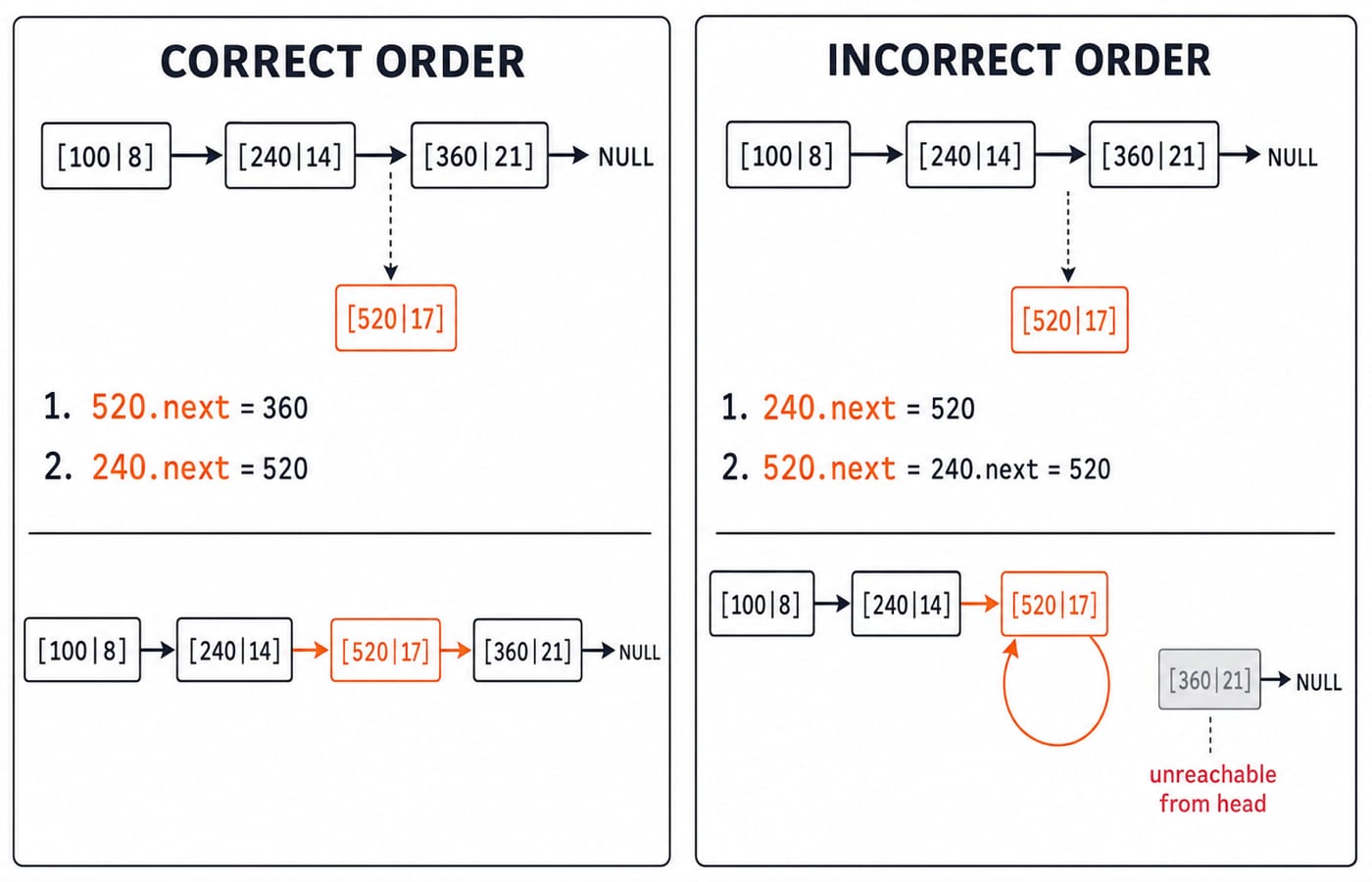
Insert a new node [520|17] immediately after node 240. Let p = 240 and new = 520. The safe order is:
new->next = p->next, so520.next = 360.p->next = new, so240.next = 520.
The result is [100|8] -> [240|14] -> [520|17] -> [360|21] -> NULL, representing 8 -> 14 -> 17 -> 21.
Now reverse those assignments. After p->next = new, node 240 already points to 520. The next statement, new->next = p->next, therefore assigns 520 to 520.next. Traversal becomes 100 -> 240 -> 520 -> 520 -> ..., while node 360 is unreachable from head.
Copy the link that must survive before overwriting its owner. If p, new, p->next, and new->next blur together, revise Pointers in C for GATE.
Deletion: Bypass First, Free Last
Continue from the correctly inserted four-node list and delete node 520. With predecessor p = 240:
Set
victim = p->next, sovictim = 520.Read
victim->next, which is360.Set
p->next = victim->next, so240.next = 360.Call
free(victim).
The restored chain is [100|8] -> [240|14] -> [360|21] -> NULL.
Calling free(p->next) first is invalid because finding 360 would then require dereferencing freed storage. Any separate pointer storing 520 becomes dangling, even though traversal from head is correct.
If p = 240 is available, bypassing its successor is O(1). Searching from head for 17 or its predecessor is O(n). Deleting the head is a separate case because it has no predecessor.
Linked List Reversal: A Complete Three-Pointer Trace
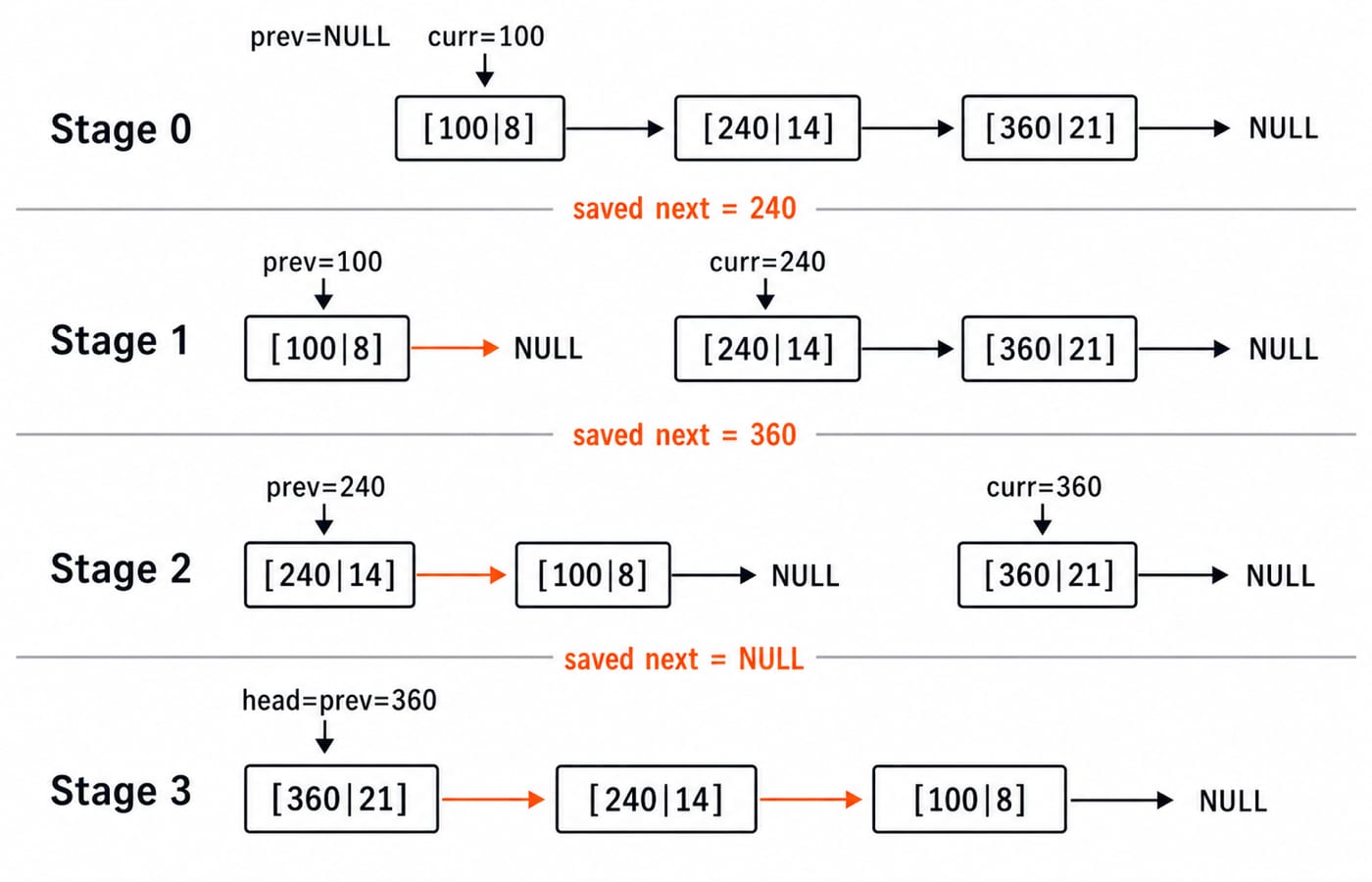
Reverse the restored chain 100 -> 240 -> 360 -> NULL. Initialise prev = NULL and curr = 100. Repeat these statements in order:
next = curr->next; curr->next = prev; prev = curr; curr = next;
Temporary next preserves the unprocessed suffix before the outgoing edge changes.
State | Saved | Changed edge |
|
|
|---|---|---|---|---|
Initial | not set | none |
|
|
Iteration 1 |
|
|
|
|
Iteration 2 |
|
|
|
|
Iteration 3 |
|
|
|
|
Finally, assign head = prev. The list becomes [360|21] -> [240|14] -> [100|8] -> NULL, and its data sequence is 21 -> 14 -> 8.
The loop invariant is this: nodes at and behind prev form the reversed prefix, while curr begins the untouched suffix. Each node belongs to exactly one part. At curr = NULL, the suffix is empty and prev is the new head.
Head-Changing Operations and Pointer-to-Pointer Parameters
Return to the original list with head = 100. To insert [80|5] at the front, first set 80.next = 100, then update the caller's head to 80. The result is [80|5] -> [100|8] -> [240|14] -> [360|21] -> NULL.
C offers two correct interfaces: return a new Node * for the caller to assign, or accept Node **head_ref and assign *head_ref = 80.
A function receiving only Node *head gets a copy. Rebinding local head to 80 does not change the caller's variable. Changing head->next instead mutates a reached node.
To delete the new first node through a pointer-to-pointer, set victim = *head_ref, giving 80; set *head_ref = victim->next, giving the caller head = 100; then free 80.
Structure Modification Traps and a Mechanical Repair Method
Pair each failure with a repair:
About to overwrite the only link to a suffix? Save that link first.
About to access
p->next? Check thatpis notNULL.Finished
free(520)? Stop using or clear every alias that stores520.Changing the first node? Return the new head or pass
Node **.Nodes contain equal values? Compare node identity when identity matters.
Three defects need different checks. A lost node such as 360 exists but is unreachable. A dangling pointer stores 520 after that node's lifetime ends. A cycle revisits an address, as in 520 -> 520.
For any trace, draw five columns: statement number, head, named pointer values, changed next field, and reachable chain from head. Fill one row immediately after each assignment. Never mentally combine two pointer writes.
How Exams Test Linked List Pointer Traces
Start again with [100|8] -> [240|14] -> [360|21] -> NULL and execute:
p = head->next, sop = 240.q = p->next, soq = 360.p->next = head, creating edge240 -> 100.head->next = q, keeping edge100 -> 360.head = p, sohead = 240.
The final reachable chain is [240|14] -> [100|8] -> [360|21] -> NULL. The printed data sequence is 14 8 21; q still points to 360; no address repeats, so there is no cycle.
Questions may ask for the output, final head, unreachable nodes, cycles, dangling aliases, link changes, safe assignment order, or O(1) modification versus O(n) search. Use structural reasoning, never compiler-dependent address arithmetic. There are about ten practice questions on structure modification and pointer logic. Continue with Data Structures MCQs for focused practice.
The Short Version and the Next Practice Step
Keep five rules close: draw addresses, save links before overwriting them, bypass before freeing, update the caller's head when the first node changes, and walk from head until NULL or a repeated address.
For a 15-minute exercise, start with [610|4] -> [725|9] -> [880|12] -> NULL. Insert [790|10] after 725, delete node 610 by updating head, then reverse the remaining list. Record every saved pointer and changed next field before checking your work.
Checkpoints are 610 -> 725 -> 790 -> 880, then 725 -> 790 -> 880, then 880 -> 790 -> 725 -> NULL. The final data is 12 -> 10 -> 9.
To place data structures beside the rest of GATE CS, continue with GATE Guidance by Sanchit Sir.
Keep learning

Structure Modification and Pointer Logic MCQs: 10 Solved Linked List Questions
Solve 10 linked-list MCQs by tracing each pointer update. The explanations cover reversal, duplicate removal, deletion, insertion, sentinels, and invalid links.
Updated 29 Oct 20269 min readData Structures MCQs

Linked List Data Structure: Complete Guide with Pointer Traces and Worked Examples
Learn how linked lists work by tracing every pointer change in core operations, then apply the same invariants to reversal, middle-node search, and cycle detection.
Updated 29 Sep 20266 min read56 viewsDSA & Algorithms

Linked List Questions for GATE: Pointer-Manipulation Patterns Solved Step by Step
Trace prev, curr and next through a complete reversal, then reuse the same discipline for middle-finding, cycle detection and safe deletion.
Updated 20 Aug 20267 min readDSA & Algorithms

Recursion with Pointers in C: Concepts, Traces and Worked Examples
Learn how local pointer copies interact with shared array memory, then trace one mutating sum and one reverse-print function from descent to unwind.
Updated 6 Sep 20266 min read55 viewsC Programming & Data Structures