C++ stack, queue and priority_queue: Adapter Behaviour with Traced Examples
Trace the same values through std::stack, std::queue and std::priority_queue, then learn comparator tie-breaking, operation costs and safe pop patterns.
KnowledgeGate Team
Exam prep & CS education
Updated 21 Sep 20266 min read
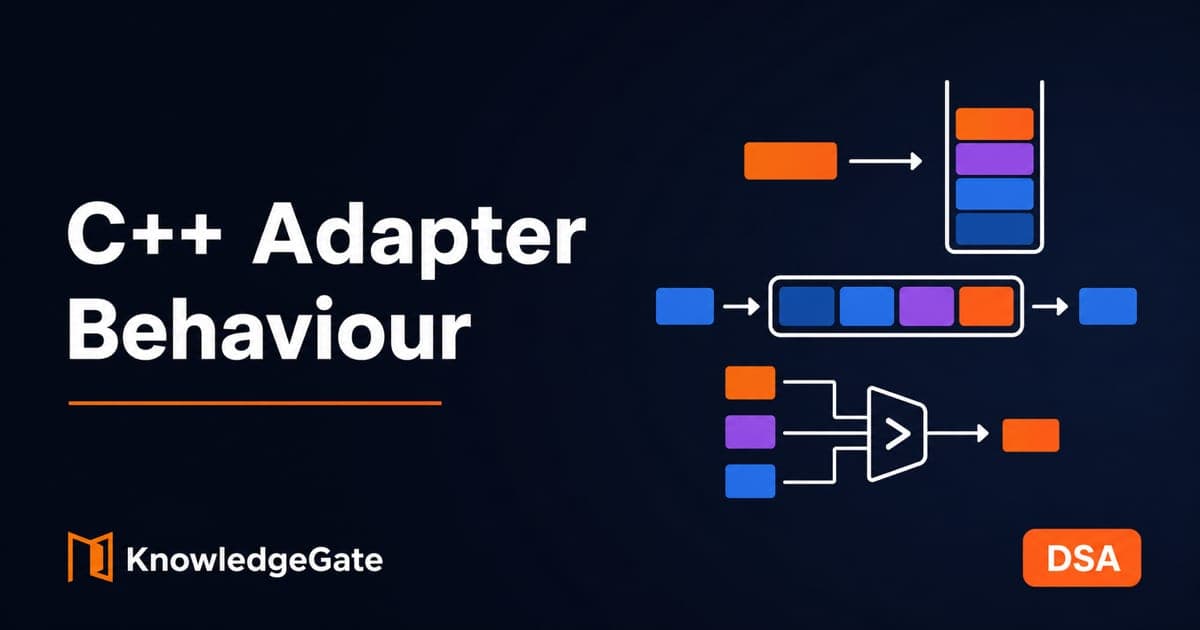
The shared method names are deceptive. C++ stack, queue and priority_queue all provide push, pop, size and empty, but they expose and remove different elements. That makes short output questions and scheduler code easy to misread, especially because pop() returns no value. Undo history, arrival-order jobs and ranked tasks follow different removal rules, as the 30, 10, 50, 20 trace shows. For the broader programming route, explore Coding & DSA courses for placements.
Related reading: priority queue MCQs and STL algorithms.
C++ container adapters restrict a container to one ordering rule
A container adapter stores another container and deliberately exposes only the operations required by one behavioural contract.
Adapter | Rule | Read next | Insert | Remove | Default container |
|---|---|---|---|---|---|
| LIFO |
|
|
|
|
| FIFO |
|
|
|
|
| comparator-ranked |
|
|
|
|
These adapters expose no public begin() or end(), indexing, arbitrary-position insertion or erase. Scanning, sorting or editing the middle needs a sequence container directly. The underlying container supplies storage; the adapter supplies the access rule. A stack is not necessarily a linked list, and a priority queue is not a sorted vector. The C++ Tutorial: The Complete Learning Path from First Program to STL places them inside the wider STL sequence.
std::stack models undo history by exposing only the newest action
Consider std::stack<std::string> history. After push("type heading"), push("insert link") and push("delete comma"), its size is 3 and top() is "delete comma". Copy that value, call pop(), and the new top is "insert link" with size 2. Repeating the read and removal reveals "type heading" next.
This is LIFO for a reason: the latest edit must be the first candidate for reversal. top() observes the newest action, while pop() removes it. Safe extraction therefore uses auto action = history.top(); history.pop();. auto action = history.pop() is illegal because pop() returns void. A reference obtained from top() must not be used after that element is removed. The abstract rule is covered separately in Stacks and queues: operations, applications and the exam angle; the C++ adapter decides which member functions are available.
std::queue processes jobs in arrival order and exposes both ends
Take std::queue<int> jobs, where the integers are job IDs, not priorities. Push 104, 205, 301. Now front() == 104, back() == 301 and size() == 3. Copy 104 and call pop(). The new state is front() == 205, back() == 301, size() == 2. Push 418, so back() == 418; draining the queue produces 205, 301, 418.
Back insertion and front removal preserve every surviving job's arrival order. back() is observable but not removed next. A standard drain is while (!jobs.empty()) { std::cout << jobs.front(); jobs.pop(); }. FIFO suits task processing when arrival order is the policy. Changing integer values cannot make urgency overtake arrival time in std::queue. The scheduling policy must live elsewhere, or the data structure must change.
std::priority_queue ranks work by a comparator
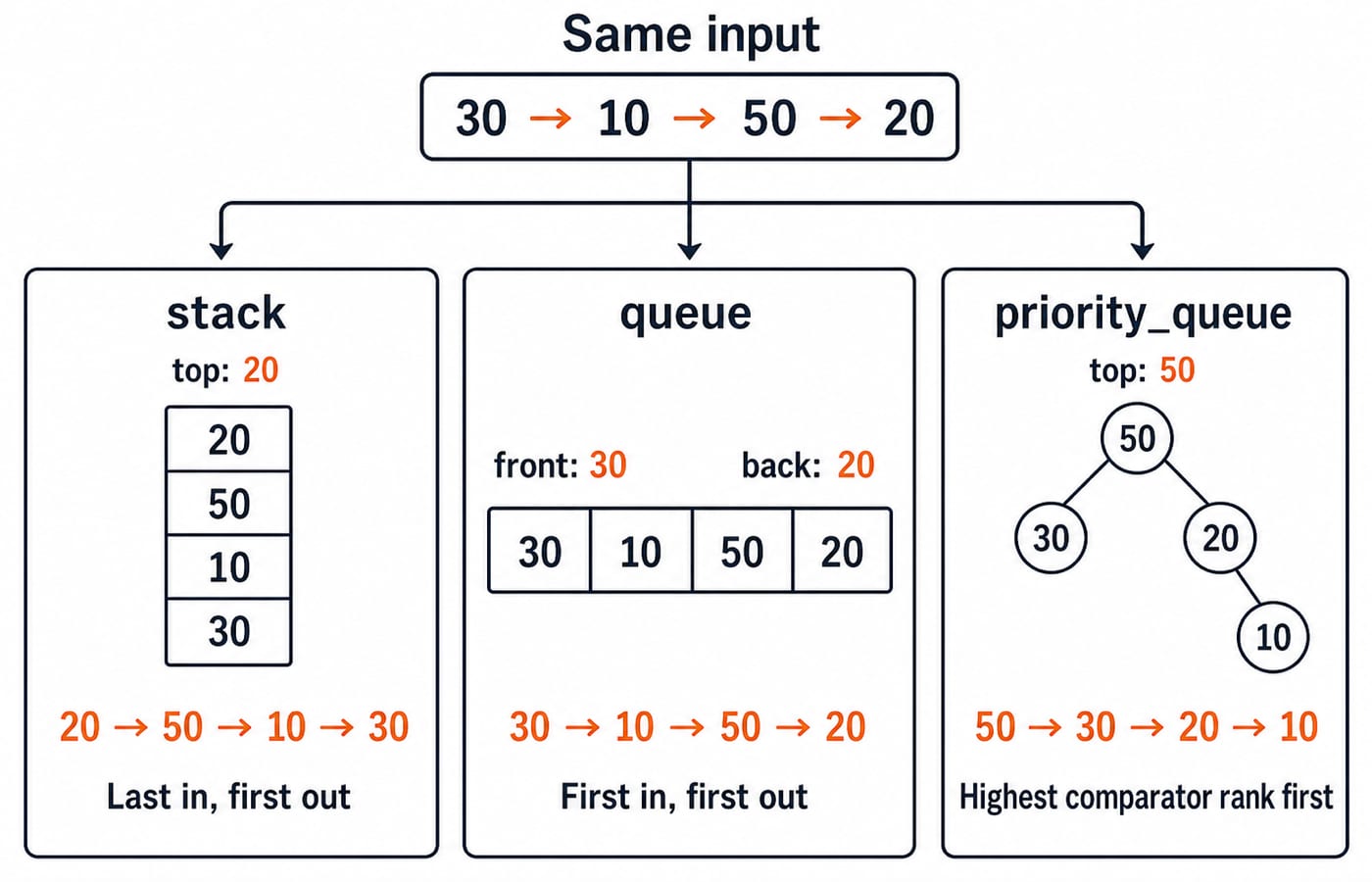
Push 30, 10, 50, 20 into std::priority_queue<int>. Its top() is 50, and draining returns 50, 30, 20, 10. The default std::less<int> puts the numerically largest value at the top. With <vector> and <functional>, the min-priority form std::priority_queue<int, std::vector<int>, std::greater<int>> drains the same inputs as 10, 20, 30, 50.
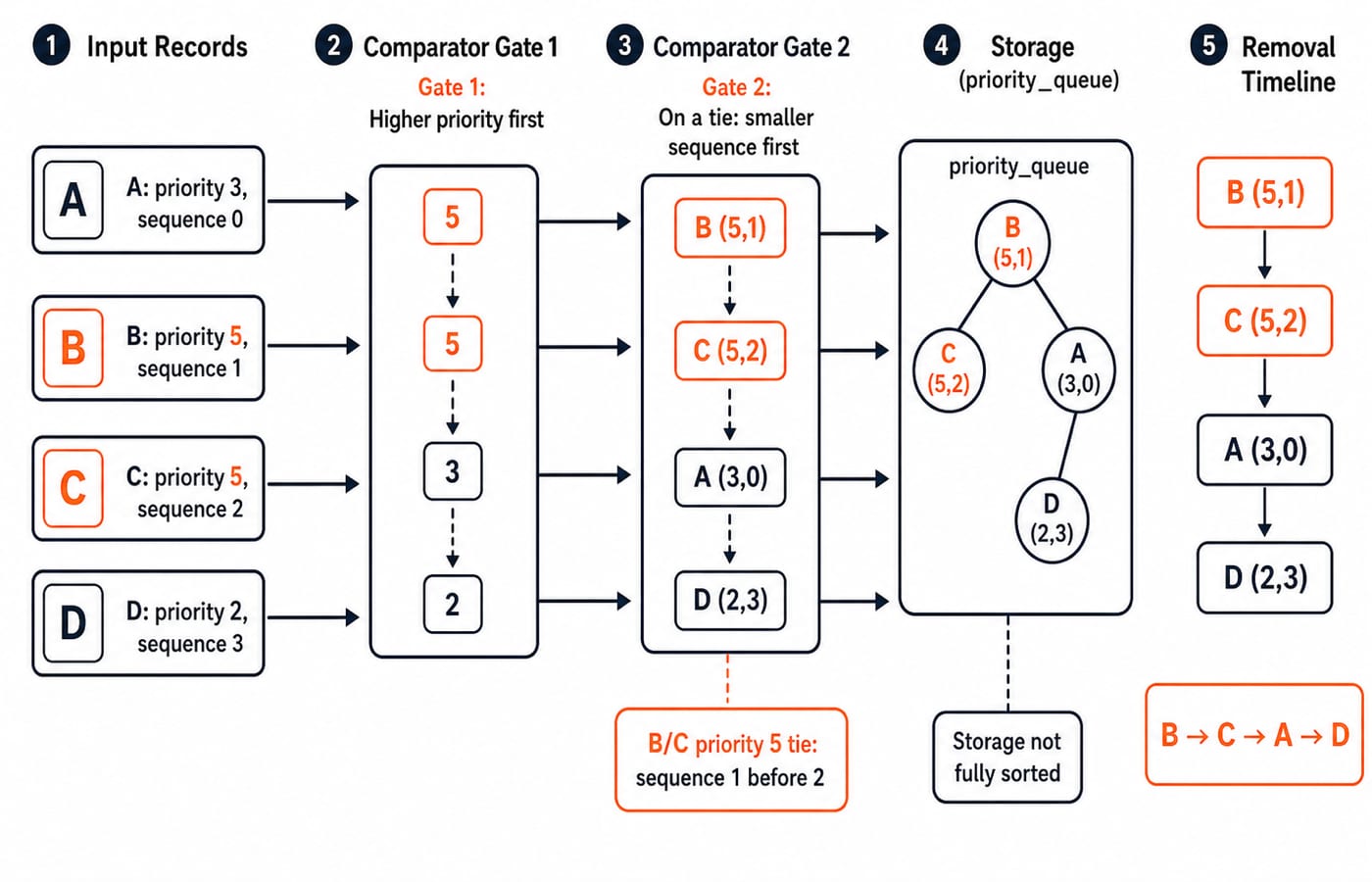
For scheduler ties, let Task hold char id, int priority and int sequence. Its comparator returns a.priority < b.priority when priorities differ, otherwise a.sequence > b.sequence. Insert A(3,0), B(5,1), C(5,2), D(2,3). The comparator says whether the left task ranks below the right. Higher numeric priority wins; for a tie, smaller sequence wins. Dispatch is B, C, A, D. Reversing the first comparison exposes the lowest priority. Without the sequence comparison, equal-priority B and C have no FIFO guarantee.
top() guarantees only the next ranked element. The remaining storage is maintained as a heap, not a fully sorted range, and the adapter exposes no iterator for inspecting internal heap order.
Stack vs queue vs priority_queue: trace one identical input
This runnable comparison inserts one stream and performs three guarded drains:
#include <iostream>
#include <queue>
#include <stack>

int main() {
    std::stack<int> s; std::queue<int> q; std::priority_queue<int> pq;

    for(int x:{30,10,50,20}) {
        s.push(x);q.push(x);pq.push(x);
    }
    while(!s.empty()){std::cout<<s.top()<<' ';s.pop();}
    std::cout<<'\n';
    while(!q.empty()){std::cout<<q.front()<<' ';q.pop();}
    std::cout<<'\n';
    while(!pq.empty()){std::cout<<pq.top()<<' ';pq.pop();}
}
after operation | stack top | queue front/back | priority_queue top |
|---|---|---|---|
after |
|
|
|
after |
|
|
|
after |
|
|
|
after |
|
|
|
The drain orders are:
Stack:
20 50 10 30, because the most recent insertion comes out first.Queue:
30 10 50 20, because insertion order is preserved.Priority queue:
50 30 20 10, because rank controls the next element.
These policies answer what arrived last, what arrived first and what currently ranks highest.
C++ adapter complexity follows the operation and default container
For the defaults:
Adapter | Constant time | Logarithmic time |
|---|---|---|
|
| none |
|
| none |
|
|
|
Undo and FIFO processing touch only an end of the default deque, so these operations are constant time. Ranked scheduling must move an inserted or removed item through a heap of n items, making priority_queue insertion and removal logarithmic. Its pop() is not constant time merely because it removes the top.
std::stack and std::queue accept other compatible underlying containers. std::priority_queue accepts a compatible random-access sequence container. This can change storage mechanics and operation costs, but it does not change the adapter contract: LIFO, FIFO or comparator-ranked access. With their default containers, stack and queue end operations are constant time; priority_queue insertion and removal are logarithmic.
C++ stack, queue and priority_queue traps are interface traps
Most mistakes have a direct correction:
Assigning from
pop()means the read was missed. Read withtop()orfront()first.Calling an accessor on an empty adapter is unsafe. Guard with
empty().queue::top()does not exist; usefront().stack::front()does not exist; usetop().A
priority_queuecannot be iterated as a sorted range. Repeatedly inspect and pop a copy if a destructive ordered drain is acceptable.Equal priorities do not preserve arrival order automatically. Encode a sequence field in the comparator.
Now trace push(4), push(9), pop(), push(2). Stack and default priority queue remove 9; queue removes 4. After push(2), stack exposes 2, queue exposes 9, and the priority queue exposes 4. Each answer follows its own rule.
For a second check, a min-priority queue receiving 7, 1, 5 has top() == 1 and drains 1, 5, 7. Written tests and interviews can probe legal member names, output traces, max-heap versus min-heap comparator direction, tie behaviour and operation complexity. Continue with Stacks and Queues MCQs: 12 solved data structures questions with explanations after reproducing these traces yourself.
C++ adapter choice: the short version and next step
Need the newest item first? Choose stack. Need arrival order? Choose queue. Need the current highest-ranked item? Choose priority_queue. Need iteration, indexing or middle edits? Choose a container directly. In every adapter, read before pop() and guard access with empty().
Reproduce the 30, 10, 50, 20 trace until all three drain orders are predictable. Then implement A(3,0), B(5,1), C(5,2), D(2,3) and assert B, C, A, D. For a structured next step across the language and STL, use the C++ Programming course when it fits your study plan.
Keep learning
C++ unordered_map and unordered_set: Hashing, Equality and a Custom-Key Frequency Counter
Build a correct mental model for C++ unordered containers, then trace a custom-key counter through a real collision without merging distinct keys.
Updated 2 Oct 20266 min readC++
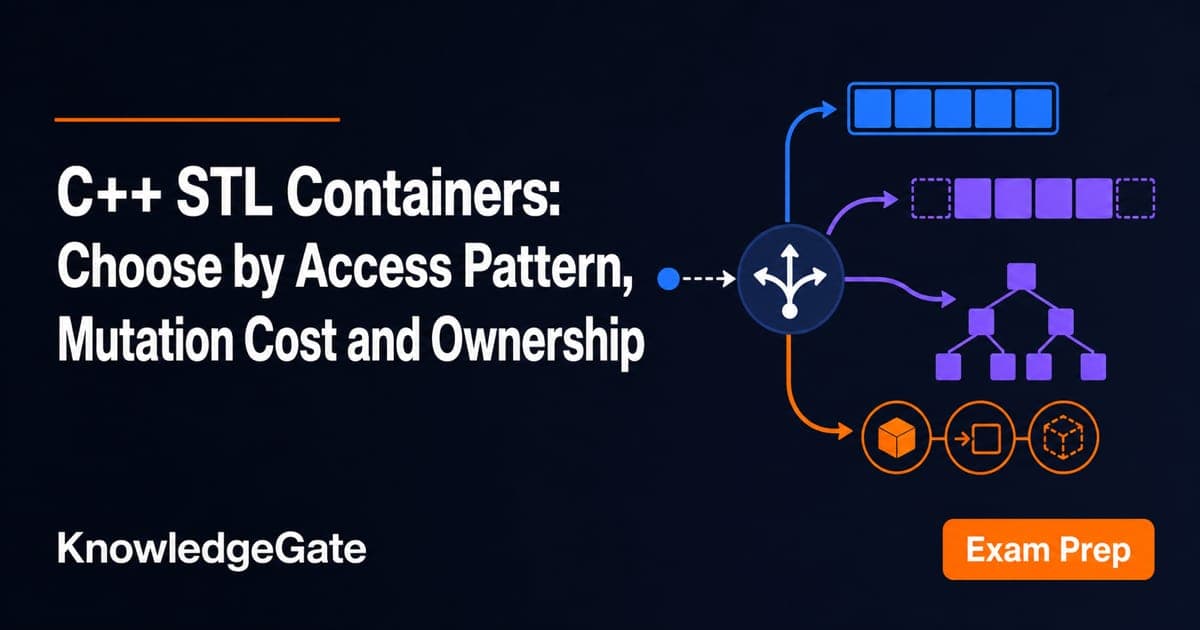
C++ STL Containers: Choose by Access Pattern, Mutation Cost and Ownership
Choose a C++ STL container from the workload, not from habit. Trace sequence operations, keyed counts, invalidation and object lifetime through exact examples.
Updated 27 Sep 20266 min readC++

C++ STL Algorithms: Sort, Search, Transform and Clean Data in One Pipeline
Trace nine sensor readings through sort, lower_bound, transform, erase-remove and accumulate, with every iterator rule and intermediate value explained.
Updated 25 Sep 20266 min readC++
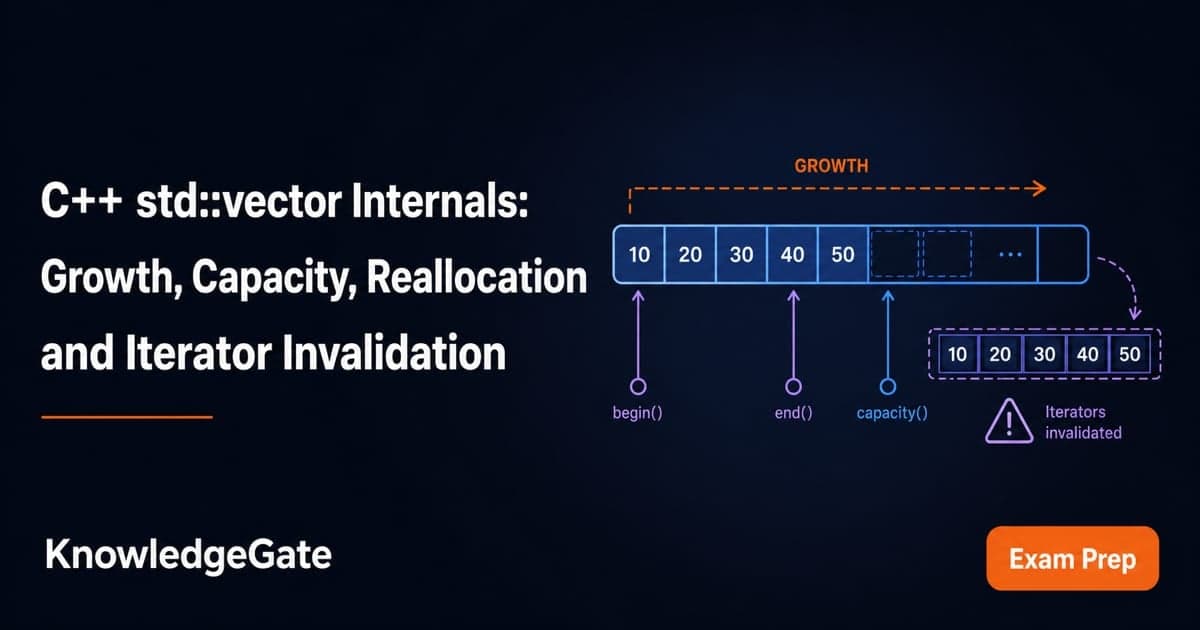
C++ std::vector Internals: Growth, Capacity, Reallocation and Iterator Invalidation
Learn how std::vector manages contiguous storage, why an append can relocate every element, and which iterators, pointers and references survive each mutation.
Updated 24 Sep 20266 min readC++