Priority Queue MCQs: 12 Solved Questions on Heaps, Deques and Variants
Attempt 12 verified priority queue and queue-variant MCQs, then learn from concise heap, array, circular queue and deque traces.
KnowledgeGate Team
Exam prep & CS education
Updated 25 Sep 20267 min read
Priority queues select by priority, circular queues reuse array positions, and deques control which ends accept updates. MCQs often mix these rules with heap repairs, workload costs and wrap-around arithmetic. Attempt each question before reading its solution, and use the linked question title for more practice.
Questions 1-2: What priority changes in a queue
Q1. In a priority queue, insertion and deletion can be done at
ISRO 2023
A. front
B. back
C. middle
D. any position
Correct answer: D. Placement and removal follow priority, not a fixed position. APIs remove the highest-priority item, not an arbitrary item. If smaller means higher priority, A(priority 3) and B(priority 1) order as [B, A]. Inserting C(priority 2) gives [B, C, A], and removal takes B.
Q2. In a Priority Queue, elements are processed based on ______.
CoCubes 2023
A. Arrival time of the element
B. Priority of the element
C. Size of the element
D. None of the above
Correct answer: B. If A, B and C arrive with priorities 3, 1 and 2, processing is B, C, A, not A, B, C. Arrival order breaks a tie only in an explicitly stable implementation.
Questions 3-4: Choosing a heap and reading its operation costs
Q3. Which data structure is the best for implementing a priority queue?
BPSC TGT 2023
A. Linked list
B. Array
C. Binary heap
D. B-Tree
E. None of the above
Correct answer: C. A binary heap is the standard dynamic choice here. It keeps the priority element at the root, gives constant-time peek, and supports insertion and removal in logarithmic time. For n = 1024, height is log2(1024) = 10, so repair follows one root-to-leaf path instead of scanning 1,024 elements.
Q4. What are the time complexities for a priority queue implemented with a heap?
MPPSC 2025
A. Insert : θ(log n), Remove : θ(log n)
B. Insert : θ(n), Remove : θ(1)
C. Insert : θ(1), Remove : θ(log n)
D. Insert : θ(log n), Remove : θ(1)
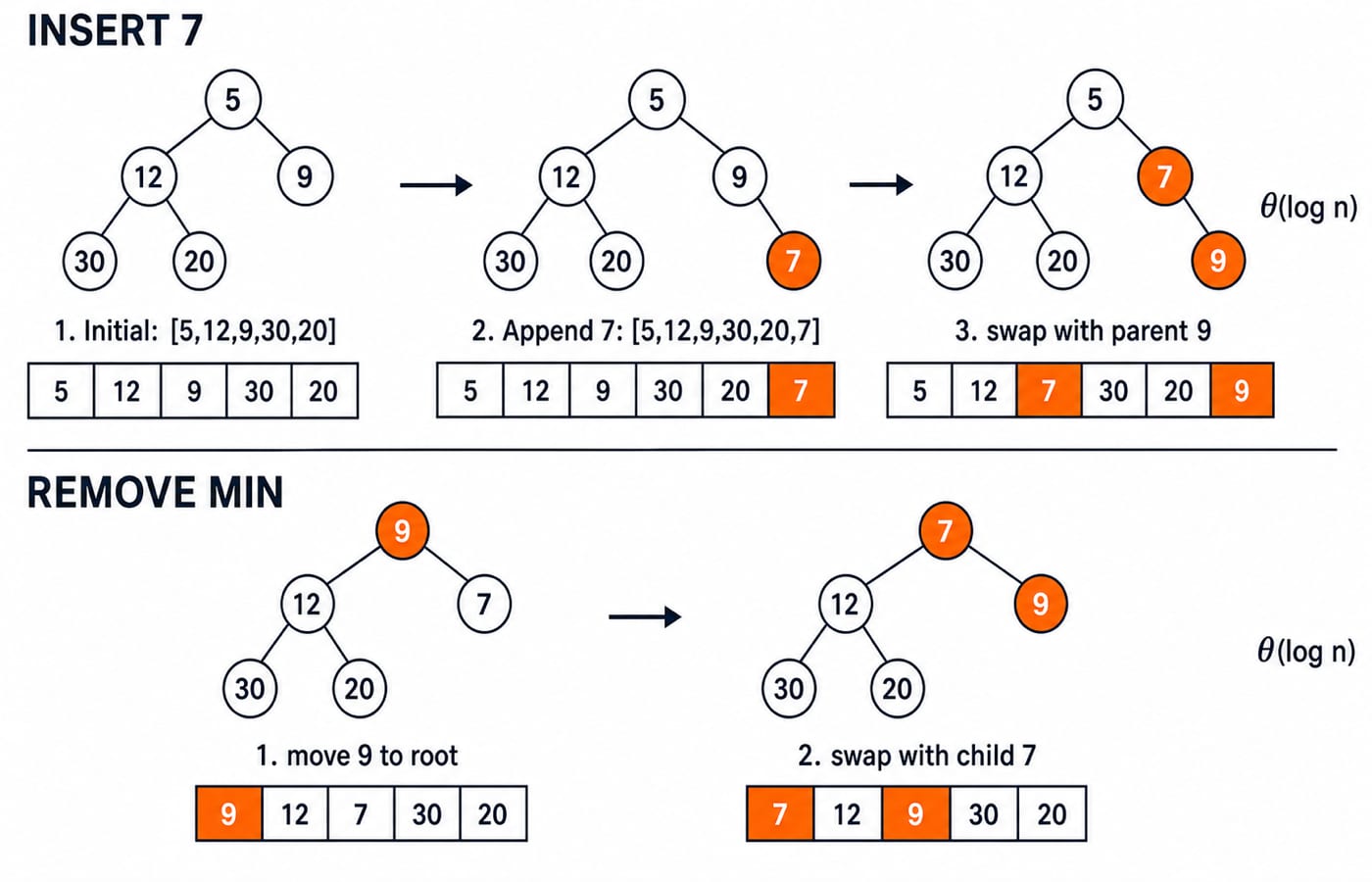
Correct answer: A. From min-heap [5, 12, 9, 30, 20], append 7 to get [5, 12, 9, 30, 20, 7]; compare with parent 9, then swap to obtain [5, 12, 7, 30, 20, 9].
Remove 5 and move 9 to the root: [9, 12, 7, 30, 20]. Swap 9 with child 7 to finish at [7, 12, 9, 30, 20]. Peek is θ(1), but Remove repairs the heap, so it is θ(log n). Use Heaps and Priority Queues: 12 Solved MCQs when you need parent indices, heap validation, sift-up, delete-max, bottom-up heapify and top-k practice. Stay with the mixed set for array, circular-queue and deque comparisons.
Questions 5-6: When an unsorted array beats a heap
Q5. What is the worst case running time of Insert and Extract-min, in an implementation of a priority queue using an unsorted array? Assume that all the insertions can be accommodated.
UGC NET December 2019
A. θ(1), θ(n)
B. θ(n), θ(1)
C. θ(1), θ(1)
D. θ(n), θ(n)
Correct answer: A. From [14, 3, 27, 9], Insert(5) appends 5, forming [14, 3, 27, 9, 5] in θ(1). Extract-min scans five entries to find 3, replaces its slot with the last entry, and shrinks to [14, 5, 27, 9]. The scan makes it θ(n).
Q6. An algorithm performs (log N)^(1/2) find operations, N insert operations, (log N)^(1/2) delete operations, and (log N)^(1/2) decrease-key operations on a set of data items with keys drawn from a linearly ordered set. For a delete operation, a pointer is provided to the record that must be deleted. For the decrease-key operation, a pointer is provided to the record that has its key decreased. Which one of the following data structures is the most suited for the algorithm to use, if the goal is to achieve the best total asymptotic complexity considering all the operations?
Cognizant 2024
A. Unsorted array
B. Min-heap
C. Sorted array
D. Sorted doubly linked list
Correct answer: A. Treat find as arbitrary-key search and use the given direct pointers.
Structure | Relevant per-operation costs | Total for this workload |
|---|---|---|
Unsorted array | find O(N), insert O(1), pointer delete O(1), decrease-key O(1) | O(N sqrt(log N)) |
Min-heap | arbitrary find O(N), insert O(log N), pointer delete O(log N), decrease-key O(log N) | O(N log N) |
Sorted array | find O(log N), insert O(N), pointer delete O(N), decrease-key O(N) | O(N^2) |
Sorted doubly linked list | find O(N), insert O(N), pointer delete O(1), decrease-key O(N) | O(N^2) |
N inserts dominate the heap and sorted structures. For N = 2^16 = 65,536, log2 N = 16 and sqrt(log2 N) = 4, so there are 65,536 insertions but four of each other operation. The totals decide the answer. GATE Guidance by Sanchit Sir covers broader Data Structures.
Questions 7-8: Priority queues and queue variants in applications
Q7. Which of the following is not an application of priority queue?
AMCAT 2024
A. Huffman codes
B. Interrupt handling in operating system
C. Undo operation in text editors
D. Bayesian spam filter
Correct answer: C. Huffman coding removes the two lowest-frequency nodes from a min-priority queue, while interrupt handling can choose by priority. Undo is last-in, first-out: after type A, type B, delete C, the first undo reverses delete C. That makes a stack natural without assuming how every spam filter works.
Q8. Match List I with List II
UGC NET June 2025
List I | List II |
|---|---|
A. Circular Queue | I. Print Queue |
B. Priority Queue | II. CPU Scheduling |
C. Double Ended Queue | III. Dijkstra Algorithm |
D. Simple Queue | IV. Palindrome Checking |
Choose the correct answer from the options given below:
A. A-II, B-III, C-I, D-IV
B. A-II, B-III, C-IV, D-I
C. A-III, B-II, C-I, D-IV
D. A-IV, B-II, C-I, D-III
Correct answer: B. A circular queue rotates CPU jobs P1 -> P2 -> P3 -> P1. Dijkstra selects the smallest distance, so for A=0, B=4, C=9, B follows A. A deque tests LEVEL as L/L, E/E, V. A simple print queue handles J1, J2, J3 in order. Thus A-II, B-III, C-IV, D-I.
Questions 9-10: Implementation costs and circular-queue fullness
Q9. A double‐ended queue (dequeue) supports adding and removing items from both the ends of the queue. The operations supported by dequeue are AddFront(adding item to front of the queue), AddRear(adding item to the rear of the queue), RemoveFront(removing item from the front of the queue), and RemoveRear(removing item from the rear of the queue). You are given only stacks to implement this data structure. You can implement only push and pop operations. What’s the time complexity of performing AddFront() and AddRear() assuming m is the size of the stack and n is the number of elements?
UGC NET 2021
A. O(m) and O(n)
B. O(1) and O(n)
C. O(n) and O(1)
D. O(n) and O(m)
Correct answer: B. Let the main stack's top be the deque front. AddFront is one push, O(1). For [10, 20, 30, 40], AddRear(50) moves four items to a temporary stack, pushes 50, then restores them. Count 4 pops + 4 pushes, 1 push, then 4 pops + 4 pushes: 17 operations for n=4. Growth is O(n), independent of capacity m.
Q10. Which of the following operations is not possible in a circular queue when it is full?
UP Police 2023
A. Enqueue
B. Traverse
C. Dequeue
D. Display
Correct answer: A. In a capacity-5 array with one unused slot, front = 2 and rear = 1 give (rear + 1) mod 5 = 2 = front. Enqueue overflows, while Traverse, Display and Dequeue work. Explicit-count implementations detect fullness differently but give the same answer.
Use Circular Queue MCQs: 12 Solved Questions with Step-by-Step Explanations to practise position arithmetic, wrap-around and full/empty conventions. In mixed priority-queue questions, the circular-queue rule matters only for storage fullness; it does not determine priority order or which deque end is used.
Questions 11-12: Deque definition and a complete operation trace
Q11. A queue in which addition as well as deletion of elements can take place at both the ends is called
UP Police 2018
A. Simple queue
B. Circular queue
C. Double-ended queue
D. Priority queue
Correct answer: C. AddRear(10) gives [10]; AddFront(20) gives [20, 10]; AddRear(30) gives [20, 10, 30]; DeleteRear removes 30; DeleteFront removes 20, leaving [10]. Simple and circular queues use rear insertion and front removal, while a priority queue selects by priority.
Q12. After performing this set of operations, what does the final list contain?
Hexaware 2024
InsertFront(10);
InsertFront(20);
InsertRear(30);
DeleteFront();
InsertRear(40);
InsertRear(10);
DeleteRear();
InsertRear(15);
display();
A. 10 30 10 15
B. 20 30 40 15
C. 20 30 40 10
D. 10 30 40 15
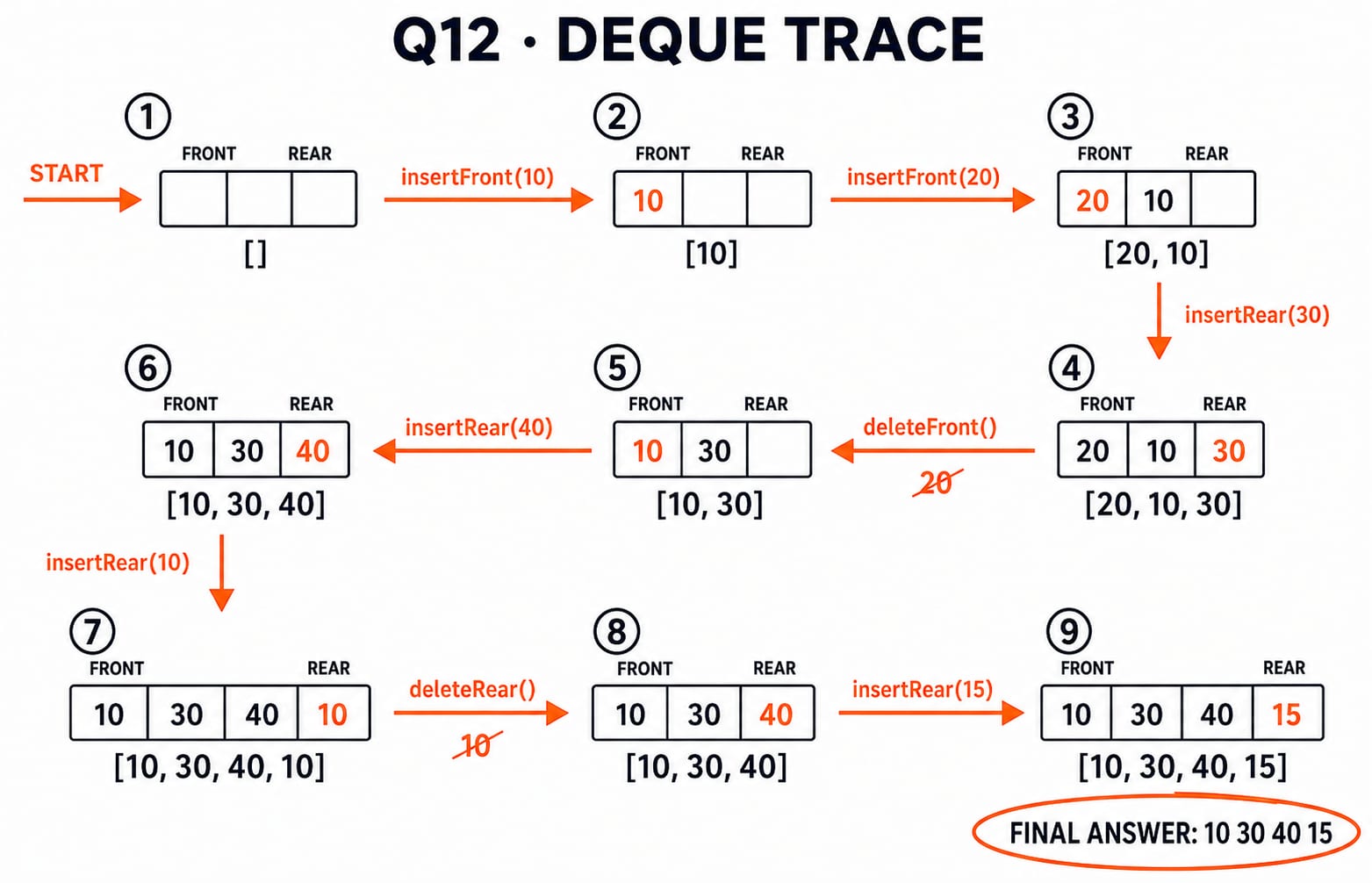
Correct answer: D. From the left-hand front, the trace is [] -> [10] -> [20,10] -> [20,10,30] -> [10,30] -> [10,30,40] -> [10,30,40,10] -> [10,30,40] -> [10,30,40,15]. DeleteRear removes the newly appended second 10, not the front 10.
Answer key, traps and the next practice step
The compact key is 1-D, 2-B, 3-C, 4-A, 5-A, 6-A, 7-C, 8-B, 9-B, 10-A, 11-C, 12-D.
Trap | Reliable check | Questions |
|---|---|---|
Priority order is FIFO unless tied and stable | Write priorities beside the arrival order | Q1-Q2 |
Heap remove is treated as heap peek | Include the repair after removing the root | Q4 |
One structure is assumed best for every workload | Multiply each cost by its operation frequency | Q5-Q6 |
Circular storage is mistaken for double-ended access | Separate wraparound storage from allowed ends | Q10-Q11 |
A deque update is applied at the wrong end | Mark FRONT and REAR before every operation | Q9, Q12 |
Retry wrong items without options, write each invariant or cost, then repeat after two days. Use DSA using Java for implementation and Coding & DSA for broader choices.
Keep learning
Stack Basics and Operations MCQs: 12 Solved Questions with Step-by-Step Explanations
Test stack fundamentals through 12 exam MCQs on LIFO, TOP, array bounds, queue transfers and permutations. Complete traces make every state and answer checkable.
Updated 3 Oct 20268 min readData Structures MCQs
Evaluation of Expressions MCQs: 12 Solved Questions with Stack Traces
Solve 12 expression MCQs step by step. Trace postfix and prefix evaluation, nesting depth, precedence and notation conversion without reversing operands.
Updated 27 Sep 20267 min readData Structures MCQs
Infix, Postfix and Prefix MCQs: 12 Solved Questions with Step-by-Step Explanations
Solve 12 expression-notation MCQs in increasing difficulty, from basic stack use to conversions, associativity and maximum operand-stack depth.
Updated 24 Sep 20268 min read53 viewsData Structures MCQs
Circular Queue MCQs: 12 Solved Questions with Step-by-Step Explanations
Solve 12 Circular Queue MCQs in sequence, with exact options and concise explanations for pointer conventions, wrap-around arithmetic and linked queues.
Updated 22 Sep 20268 min readData Structures MCQs