Second Normal Form (2NF) MCQs: 12 Solved Questions with Explanations
Test your 2NF understanding with 12 solved MCQs on full dependency, partial dependency, candidate keys, closures, and normal-form guarantees.
KnowledgeGate Team
Exam prep & CS education
Updated 23 Sep 20268 min read
Second Normal Form looks easy when reduced to “no partial dependency”. Errors begin when you forget to find every candidate key and separate prime from non-prime attributes. Attempt each of these 12 MCQs before you look at the answer, then identify the key, dependency, or rule doing the work.
Second Normal Form in 60 seconds
A relation is in 2NF when it is in 1NF and no non-prime attribute is functionally dependent on a proper subset of any candidate key.
A prime attribute belongs to at least one candidate key.
A non-prime attribute belongs to no candidate key.
A full functional dependency needs the complete candidate key on its left side.
A partial dependency exists when a proper subset of a candidate key determines a non-prime attribute.
Use this four-step routine:
Find every candidate key using attribute closure.
Mark prime and non-prime attributes.
Inspect every proper subset of each composite candidate key.
If one such subset determines a non-prime attribute, the relation is not in 2NF.
A single-attribute candidate key has no proper non-empty subset, so it cannot create a partial dependency. Although questions often mention a primary key, check every candidate key.
Atomic values and repeating groups belong to Introduction to Normalization and 1NF MCQs. Once 1NF holds, 2NF shifts the test to proper subsets of composite candidate keys and the non-prime attributes they determine.
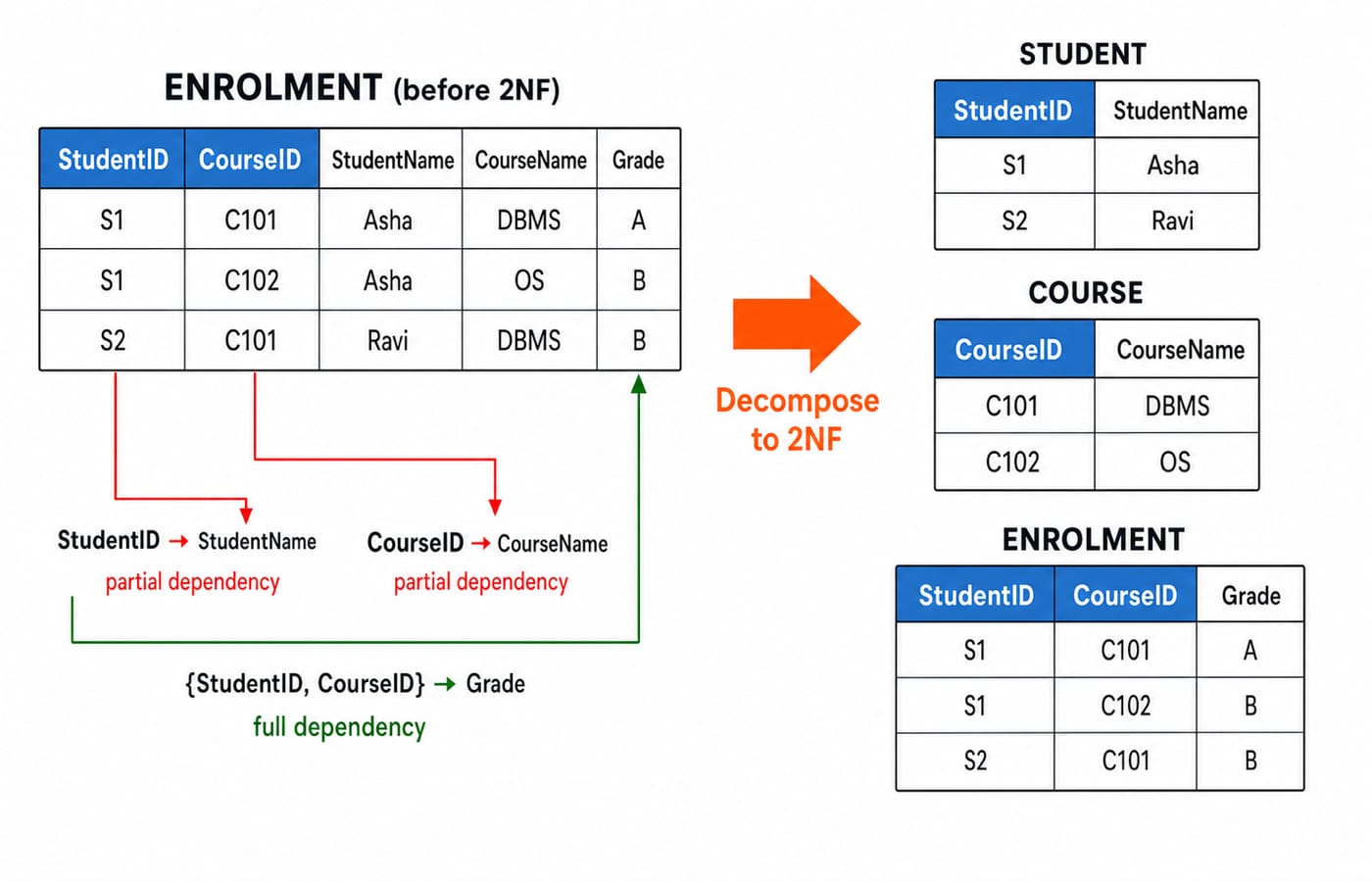
Consider ENROLMENT(StudentID, CourseID, StudentName, CourseName, Grade) with candidate key {StudentID, CourseID} and these dependencies:
StudentID → StudentNameCourseID → CourseName{StudentID, CourseID} → Grade
StudentID | CourseID | StudentName | CourseName | Grade |
|---|---|---|---|---|
S1 | C101 | Asha | DBMS | A |
S1 | C102 | Asha | OS | B |
S2 | C101 | Ravi | DBMS | B |
StudentName repeats because it depends only on StudentID; CourseName repeats because it depends only on CourseID. Each determinant is a proper key subset, while Grade depends on the whole key.
Decompose into STUDENT(StudentID, StudentName) with S1/Asha and S2/Ravi, COURSE(CourseID, CourseName) with C101/DBMS and C102/OS, and ENROLMENT(StudentID, CourseID, Grade) with S1/C101/A, S1/C102/B, and S2/C101/B.
Questions 1-4: identify the defining rule
Q1. Full dependency fixes which normal form?
If every non-key attribute is fully dependent on the primary key, then the relation will be in ______.
First Normal Form (1NF)
Second Normal Form (2NF)
Third Normal Form (3NF)
More than one of the above
None of the above
Answer: Second Normal Form (2NF). Full dependence defines 2NF once 1NF is satisfied. The closest distractor is 3NF, but the question does not rule out transitive dependency.
Q2. Non-key attributes and the primary key
Which of the following normal forms deals with ensuring that non-key attributes are fully functionally dependent on the primary key ?
First Normal Form (1NF)
Second Normal Form (2NF)
Third Normal Form (3NF)
Boyce-Codd Normal Form (BCNF)
Answer: Second Normal Form (2NF). 1NF concerns atomic values, 3NF tests transitive dependency, and BCNF requires every non-trivial determinant to be a superkey.
Q3. The dependency type 2NF eliminates
What type of functional dependency must be eliminated to ensure a relation is in Second Normal Form (2NF)?
Circular dependency among attributes
Transitive dependency between non-key attributes
Partial dependency on a subset of a composite primary key
Multivalued dependency on a super key
Answer: Partial dependency on a subset of a composite primary key. Here, subset means a proper subset. The closest distractor, transitive dependency, belongs to the 3NF check.
Q4. What 2NF actually forbids
In 2NF
No functional dependencies (FDs) exist
No multivalued dependencies (MVDs) exist
No partial FDs exist
No partial MVDs exist
Answer: No partial FDs exist. 2NF bans a partial FD from part of a candidate key to a non-prime attribute, not all FDs as the first option claims.
Questions 5-8: full dependency, nesting, and exam wording
Q5. The form built on full functional dependency
Which normal form is based on the concept of 'full functional dependency'?
First Normal Form
Second Normal Form
Third Normal Form
Fourth Normal Form
Answer: Second Normal Form. “Full” means the non-prime attribute needs the whole composite key. Third Normal Form is the closest distractor, but its additional concern is transitive dependency.
Q6. What 2NF guarantees underneath it
If a relation schema is in 2NF, then it is definitely in:
1NF
4NF
3NF
BCNF
Answer: 1NF. 1NF is a prerequisite for 2NF. A transitive dependency can remain, so 3NF and the stronger BCNF and 4NF are not guaranteed.
Q7. A long exam definition, decoded
A relation which is in 1NF and no attribute that is not a part of the Primary Key is partially dependent only on a portion of the Primary Key is in which Normal Form?
2NF
3NF
4NF
5NF
Answer: 2NF. The long sentence translates directly to “1NF plus no partial dependency of a non-prime attribute”. It says nothing about the transitive dependencies needed to guarantee 3NF.
Q8. The whole-key test after 1NF
Assuming the relation is in 1NF, if every non-key attribute is fully functionally dependent on the whole primary key, then the relation is in __________.
First normal form
Second normal form
Third normal form
Fourth normal form
Answer: Second normal form. Full dependency on the whole key establishes 2NF. Without information about transitive dependencies, the closest stronger choice, 3NF, is not guaranteed.
Questions 9-10: decide the highest guaranteed normal form
Q9. BOOK relation: how far does it normalise?
Consider the following dependencies for the BOOK relation in a relational database design. Determine the normal form of the given relation.
ISBN → Title
ISBN → Publisher
Publisher → Address
First Normal Form
Second Normal Form
Third Normal Form
BCNF
Answer: Second Normal Form. ISBN is a single-attribute candidate key, so partial dependency cannot arise and 2NF holds. However, ISBN → Publisher → Address is transitive through non-key Publisher, so 3NF is not guaranteed.
Q10. R(a,b,c,d) with a → c and b → d
For a database relation R(a,b,c,d), where the domains a, b, c, d include only atomic values, only the following functional dependencies and those that can be inferred from them hold:
{ a → c, b → d }This relation is
in first normal form but not in second normal form
in second normal form but not in first normal form
in third normal form
None of the above
Answer: in first normal form but not in second normal form. a+ = {a,c}, b+ = {b,d}, and {a,b}+ = {a,b,c,d}, so {a,b} is the candidate key. Atomic domains establish 1NF, but a → c and b → d are partial dependencies to non-prime attributes. Thus 2NF, and therefore 3NF, fails.
Questions 11-12: candidate-key closure exposes the violation
Q11. Seven attributes, one closure, one violation
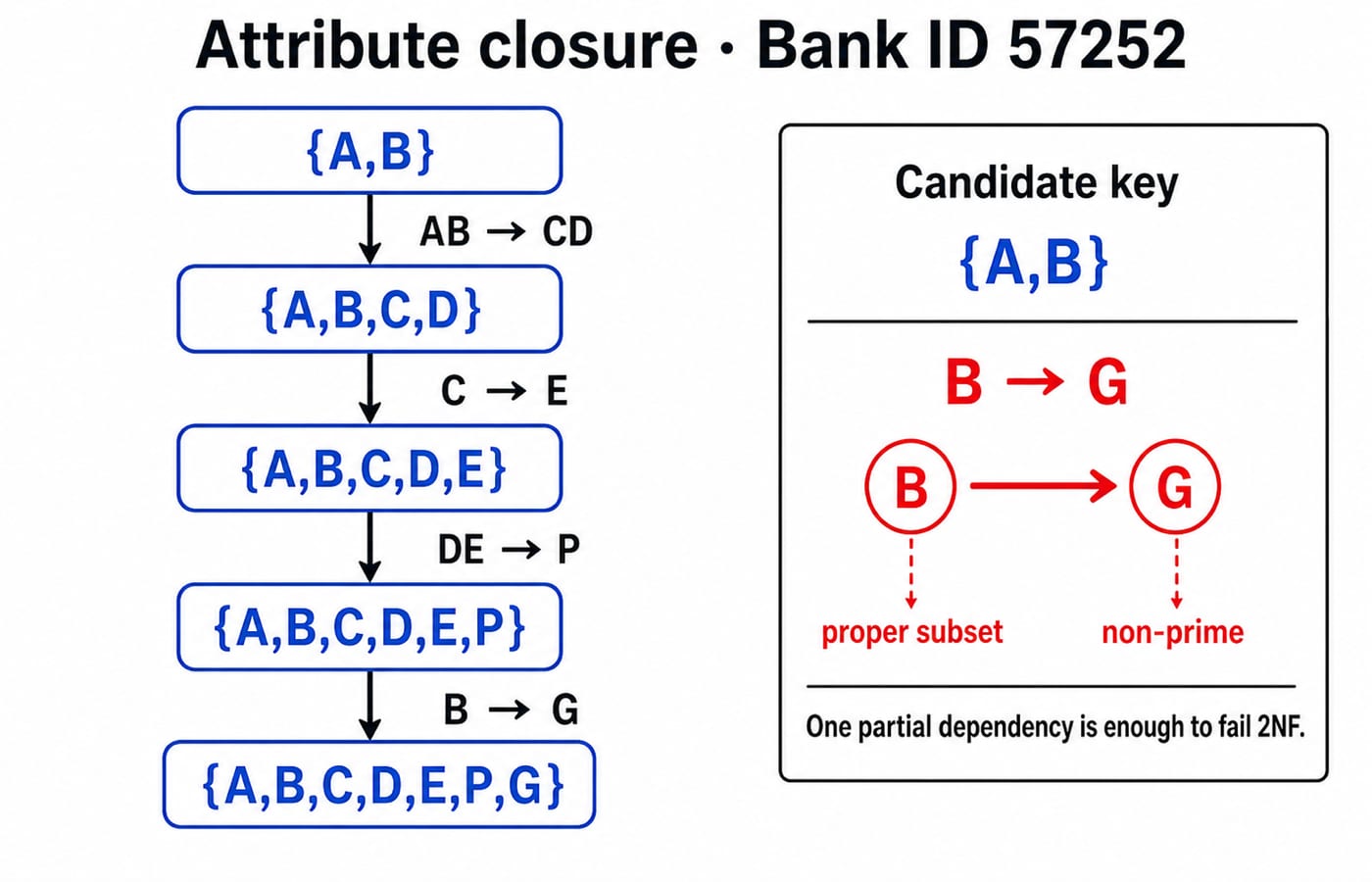
Consider the relation R(A, B, C, D, E, P, G) with the following functional dependencies:
AB → CD, DE → P, C → E, P → C, B → GWhich one of the following is true?
R is in BCNF
R is in 3NF, but not in BCNF
R is in 2NF, but not in 3NF
R is not in 2NF
Answer: R is not in 2NF. Start with {A,B}. AB → CD gives {A,B,C,D}; C → E gives {A,B,C,D,E}; DE → P gives {A,B,C,D,E,P}; and B → G gives {A,B,C,D,E,P,G}. A and B never appear on a right-hand side, so both are required and {A,B} is the candidate key. B → G fails 2NF because B is a proper key subset and G is non-prime. The 2NF option is the closest distractor. Because this same relation also anchors the earlier Boyce-Codd Normal Form (BCNF) MCQs, keep the two lessons distinct: the BCNF set uses the 2NF failure to stop higher-form checks, while the 2NF diagnosis is the dependency B → G from proper key subset B to non-prime G.
Q12. Which statements about R(x,y,z,w) hold?
Given a relation scheme R(x, y, z, w) with functional dependencies F = {x → y, z → w}. All attributes take single and atomic values only.
A. Relation R is in First Normal Form
B. Relation R is in Second Normal Form
C. Primary key of R is xz
Choose the correct answer from the options given below:
C only
B and C only
A and C only
B only
Answer: A and C only. x+ = {x,y}, z+ = {z,w}, and {x,z}+ = {x,y,z,w}, so xz is the candidate key. Atomic values establish 1NF. Both x → y and z → w are partial dependencies to non-prime attributes, so B is false. “B and C only” is the closest distractor.
The 2NF traps these questions are testing
Checking only atomicity. Atomic values settle 1NF, not 2NF. Q10 and Q12 prove it.
Calling any FD partial. A partial FD must run from a proper candidate-key subset to a non-prime attribute.
Publisher → Addressin Q9 is instead a 3NF concern.Stopping before minimality. A candidate key must determine every attribute, and removing any member must stop it doing so. Use closure and removal checks.
Assuming 2NF means 3NF or BCNF. Q6 and BOOK show why one level does not guarantee the next.
10-second exam check: Atomic values? Candidate keys? Prime attributes? Any FD from a proper key subset to a non-prime attribute? If yes, stop at 1NF. If no, the relation reaches at least 2NF.
Answer key, diagnosis, and next step
Answer key: Q1 Second Normal Form; Q2 Second Normal Form; Q3 partial dependency; Q4 no partial FDs; Q5 Second Normal Form; Q6 1NF; Q7 2NF; Q8 Second normal form; Q9 Second Normal Form; Q10 1NF but not 2NF; Q11 not in 2NF; Q12 A and C only.
Diagnose misses by type, not by total. Errors in Q1-Q8 point to the definition or normal-form ladder. Errors in Q9-Q10 point to confusion between partial and transitive dependency. Errors in Q11-Q12 point to candidate-key closure or the prime/non-prime split.
For more question-bank practice, use the Second Normal Form practice module. For a structured preparation route, use GATE Guidance by Sanchit Sir, and compare broader options on the GATE catalog page. Then solve the weak area again without looking at the key.
Keep learning

SQL Library Functions MCQs: 12 Solved Math, Aggregate, String and Date Questions
Practise 12 solved SQL library function MCQs with inside-out calculations, exact intermediate values and clear explanations of the common traps.
Updated 3 Oct 20268 min readDBMS MCQs

SQL Introduction, Components & Structure MCQs: 12 Solved Questions
Test your SQL foundations with 12 explained MCQs covering terminology, query behaviour, metadata, dynamic SQL, database models and QBE.
28 Sep 20267 min readDBMS MCQs

GROUP BY Clause MCQs: 10 Solved SQL Questions with Explanations
Solve ten published GROUP BY questions, then check each answer with row-level and group-level reasoning. Two full traces make the common SQL traps visible.
Updated 25 Sep 20268 min readDBMS MCQs
Third Normal Form (3NF) MCQs: 12 Solved Questions with Explanations
Solve 12 real 3NF exam MCQs with clear explanations, candidate-key closures, a raw-row decomposition, and the prime-attribute exception that separates 3NF from BCNF.
Updated 24 Sep 20267 min readDBMS MCQs