Basic Recursion in C: Call Stack, Worked Traces and Exam Patterns
Learn how recursive C functions descend, stop and unwind. Trace factorial and printed output, count Fibonacci calls, and compare recursion with iteration.
KnowledgeGate Team
Exam prep & CS education
Updated 18 Sep 20265 min read
Recursion looks like a function simply repeating itself, but most mistakes come from losing track of the base case, pending work and return order. Recursion questions become manageable when you trace C calls, compute exact outputs and costs, and apply a repeatable solving method.
Related reading: Recursion MCQs and Recursion and stacks.
Basic recursion in C programming: base case, recursive case and progress
Direct recursion means a function calls itself with a smaller input. A correct recursive function has three obligations: a base case that returns without another call, a recursive case that reduces the problem, and guaranteed progress towards the base case. In indirect recursion, functions call one another in a cycle, but the same obligations still matter.
Consider this warm-up:
void countdown(int n) {
    if (n == 0) return;
    printf("%d ", n);
    countdown(n - 1);
}
For countdown(3), the calls are countdown(3), countdown(2), countdown(1) and countdown(0). The output is 3 2 1. The base-case invocation countdown(0) still exists, even though it prints nothing.
The Coding & DSA category is the broader route for C programming and data-structure study.
Factorial recursion in C: work fact(5) from calls to returns
For non-negative integers, use:
int fact(int n) {
    if (n <= 1) return 1;
    return n * fact(n - 1);
}
Its contract is: fact(n) returns n! for n >= 0. Negative input is outside its valid domain.
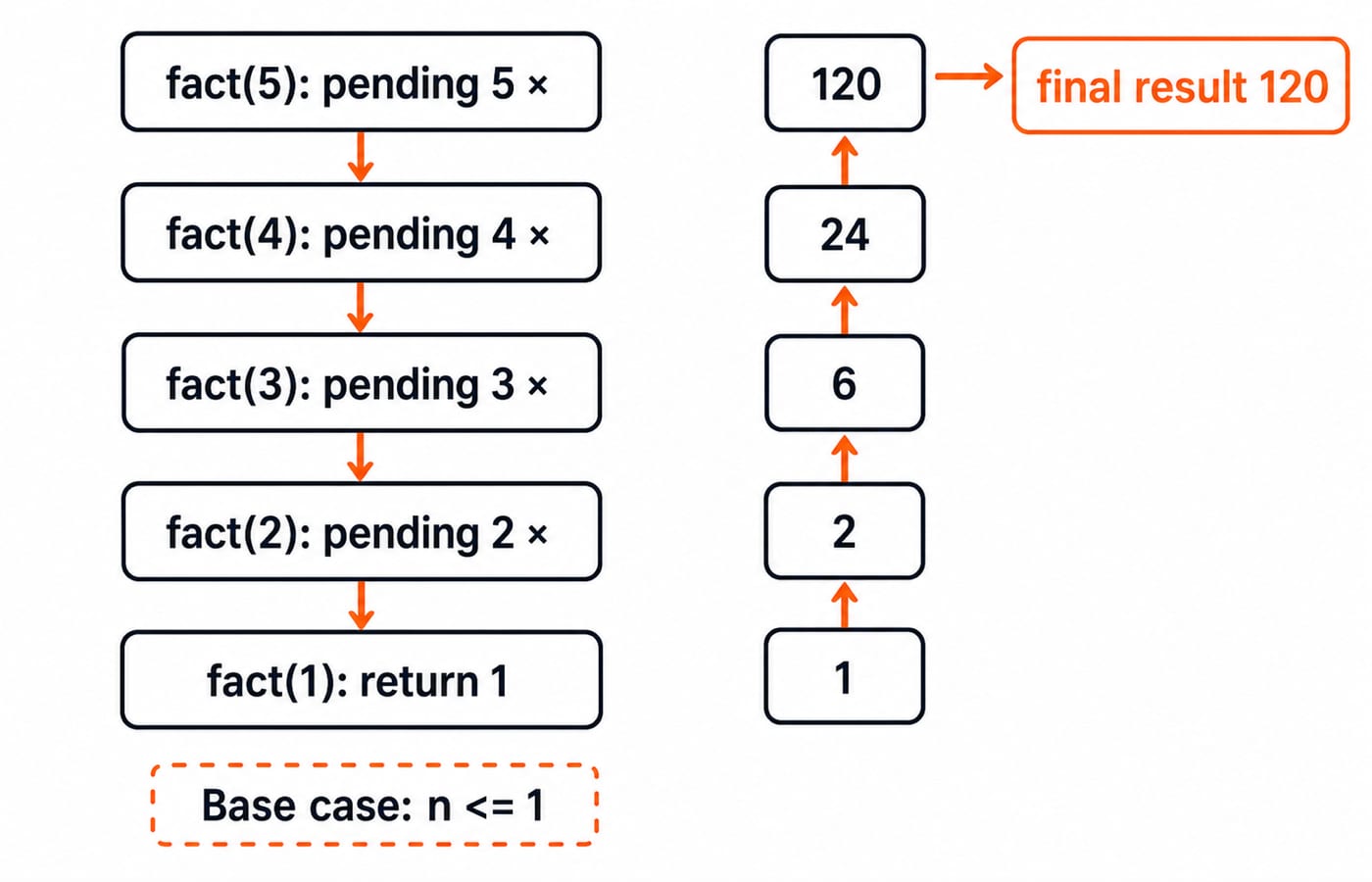
The descent is:
fact(5)
-> 5 * fact(4)
-> 5 * 4 * fact(3)
-> 5 * 4 * 3 * fact(2)
-> 5 * 4 * 3 * 2 * fact(1)
Now unwind in reverse: fact(1)=1, fact(2)=2*1=2, fact(3)=3*2=6, fact(4)=4*6=24, and fact(5)=5*24=120.
There are five invocations and five simultaneously active frames at maximum depth. Each frame lives on the call stack, the LIFO structure explained in Stacks and Queues: Operations and Uses, and stores its own n and pending multiplication.
Recursive output tracing: solve trace(5) without guessing
This function performs work both before and after its recursive call:
void trace(int n) {
    if (n <= 0) return;
    printf("%d ", n);
    trace(n - 2);
    printf("%d ", n);
}
The calls are trace(5), trace(3), trace(1) and trace(-1). Descent prints 5 3 1. The base case returns, then unwinding prints 1 3 5. The exact output is 5 3 1 1 3 5.
For such questions, draw one row per invocation. Record pre-call output on the left, then read post-call output from the bottom row upwards. Here there are four total invocations, including the base-case call, and four frames at maximum depth.
Recursive time and space: compare fact(5) with naive fib(5)
Factorial follows T(n)=T(n-1)+constant, so its time is Theta(n) and its auxiliary stack space is Theta(n). For the worked input, fact(5) makes five calls and returns 120.
Naive Fibonacci branches:
int fib(int n) {
    if (n <= 1) return n;
    return fib(n - 1) + fib(n - 2);
}
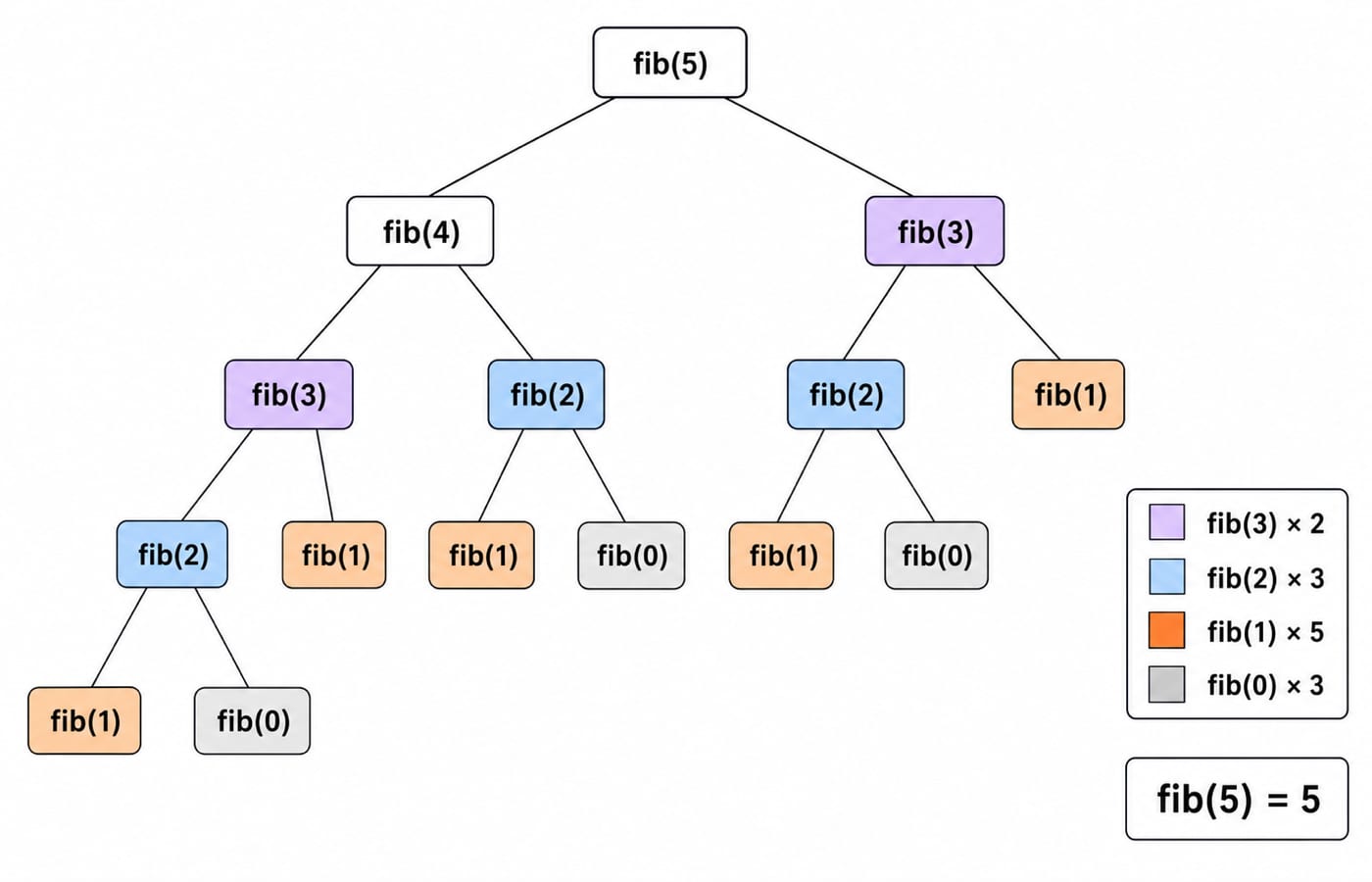
The values are fib(0)=0, fib(1)=1, fib(2)=1, fib(3)=2, fib(4)=3 and fib(5)=5. To count calls, use C(0)=C(1)=1 and C(n)=1+C(n-1)+C(n-2). Therefore C(2)=3, C(3)=5, C(4)=9 and C(5)=15.
Branching repeats subproblems. Naive Fibonacci time is Theta(phi^n), commonly upper-bounded by O(2^n), while its maximum stack depth remains Theta(n). The link between a recurrence and its growth rate is developed in Time Complexity and Asymptotic Notation. Memoisation removes the repeated evaluation of overlapping subproblems.
Recursion versus iteration: choose from the problem shape
Point | Recursion | Iteration |
|---|---|---|
Control state | Stored in call frames | Stored in explicit variables |
Auxiliary space | Often grows with depth | Usually constant for a simple linear loop |
Natural problem shapes | Trees, divide and conquer, recursive definitions | Linear repetition and state updates |
Common failure mode | Missing base case or excessive depth | Wrong loop bound or update |
Ease of tracing | Requires descent and unwind tracking | Usually follows execution order directly |
An iterative factorial starts with result=1. It reaches 2 after i=2, 6 after i=3, 24 after i=4, and 120 after i=5. It matches fact(5)=120 without five call frames.
Recursion is natural for recursively defined structures, but it is not automatically faster. A binary-tree traversal can process the root, recursively traverse the left subtree, then recursively traverse the right subtree because the data itself has recursive shape.
Basic recursion mistakes: why they fail and how to repair them
Wrong base condition: If the
trace(5)guard becomesn == 0, arguments follow5, 3, 1, -1, -3, ...and never reach zero. Calls continue until stack exhaustion. Usen <= 0for this decrement-by-two function.No progress or wrong progress: Calling
fact(n)repeats the same state, whilefact(n + 1)moves away from the base. Write the decreasing measure beside the call, heren - 1, and prove it reachesn <= 1.Return-order or domain mistake: A statement after the recursive call runs during unwinding, not descent. Split every frame into pre-call and post-call work. Also reject negative factorial input at the public boundary because it violates the function contract.
Basic recursion exam patterns: trace, count, evaluate and analyse
Recurring tasks ask you to predict printed output, compute a returned value, count calls or maximum depth, and derive time plus auxiliary space. For these functions, trace(5) prints 5 3 1 1 3 5, fact(5) returns 120 with five calls, and fib(5) returns 5 with 15 calls.
Changing only the base case can change the count, so never import an answer from a similar-looking function. Use this checklist:
Copy the base case exactly.
List argument values on descent.
Evaluate deferred operations on unwind.
Count every invocation, including the base-case invocation.
GATE Guidance by Sanchit Sir provides a broader subject-wise preparation route when you want to place recursion inside a complete CS sequence.
Basic recursion: the short version and next step
Identify the base case.
Prove progress towards it.
State the smaller call's contract before trusting its result.
Unwind pending work in reverse order.
Analyse running time separately from stack space.
Keep the three anchor answers clear: fact(5)=120, trace(5) prints 5 3 1 1 3 5, and naive fib(5) makes 15 calls.
For the wider sequence with concepts, MCQs and coding practice, continue with the C Language course.
Keep learning
Functions in C: Syntax, Parameters and Worked Examples
Learn how C declarations, calls, and definitions fit together. Compile two complete programs, follow their values, and trace composition and recursion.
Updated 6 Oct 20266 min readC Programming & Data Structures
Smart Pointers in C++: unique_ptr, shared_ptr and weak_ptr with Worked Examples
Learn who owns a C++ object, when it is destroyed, and how to choose among unique_ptr, shared_ptr, weak_ptr and a borrowed raw pointer.
Updated 1 Oct 20265 min readC Programming & Data Structures
Pointers in C: Addresses, Arrays and Functions with Worked Examples
Build a practical pointer model with runnable C programs for dereferencing, arrays, swapping, dynamic memory and common tracing questions.
Updated 26 Sep 20265 min readC Programming & Data Structures
Pointers and Arrays in C: Decay, Indexing and Worked Examples
Separate arrays from pointers with runnable traces covering indexing, one-past boundaries, function parameters, two-dimensional arrays and declaration traps.
Updated 24 Sep 20265 min readC Programming & Data Structures