

Array Basics and Operations: Concepts, Worked Examples and Exam Traps
Understand array indices, size, capacity and operation costs through a single worked array. Then practise insertion, deletion, search and address calculation without off-by-one errors.
KnowledgeGate Team
Exam prep & CS education
Updated 1 Nov 20265 min read
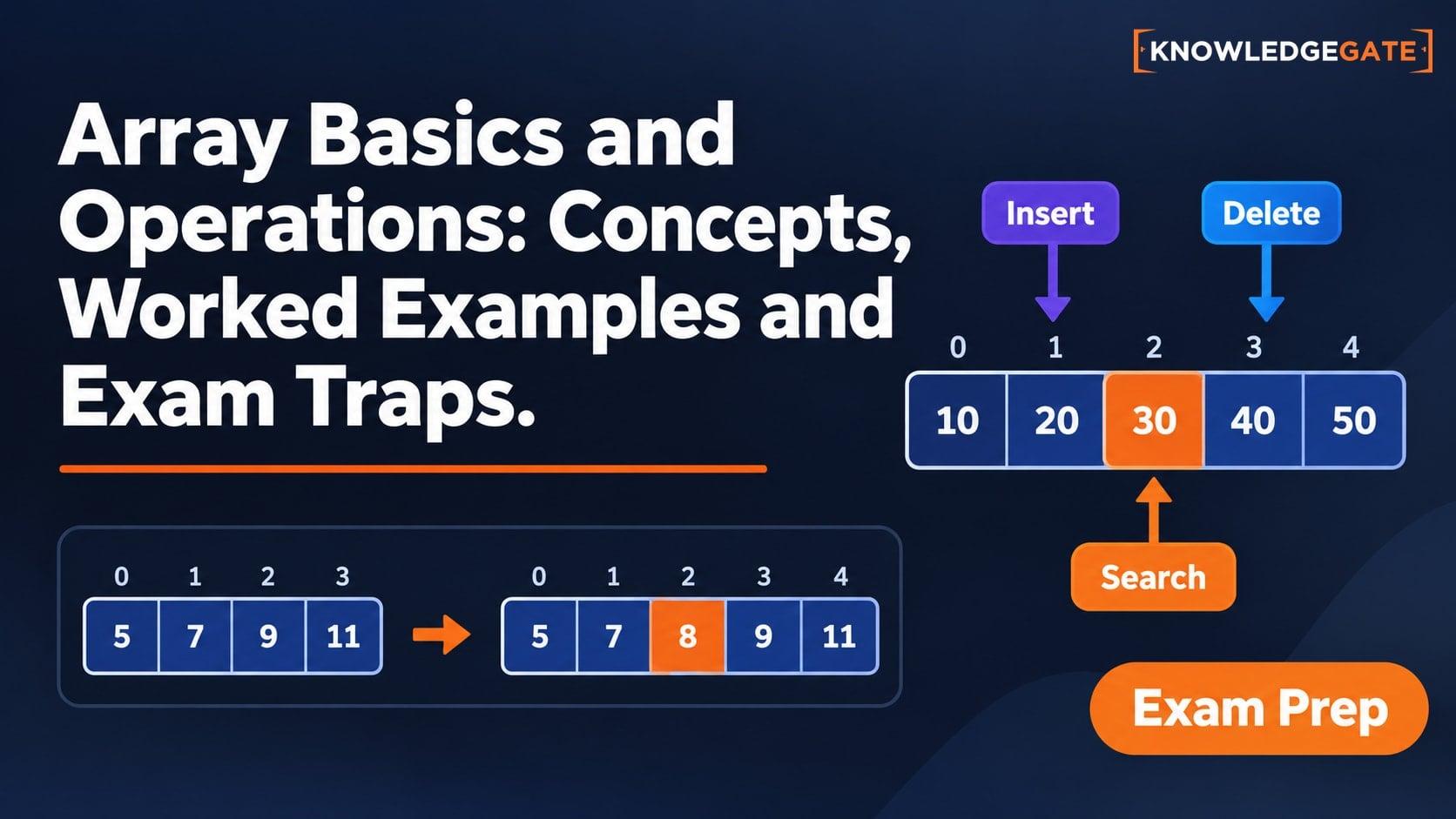
An array looks simple, but exam errors come from confusing an index with a value, logical size with capacity, or an O(1) lookup with an O(n) insertion. A zero-based array model links direct access, insertion, deletion and boundary checks.
Array basics: slots, indices, size and capacity
A one-dimensional array has indexed slots holding elements of one declared type. In this C-like model, logical size n gives valid indices 0 through n - 1.
Take this running state:
A = [12, 7, 25, 9, 18, _, _, _]
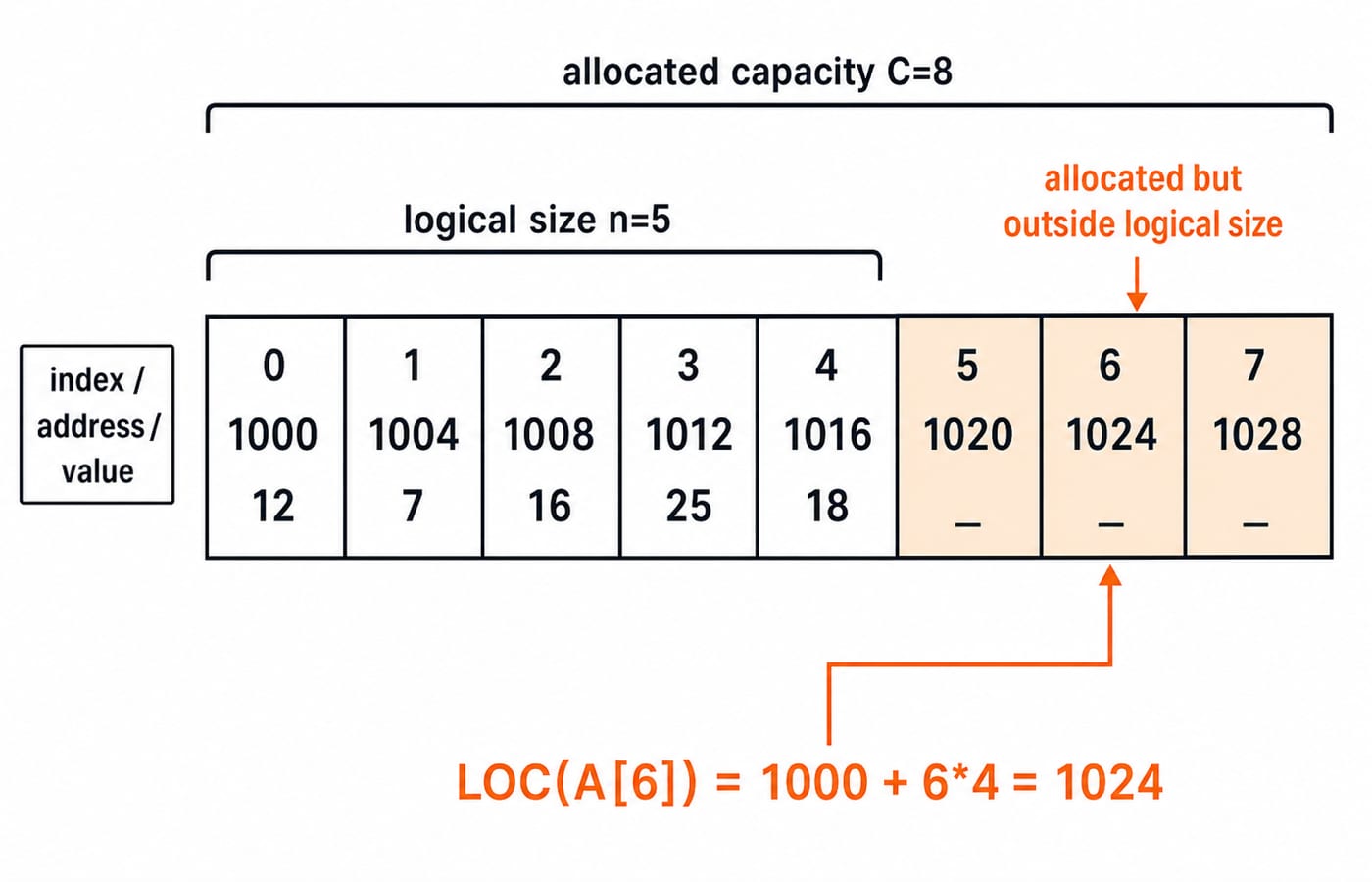
Here C = 8, but n = 5. Only indices 0 through 4 are logical elements. Indices 5 through 7 are allocated but unused.
Reading A[5] is therefore invalid. A valid end insertion may write there because capacity remains.
Contiguous storage enables direct address calculation. Languages may add bounds checks or array-object behaviour, but the same indexed model helps. See CS Fundamentals for the wider programming foundation.
What each basic array operation actually costs
Complexity follows from the work performed:
Operation | Typical or worst-case cost | Why |
|---|---|---|
Access or update by valid index |
| Calculate one address and read or write one slot |
Traverse all logical elements |
| Visit |
Search an unsorted array |
| The target may be last or absent |
Insert at an arbitrary position |
| Shift later elements right |
Delete at an arbitrary position |
| Shift later elements left |
Inserting at index n can take O(1) when capacity exists because nothing shifts. Deleting index n - 1 can also take O(1). Arbitrary insertion or deletion remains O(n) worst case.
A growable container may allocate new storage and copy elements, so an append that triggers resizing is not an O(1) individual operation.
Worked example: insert, delete and search
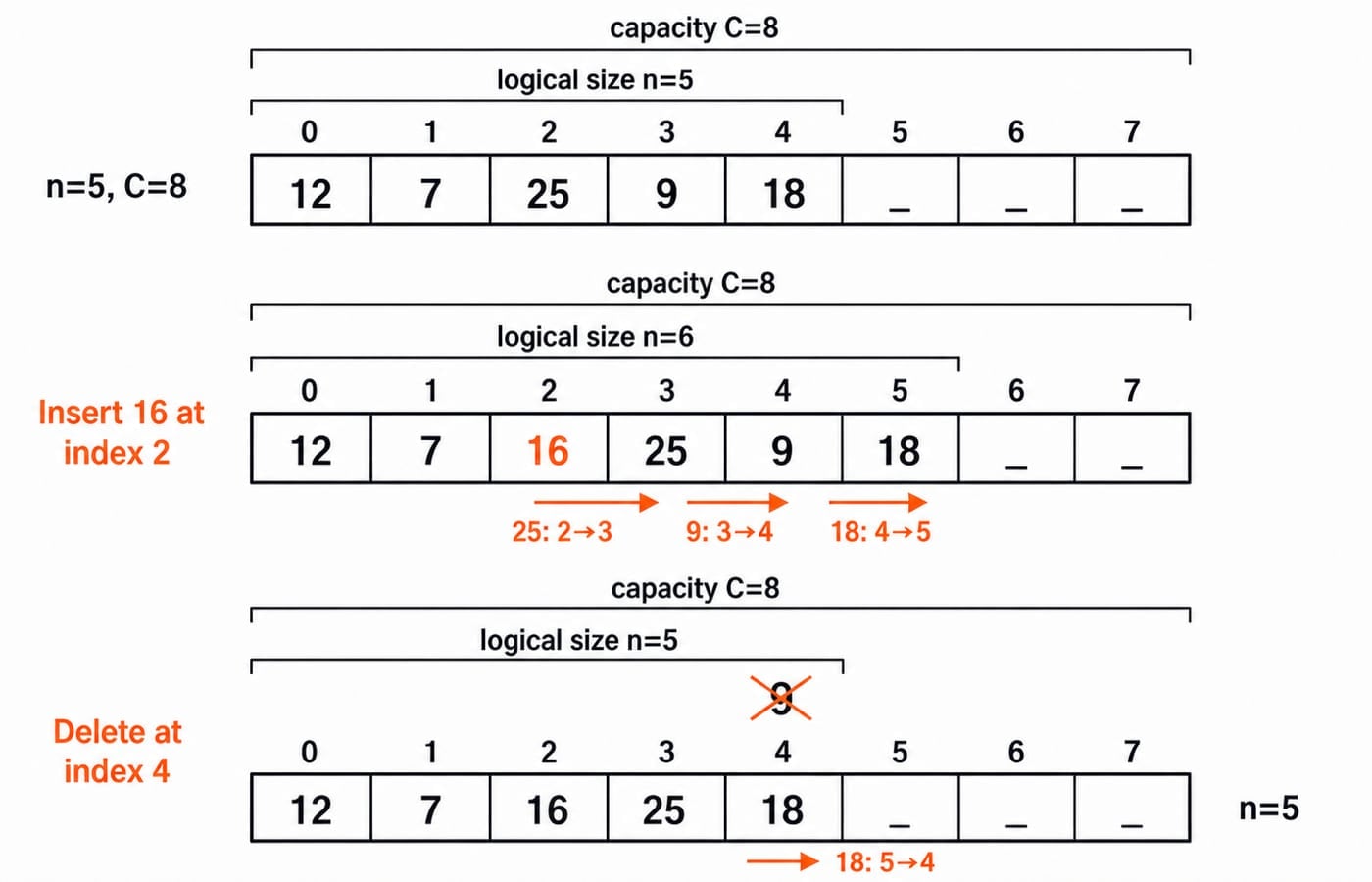
Start with A = [12, 7, 25, 9, 18, _, _, _], n = 5, C = 8.
Insert 16 at index 2, moving right to left:
Move
18from index4to index5.Move
9from index3to index4.Move
25from index2to index3.Write
16at index2and setn = 6.
Result: [12, 7, 16, 25, 9, 18, _, _], with three shifts and one inserted write.
Delete index 4, whose value is 9. Move 18 from index 5 to 4, then reduce n to 5. Within capacity the result is [12, 7, 16, 25, 18, _, _, _]. This used one shift.
Searching left to right for 25 succeeds at index 3 after four comparisons. Searching for 11 fails after five. The successful result is index 3, not value 25.
The operation loops and their invariants
For insertion, require 0 <= pos <= n and n < C.
for i from n down to pos + 1:
    A[i] = A[i - 1]
A[pos] = value
n = n + 1
Right-to-left movement preserves unread elements. The opposite direction would overwrite 25 before moving it.
For deletion, require 0 <= pos < n. Save A[pos] first if needed.
for i from pos through n - 2:
    A[i] = A[i + 1]
n = n - 1
Left-to-right movement lets each next element fill the gap.
Traversing [12, 7, 16, 25, 18] gives running sums 12, 19, 35, 60, 78, total 78, and maximum 25.
Direct access and address calculation
With lower bound L and element width w bytes:
LOC(A[k]) = base + (k - L) * w
For a C-style int A[8] with base = 1000, L = 0 and w = 4:
LOC(A[2]) = 1000 + (2 - 0) * 4 = 1000 + 8 = 1008LOC(A[6]) = 1000 + (6 - 0) * 4 = 1000 + 24 = 1024
For one-based B[1..8], base 500 and width 2:
LOC(B[5]) = 500 + (5 - 1) * 2 = 500 + 8 = 508
Subtracting the lower bound keeps both cases consistent. Address 1024 is allocated, but index 6 is not logical when n = 5.
Use Array Basics in C: Indexing, Memory Layout and Worked Exam Traces for declaration, initialization, sizeof and mutation traces. The address calculation above answers a different question: an allocated slot can still sit outside logical size. Pointers in C: Memory Diagrams develops the next layer of pointer arithmetic.
Common array traps and how to repair them
Indices
0..n: use0..n-1.Size versus capacity:
n = 5elements,C = 8slots.Insertion shifting left: move right to left to preserve unread values.
Deletion shifting right: move left to right to close the gap.
Value instead of position: searching for
25returns index3.
Index 5 may receive a new end element during insertion, but cannot be read as current beforehand. After deletion, the last logical element is A[4] = 18.
Access is O(1) because address calculation uses constant work, not because the array is small. Unsorted search is O(n). The example insertion moved three elements even though its final write was constant time.
How exams test array basics and operations
Start with [4, 8, 15, 16, 23] and delete index 1. Moving 15, 16 and 23 left gives [4, 15, 16, 23], with three shifts.
Insert 9 at index 3. Move 23 to index 4, write 9, and get [4, 15, 16, 9, 23], with one shift. Therefore:
A[2] + A[4] = 16 + 23 = 39
Questions may ask you to trace code, select a valid range, count shifts, calculate an address, identify complexity, or spot an invalid access. Write n, index labels and loop direction first.
The short version and the next practice step
Remember five ideas:
Indices identify positions, not values.
Logical size may be smaller than allocated capacity.
Address arithmetic makes valid indexed access
O(1).Middle insertion and deletion require shifts.
Every loop needs an explicit valid-index invariant.
For a 15-minute drill, take capacity 7 with [6, 10, 14, 18, _, _, _]. Insert 12 at index 2, delete index 4, then search for 18. Record each array, n and every shift.
Repeat the 15-minute drill above, test each boundary case, then use Zero to Hero for a broader CS path or the C Language course for direct array practice.
Keep learning
Array Basics and Operations MCQs: 12 Solved Questions with Explanations
Attempt 12 published array MCQs, then check concise explanations for indexing, address arithmetic, search, shifting costs, and rotation.
Updated 29 Oct 20267 min readData Structures MCQs
Stack Basics and Operations MCQs: 12 Solved Questions with Step-by-Step Explanations
Test stack fundamentals through 12 exam MCQs on LIFO, TOP, array bounds, queue transfers and permutations. Complete traces make every state and answer checkable.
Updated 3 Oct 20268 min read110 viewsData Structures MCQs

Language Operations and Sets Explained: Union, Concatenation, Kleene Star and Exam Problems
Learn why epsilon differs from the empty language, how order changes concatenation, and how small counterexamples expose false identities. Two worked languages carry every result.
Updated 30 Oct 20266 min readTheory of Computation
String Operations in Theory of Computation: Basics, Definitions and Worked Examples
Build string notation from alphabet and epsilon through prefixes, reversal, language products and Kleene closure. Every rule is checked with exact worked values.
Updated 6 Sep 20265 min readTheory of Computation