Stack Basics and Operations MCQs: 12 Solved Questions with Step-by-Step Explanations
Test stack fundamentals through 12 exam MCQs on LIFO, TOP, array bounds, queue transfers and permutations. Complete traces make every state and answer checkable.
KnowledgeGate Team
Exam prep & CS education
Updated 3 Oct 20268 min read
Stack traces become fragile when TOP changes repeatedly, a queue appears, or an array grows towards lower indices. One missed state corrupts every later answer.
LIFO order, overflow and underflow, array and linked representations, stack-queue transfers, shared storage, permutations and queue construction all depend on explicit state. Use Coding & Skills for broader practice. Choose an option first, then record each stack state before reading the explanation.
Stack rules and the state-trace method
Rule | Meaning |
|---|---|
Stack | Last in, first out (LIFO) |
| Insert at TOP |
| Remove and return TOP |
| Read TOP without removing it |
Underflow | Pop an empty stack |
Overflow | Push a full fixed-capacity stack |
For an array stack, empty means top = -1, full means top = N - 1, and push and pop are O(1). A linked stack keeps TOP at the head.
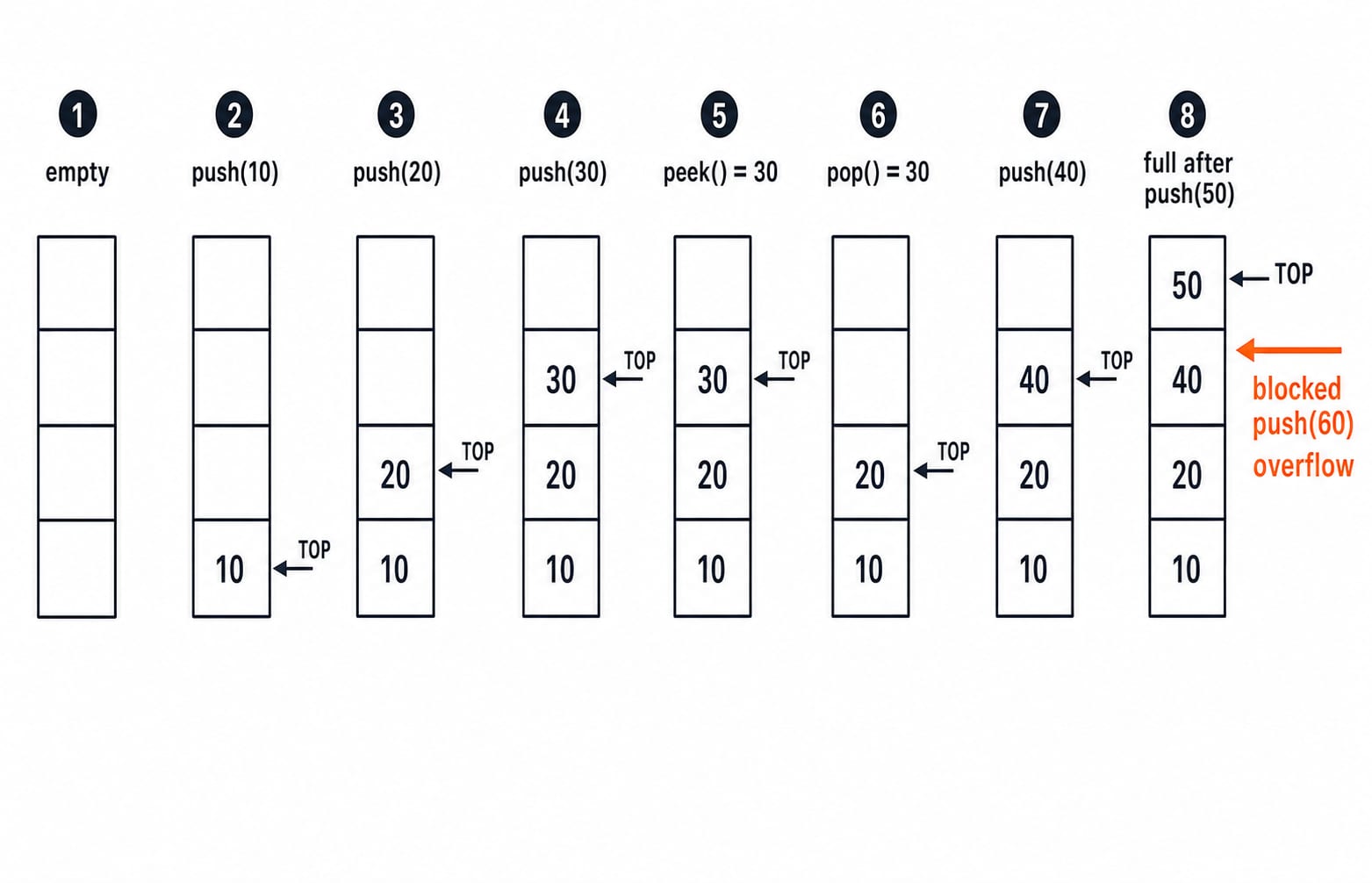
Trace a capacity 4 stack bottom to top. Begin with [], top = -1. push(10) gives [10], top = 0; push(20) gives [10, 20], top = 1; push(30) gives [10, 20, 30], top = 2. peek() returns 30 unchanged. pop() returns 30, leaving [10, 20], top = 1. push(40) gives [10, 20, 40], top = 2; push(50) fills [10, 20, 40, 50], top = 3. Another push(60) overflows. Always record contents and TOP.
Stack MCQs 1 to 3: operations, overflow and constant-time push
Question 1, TPSC 2025
Which of the following operations is not possible in a stack ?
A. Push
B. Pop
C. Peek
D. Delete from the middle
Answer: D.
In [10, 20, 30], push, pop and peek touch TOP (30). Deleting 20 is not a standard operation because 30 must be removed or bypassed first.
Question 2, Hexaware 2024
If the size of the stack is 10 and we try to add the 11th element in the stack then the condition is known as___
A. Underflow
B. Garbage collection
C. Overflow
D. None of the above
Answer: C.
A size 10 stack has positions 0 through 9. The 11th push causes overflow; pop() on [] causes underflow.
Question 3, Beltron Programmer 2025
What is the time complexity of the push() operation in an array-based stack?
A. O(1)
B. O(log n)
C. O(n log n)
D. O(n)
Answer: A.
With top = 6, pushing 42 checks capacity, sets top = 7, and writes A[7] = 42: O(1) work. A dynamic array may sometimes resize.
Stack MCQs 4 to 6: trace every push, pop and queue transfer
For the broader mixed-structure set, including the 10/20 version of this operation pattern, use Stacks and Queues MCQs: 12 Solved (GATE). Trace the 1/2 sequence below from bottom to top; the following question then adds a queue transfer.
Question 4, Indian Space Research Organization 2015
If the sequence of operations - push (1), push (2), pop, push (1), push (2), pop, pop, pop, push (2), pop are performed on a stack, the sequence of popped out values
A. 2,2,1,1,2
B. 2,2,1,2,2
C. 2,1,2,2,1
D. 2,1,2,2,2
Answer: A.
Trace [] -> [1] -> [1,2]; pop outputs 2, leaving [1]; pushing 1 and 2 gives [1,1] -> [1,1,2]; three pops output 2,1,1, leaving []; push 2 gives [2], then pop outputs 2. Thus 2,2,1,1,2.
Queue Basics and Stack Mix MCQs works through the longer seven-item transfer in a table. This five-item BEL variant is shorter: the decisive point is the order in which E and D leave the queue and return to TOP.
Question 5, BEL 2007
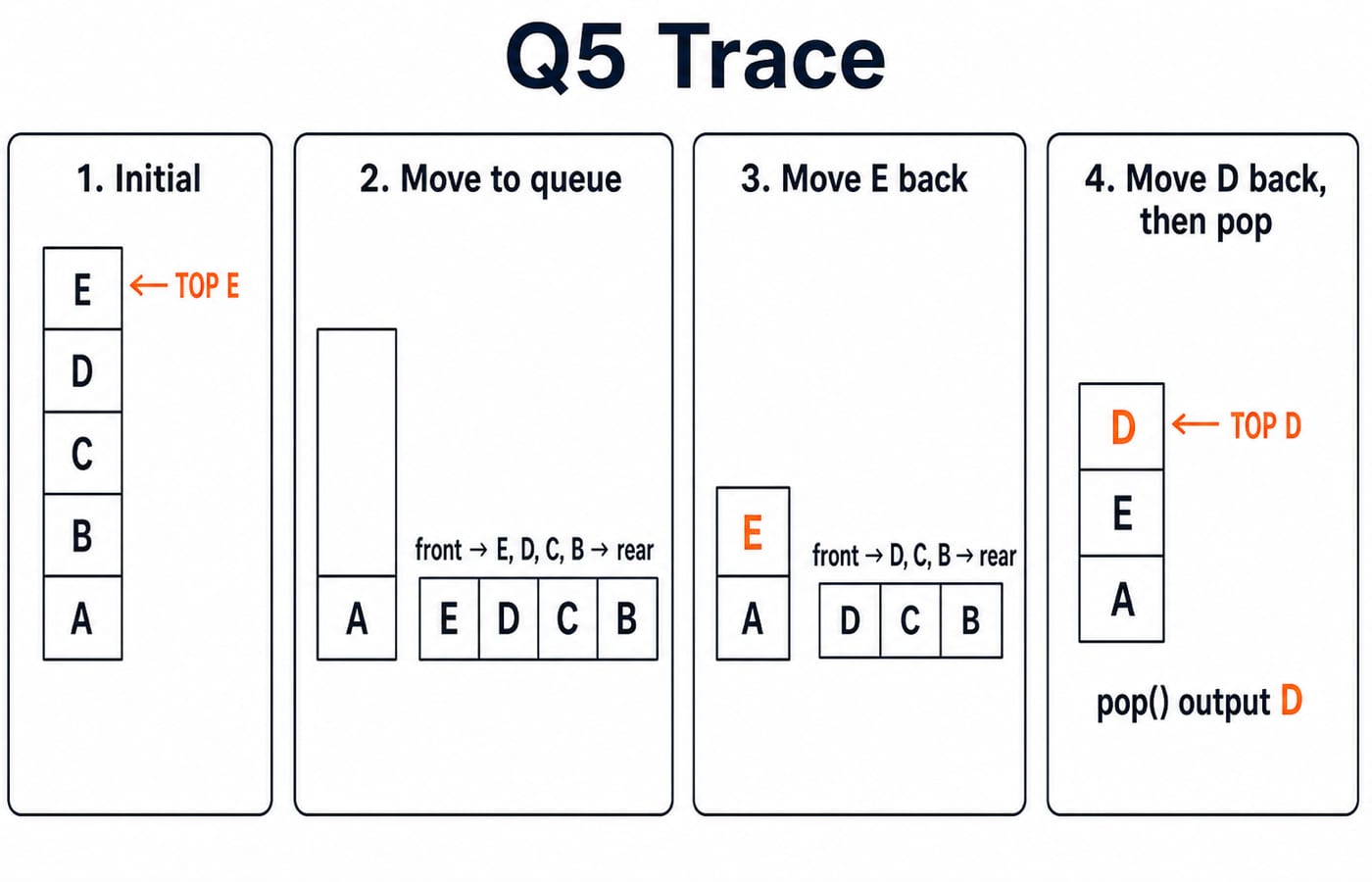
The five items: A, B, C, D, and E are pushed in a stack, one after the other starting from A. The stack is popped four times and each element is inserted in a queue. Then two elements are deleted from the queue and pushed back on the stack. Now one item is popped from the stack. The popped item is
A. A
B. B
C. C
D. D
Answer: D.
The pushes produce [A,B,C,D,E], with E at TOP. Four pops leave [A] and enqueue E,D,C,B, E first. Dequeue and push E to get [A,E]; repeat with D for [A,E,D]. The next pop returns D.
Question 6, UGC NET 2016
Consider the following operations performed on a stack of size 5 :
Push (a); Pop() ; Push(b); Push(c); Pop();
Push(d); Pop();Pop(); Push (e)
Which of the following statements is correct ?
A. Underflow occurs
B. Stack operations are performed smoothly
C. Overflow occurs
D. None of the above
Answer: B.
Trace [] -> [a] -> [] -> [b] -> [b,c] -> [b] -> [b,d] -> [b] -> [] -> [e]. No pop hits []; occupancy peaks at 2, below capacity 5. No error occurs.
Stack MCQs 7 to 9: array direction, valid TOP and linked representation
Question 7, Indian Space Research Organization 2020
A stack is implemented with an array of ‘A[0...N – 1]’ and a variable ‘pos’. The push and pop operations are defined by the following code.
push (x)
  A[pos] ← x
  pos ← pos – 1
end push

pop ( )
  pos ← pos + 1
  return A[pos]
end pop
Which of the following will initialize an empty stack with capacity N for the above implementation ?
A. pos ← –1
B. pos ← 0
C. pos ← 1
D. pos ← N – 1
Answer: D.
The code writes before decrementing, so growth is towards smaller indices. For N = 4, start at pos = 3. Four pushes fill A[3], A[2], A[1], A[0], leaving pos = -1; every cell is used.
Question 8, RSSB 2022
Consider the following stack implemented using stack –
#define SIZE 11
Struct STACK
{
    int arr[SIZE];
    int top = -1;
}
What would be the maximum value of top that does not cause the overflow of the stack?
A. 8
B. 9
C. 11
D. 10
Answer: D.
arr[11] has indices 0 through 10. From top = -1, the first item occupies 0 and the 11th occupies 10. Thus the maximum safe TOP is 10; 11 is outside the array.
Question 9, CDAC CCAT 2017
In the standard linked-list representation of a stack, where TOP points to the first node and links continue toward older stack elements, the null pointer of the last node in the list represents:
A. Beginning of the stack
B. Bottom of the stack
C. Middle of the stack
D. In between some value
Answer: B.
In TOP -> 42 -> 17 -> 9 -> null, links reach older elements. Node 9 has no successor, so null marks the bottom; the head is TOP.
Stack MCQs 10 to 12: shared arrays, permutations and queue construction
Question 10, GATE 2004
A single array A[1..MAXSIZE] is used to implement two stacks. The two stacks grow from opposite ends of the array. Variables top1 and top2 (topl< top 2) point to the location of the topmost element in each of the stacks. If the space is to be used efficiently, the condition for “stack full” is
A. (top1 = MAXSIZE/2) and (top2 = MAXSIZE/2+1)
B. top1 + top2 = MAXSIZE
C. (top1= MAXSIZE/2) or (top2 = MAXSIZE)
D. top1= top2 -1
Answer: D.
Full means no gap remains between TOP positions. With MAXSIZE = 10, top1 = 6 and top2 = 7 are adjacent, so another push collides. Thus top1 = top2 - 1; a midpoint could waste cells.
Question 11, GATE 1994
Which of the following permutations can be obtained in the output (in the same order) using a stack assuming that the input is the sequence 1, 2, 3, 4, 5 in that order?
A. 3, 4, 5, 1, 2
B. 3, 4, 5, 2, 1
C. 1, 5, 2, 3, 4
D. 5, 4, 3, 1, 2
Answer: B.
Construct B: push 1,2,3, pop 3; push 4, pop 4; push 5, pop 5; then pop 2,1. A and D demand 1 while it is below 2. In C, after outputting 1 and stacking 2,3,4,5, popping 5 exposes 4, not 2.
Question 12, Goldman Sachs 2023
Suppose implementation supports an instruction REVERSE, which reverses the order of elements on the stack, in addition to the PUSH and POP instructions. Which one of the following statements is TRUE with respect to this modified stack?
A. A queue cannot be implemented using this stack.
B. A queue can be implemented where ENQUEUE takes a single instruction and DEQUEUE takes a sequence of two instructions.
C. A queue can be implemented where ENQUEUE takes a sequence of three instructions and DEQUEUE takes a single instruction.
D. A queue can be implemented where both ENQUEUE and DEQUEUE take a single instruction each.
Answer: C.
Keep the queue front at TOP, so DEQUEUE is one POP. To append 30 to [10,20], use REVERSE, PUSH(30), REVERSE. TOP-to-bottom order becomes 10,20,30, so the next pop returns 10: three ENQUEUE instructions, one DEQUEUE instruction.
Common traps in stack operations
Trap | What fails | Replacement habit |
|---|---|---|
TOP treated as a count | Q8 uses an invalid index | Write the valid range |
Errors confused | Q2 and Q6 get reversed | Test full and empty separately |
Queue read as LIFO | Q5 returns the wrong item | Mark front and rear |
Upward growth assumed | Q7 starts at the wrong end | Read the code's direction |
Midpoint fixed | Q10 wastes shared cells | Test TOP adjacency |
Permutation guessed | Q11 accepts the impossible | Construct legal pushes and pops |
Answer check and the next practice step
Answer key: 1-D, 2-C, 3-A, 4-A, 5-D, 6-B, 7-D, 8-D, 9-B, 10-D, 11-B, 12-C.
10 to 12 correct: Move to mixed stack problems.
7 to 9 correct: Repeat the representation or trace type you missed.
0 to 6 correct: Rebuild LIFO, TOP, overflow and underflow first.
Redo Q4, Q5, Q10 and Q11 without options. Q4 checks a pure LIFO trace, Q5 adds a queue transfer, Q10 checks shared-array boundaries, and Q11 tests whether an output permutation is constructible.
Continue with DSA Using Java, or use Coding for Placements for placement practice. Record every stack state so each operation remains checkable.
Keep learning
Evaluation of Expressions MCQs: 12 Solved Questions with Stack Traces
Solve 12 expression MCQs step by step. Trace postfix and prefix evaluation, nesting depth, precedence and notation conversion without reversing operands.
Updated 27 Sep 20267 min readData Structures MCQs
Priority Queue MCQs: 12 Solved Questions on Heaps, Deques and Variants
Attempt 12 verified priority queue and queue-variant MCQs, then learn from concise heap, array, circular queue and deque traces.
Updated 25 Sep 20267 min readData Structures MCQs
Infix, Postfix and Prefix MCQs: 12 Solved Questions with Step-by-Step Explanations
Solve 12 expression-notation MCQs in increasing difficulty, from basic stack use to conversions, associativity and maximum operand-stack depth.
Updated 24 Sep 20268 min read53 viewsData Structures MCQs
Circular Queue MCQs: 12 Solved Questions with Step-by-Step Explanations
Solve 12 Circular Queue MCQs in sequence, with exact options and concise explanations for pointer conventions, wrap-around arithmetic and linked queues.
Updated 22 Sep 20268 min readData Structures MCQs