

Array Basics Interview Questions and Answers in C: Worked Traces and Traps
Build interview-ready answers for C arrays through exact memory, reversal, and second-largest traces, with the edge cases and reasoning behind each result.
KnowledgeGate Team
Exam prep & CS education
Updated 19 Nov 20266 min read
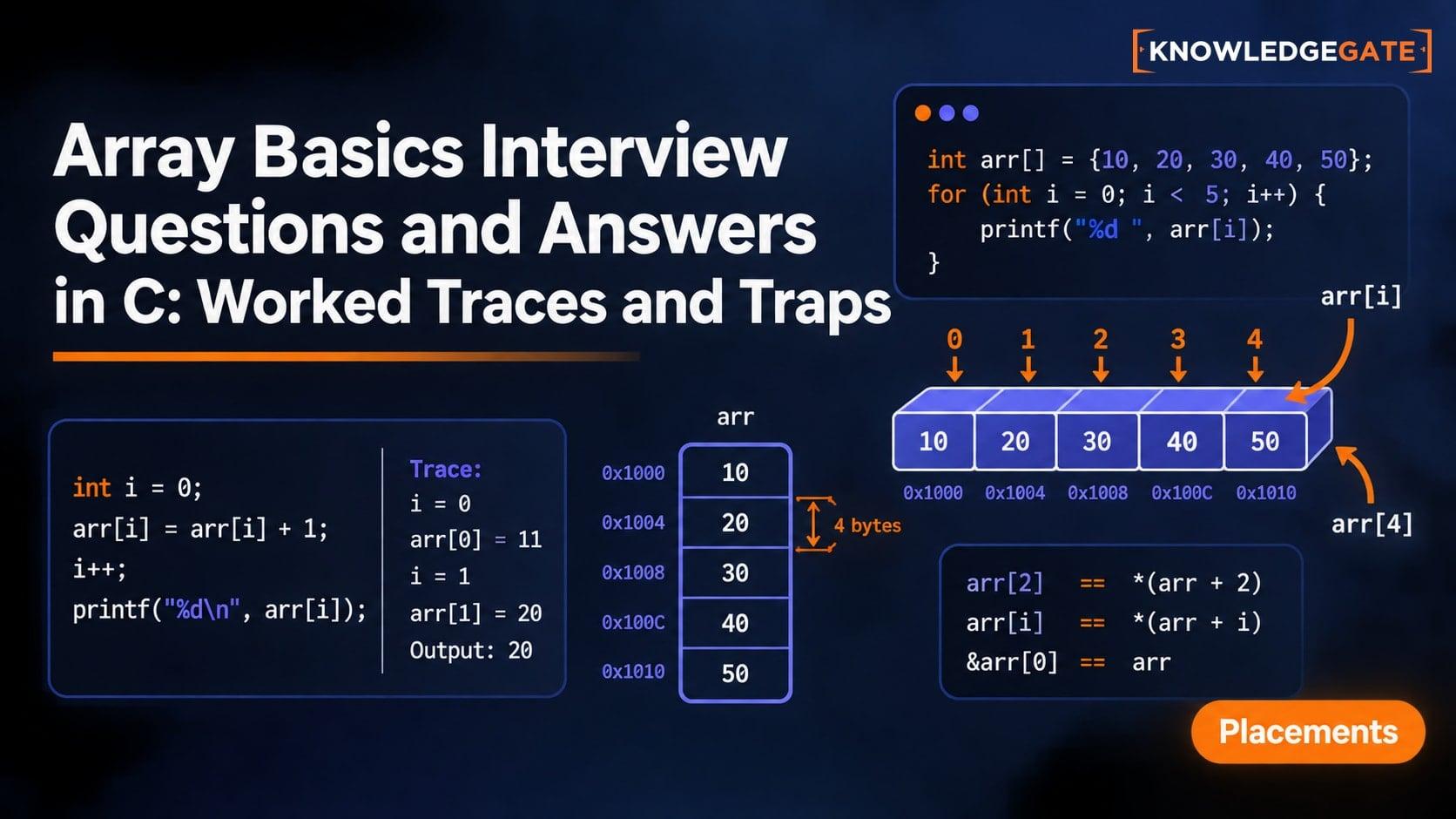
Many candidates can declare an array, then stumble when asked why indexing starts at zero, whether an array is a pointer, what sizeof sees after a function call, or how a loop invariant proves correctness. Strong answers connect each definition to a reason, then trace memory layout, in-place reversal, and the second-largest distinct value. Fundamentals-first screening and deeper implementation follow-ups are useful preparation lenses, not fixed employer patterns.
Array basics: definition and properties
An array in C is a fixed-size, contiguous sequence of one element type. int a[5] has five int elements, indices 0 through 4, and a fixed size for that object. Some versions and implementations permit variable length arrays, but the indexing model is unchanged.
a[i] is defined as *(a + i). Index 0 therefore means zero elements from the first element, while index i has byte offset i * sizeof(element type). Valid-index access is O(1) address arithmetic, not a search.
Unsorted search is O(n). Front insertion or deletion in a packed array is O(n) because elements shift, but appending into available capacity in an array-backed container can be O(1). See Arrays in C: Declaration, Initialization and Worked Examples for the declaration foundation.
C array memory layout: five values and addresses
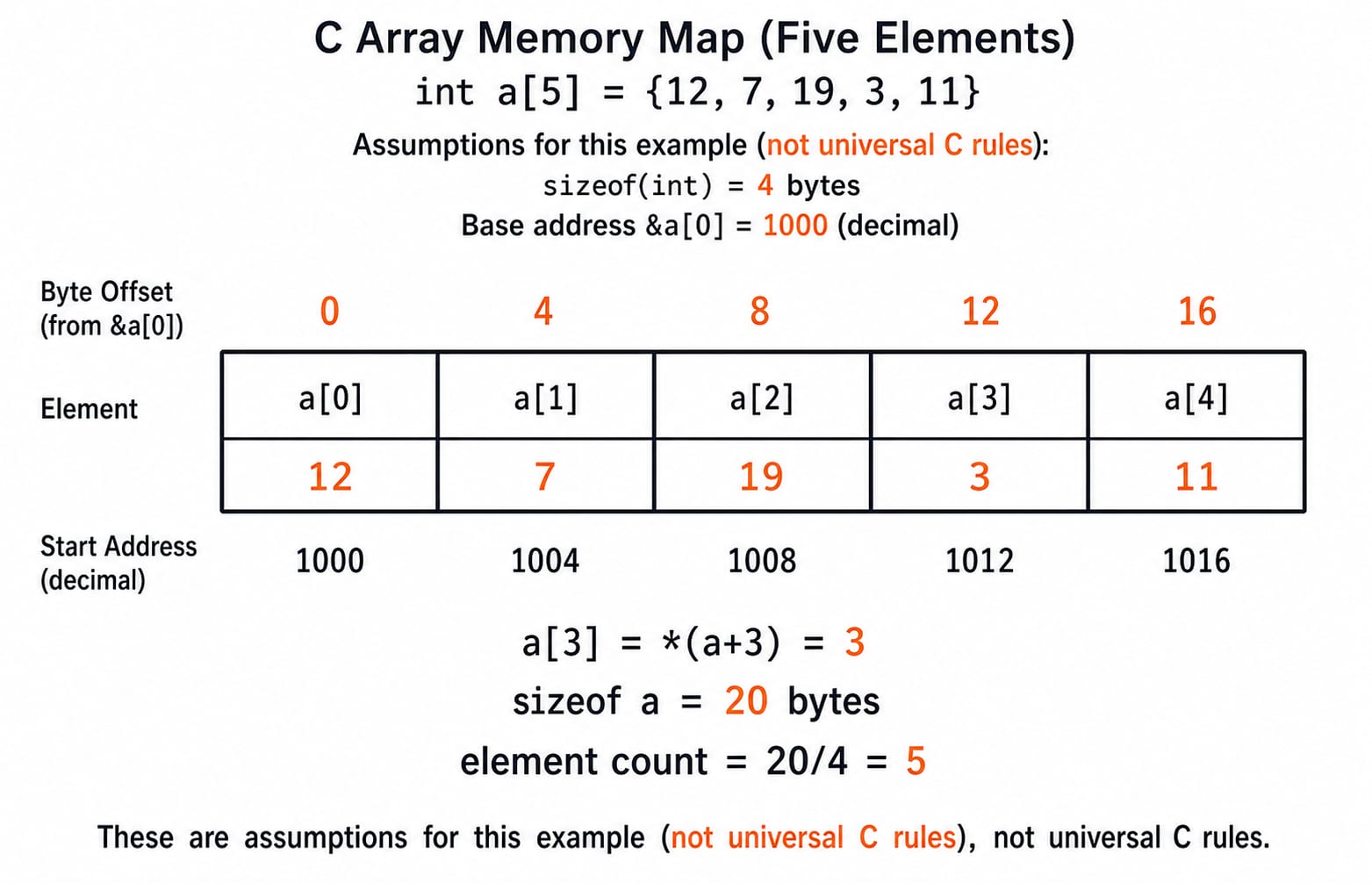
Take int a[5] = {12, 7, 19, 3, 11};. Assume sizeof(int) = 4 bytes and decimal base address &a[0] = 1000. Element i starts at 1000 + i * 4:
Element | Value | Address calculation | Start address |
|---|---|---|---|
| 12 |
| 1000 |
| 7 |
| 1004 |
| 19 |
| 1008 |
| 3 |
| 1012 |
| 11 |
| 1016 |
Thus a[3] = *(a + 3) = 3, *(a + 4) = 11, and a[1 + 2] = a[3] = 3. The offset of a[4] from a[0] is 4 * 4 = 16 bytes. In the declaring scope, sizeof a = 5 * 4 = 20 bytes and sizeof a / sizeof a[0] = 20 / 4 = 5 elements.
Addresses 1000 through 1019 are occupied; only 1000, 1004, 1008, 1012, and 1016 start elements. C fixes neither a four-byte int nor address 1000; both are assumptions.
Is an array a pointer? sizeof and decay
No. a is an int[5] array object. In most expressions its name converts to a pointer to the first element, so a[i] equals *(a + i). The array owns five elements; a pointer stores a reassignable address. An array name is not a modifiable lvalue, so a++ and a = other are invalid.
In its declaring scope, sizeof a = 20 under our assumptions. In void inspect(int a[]), the parameter adjusts to int *a, so sizeof a is the pointer size, not 20. Assuming sizeof(int *) = 8, it yields 8. Pointer size is implementation-dependent; pass the element count separately.
a + 1 points to 1004. &a, type int (*)[5], starts numerically at 1000, but &a + 1 advances 20 bytes to 1020. Arrays and Strings in C: Decay, sizeof and 2D Addresses covers deeper cases.
Array bounds and initialization: four traps
What happens at a[5]? Valid indices are 0 through 4. The access has undefined behaviour: it need not wrap, return zero, or fail at compilation. Use i < 5, not i <= 5.
What does partial initialization do? int b[5] = {9, 4}; gives {9, 4, 0, 0, 0}. An uninitialised automatic local int b[5]; has indeterminate elements. Static-storage objects are zero-initialised.
Where does the count formula work? sizeof a / sizeof a[0] works where a is the array, not after parameter adjustment.
Can arrays be assigned? Direct left = right is invalid. Use suitable memcpy or an element loop. A character array initialised from a string literal may contain its terminating null character.
Reverse an array in place: exact swaps, invariant, and complexity
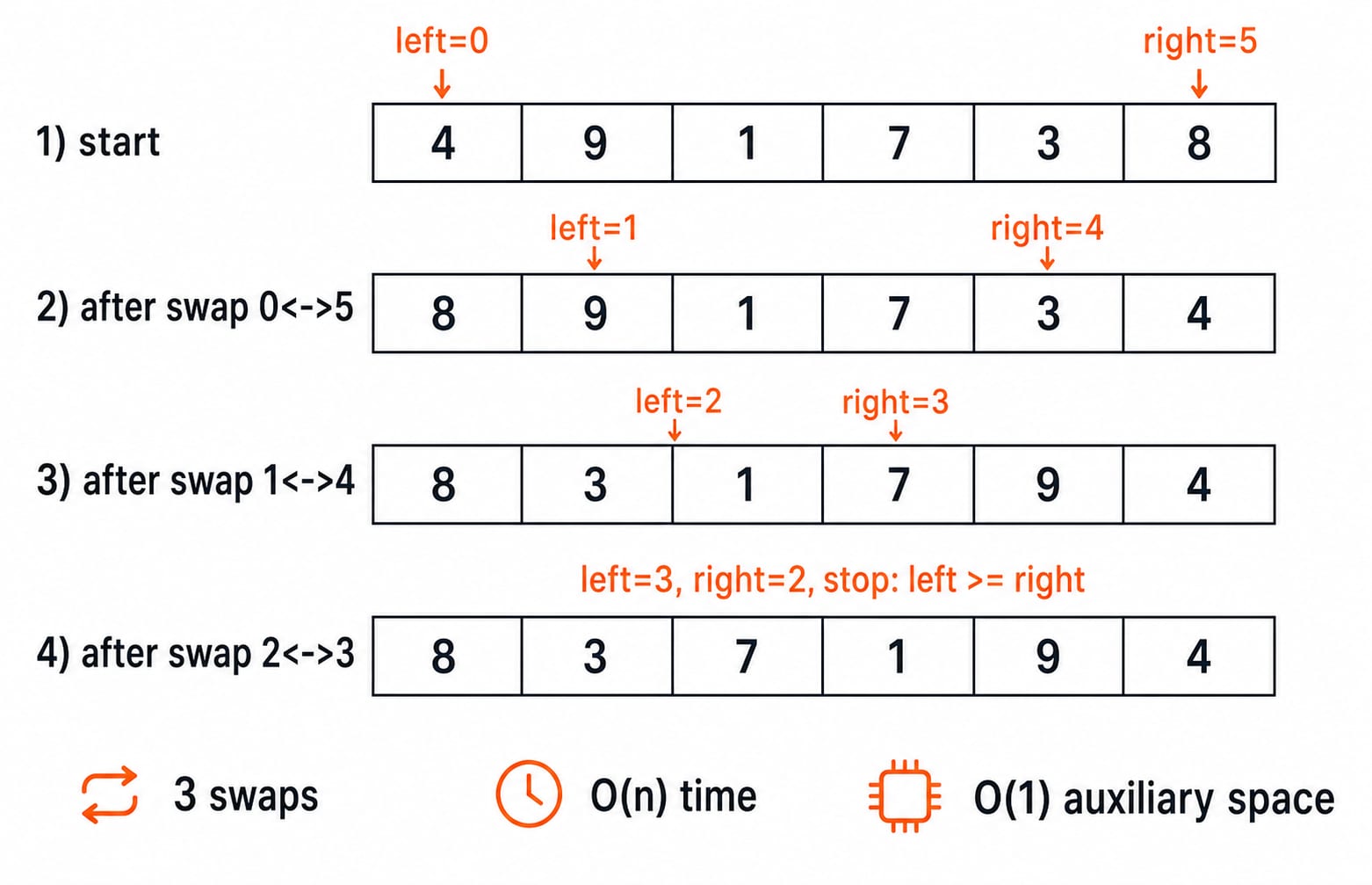
Reverse {4, 9, 1, 7, 3, 8} with left = 0, right = 5. Swap 0 and 5: {8, 9, 1, 7, 3, 4}; advance to left = 1, right = 4. Swap 1 and 4: {8, 3, 1, 7, 9, 4}; advance to left = 2, right = 3. Swap 2 and 3: {8, 3, 7, 1, 9, 4}. Now left = 3, right = 2, so left >= right stops the loop.
while (left < right) {
    temp = a[left];
    a[left] = a[right];
    a[right] = temp;
    left++;
    right--;
}
Each swap has one temporary and three assignments. After each iteration, elements outside [left, right] are in final reversed positions. This invariant proves that completed pairs need no revisit and crossing means stop.
For n = 6, floor(6 / 2) = 3 swaps. General cost is O(n) time and O(1) auxiliary space, excluding the input array's storage.
Find the second-largest distinct value in one pass
For {7, 2, 9, 9, 5, 8}, begin with largest and second both not set. Trace every value:
Value read |
|
|---|---|
7 |
|
2 |
|
first 9 |
|
duplicate 9 |
|
5 |
|
8 |
|
The answer is 8. If x > largest, move the old largest to second, then set largest = x. Otherwise update second only when x < largest and second is unset or x > second. Treat unset largest as the first update. Strict x < largest rejects the duplicate 9. Use explicit optional states, not a magic sentinel.
The scan is O(n) time and O(1) auxiliary space. {5, 5, 5} must return "no second-largest distinct value", not 5. Sorting works but exceeds the one-pass requirement.
How array-basics interviews move from recall to reasoning
Probe | Strong answer includes | Trap |
|---|---|---|
Definition and indexing | Contiguous type; | Calling zero arbitrary |
Declaration and initialization | Fixed count; omitted values become zero | Every local starts at zero |
Contiguous addresses |
| Universal sizes |
Array conversion | Decay, not pointer identity | "Array equals pointer" |
Bounds |
| Using |
Reversal | Invariant, | Memorised loop only |
Second-largest distinct | One pass, duplicates, failure | Accepting duplicate |
A fundamentals-first lens covers declarations, output prediction, bounds, and loops. A depth-oriented lens adds invariants, edge cases, complexity, or distinct values. These are preparation lenses, not employer claims. Check current careers information or candidate communication.
The path has about 35 practice questions. That volume signals practice scope, not predicted frequency. Try C Programming Interview Questions for Freshers: 40 Answered for broader follow-ups and Placement Preparation for the wider route.
Array basics in 30 seconds, then the next step
An array stores same-type elements contiguously. a[i] means *(a + i), and valid bounds for length n are 0 through n - 1. The array converts to a pointer to its first element in most expressions, but it is not itself a pointer. A strong coding answer also states its invariant, edge cases, time complexity, and auxiliary space. For a structured sequence of concepts, MCQs, and coding questions, continue with the C Language course.
Keep learning
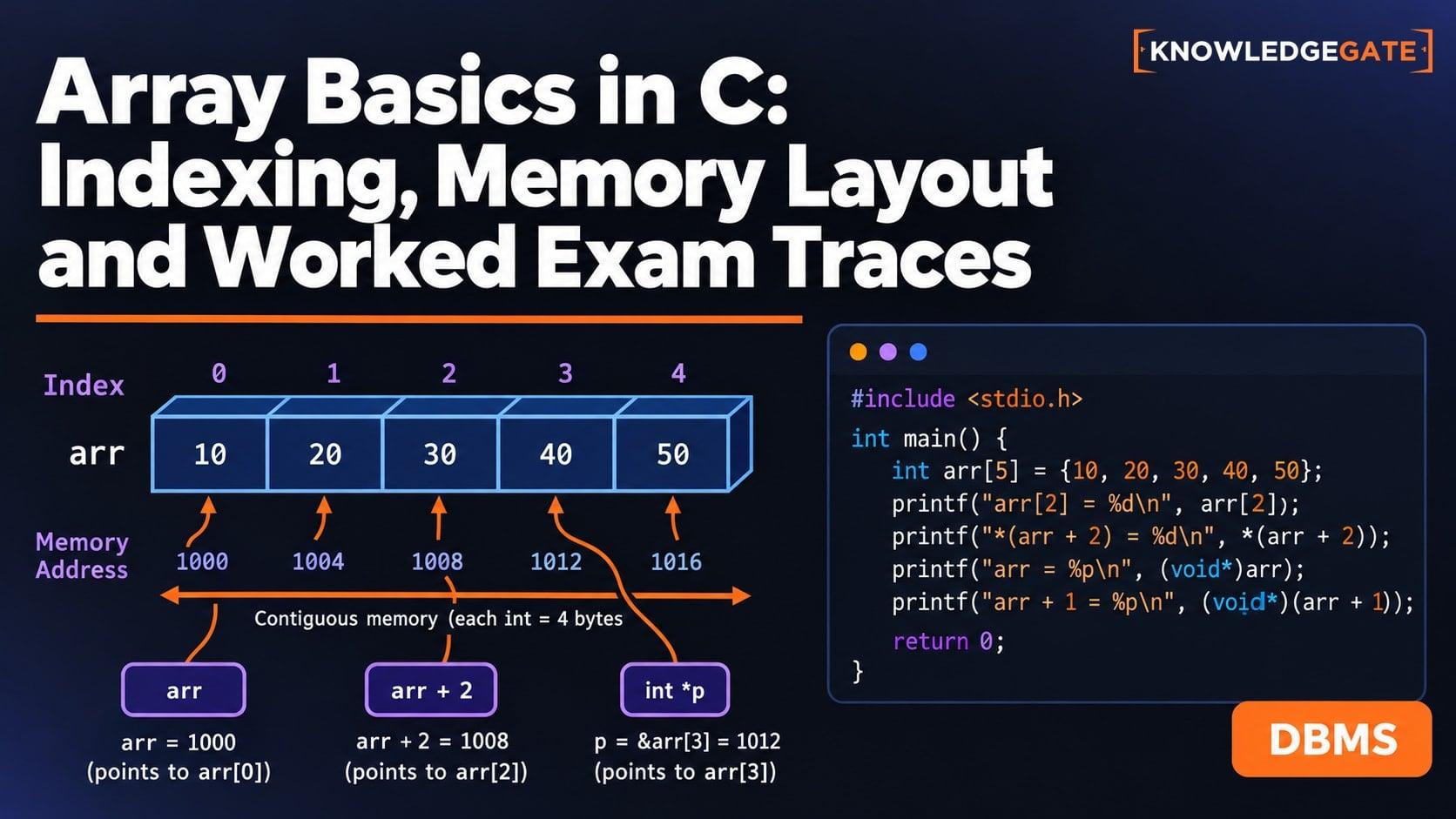
Array Basics in C: Indexing, Memory Layout and Worked Exam Traces
C arrays become much easier once indices, addresses, loop bounds, and mutations are kept separate. Build that model with two complete traces and common-error checks.
Updated 16 Sep 20266 min read50 viewsC Programming & Data Structures
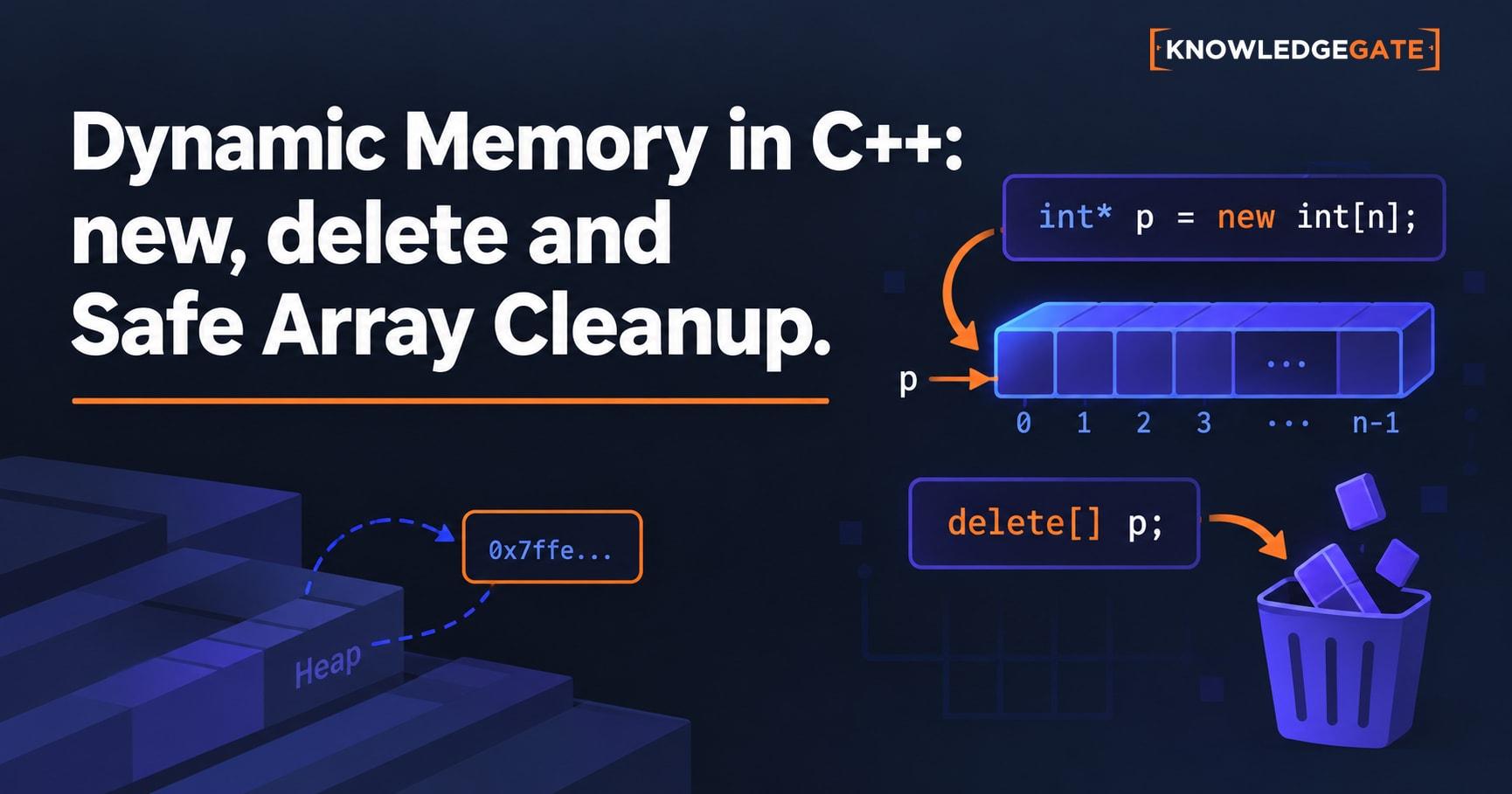
Dynamic Memory in C++: new, delete and Safe Array Cleanup
Follow an integer and a three-element array from allocation to cleanup. Learn which delete form matches, why aliases dangle, and how standard-library owners simplify the job.
Updated 18 Nov 20265 min readC++
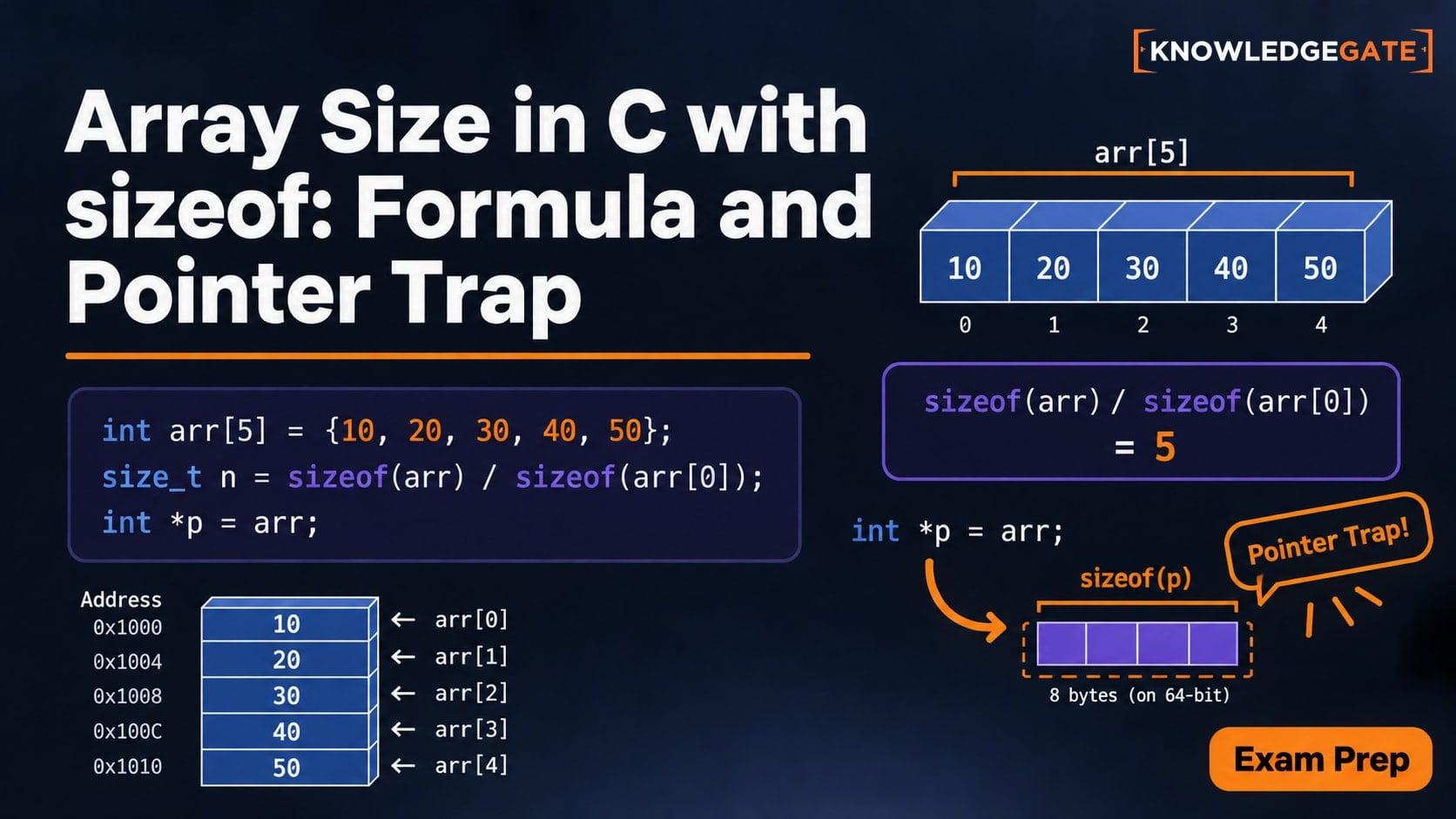
Array Size in C with sizeof: Formula and Pointer Trap
Learn the array-length idiom through a five-element C program, then trace the pointer adjustment that makes the same expression fail inside a function.
Updated 10 Nov 20265 min readC Programming & Data Structures
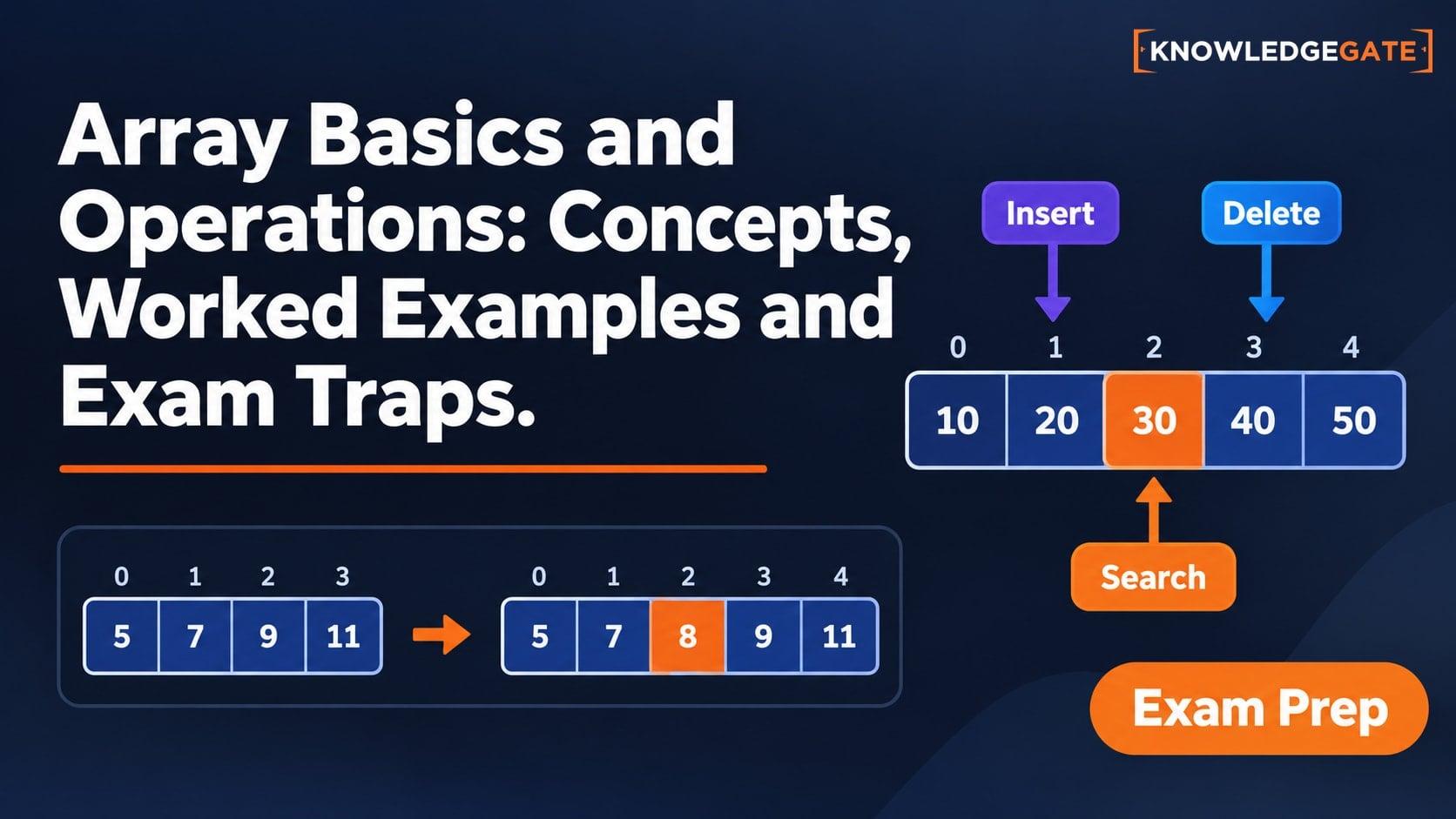
Array Basics and Operations: Concepts, Worked Examples and Exam Traps
Understand array indices, size, capacity and operation costs through a single worked array. Then practise insertion, deletion, search and address calculation without off-by-one errors.
Updated 1 Nov 20265 min readC Programming & Data Structures