Define 2D Transformations in computer graphics. Explain the three basic…
Define 2D Transformations in computer graphics. Explain the three basic geometric transformations Translation, Scaling, and Rotation and justify the need for using Homogeneous Coordinates in these operations.
Attempted by 14 students.
Show answer & explanation
Introduction to 2D Transformations
2D transformation is the process of modifying the position, size, or orientation of an object on a 2D plane. It involves mapping points from one coordinate space to another, which is fundamental for animation, viewing, and object manipulation in graphical applications.
Basic Geometric Transformations
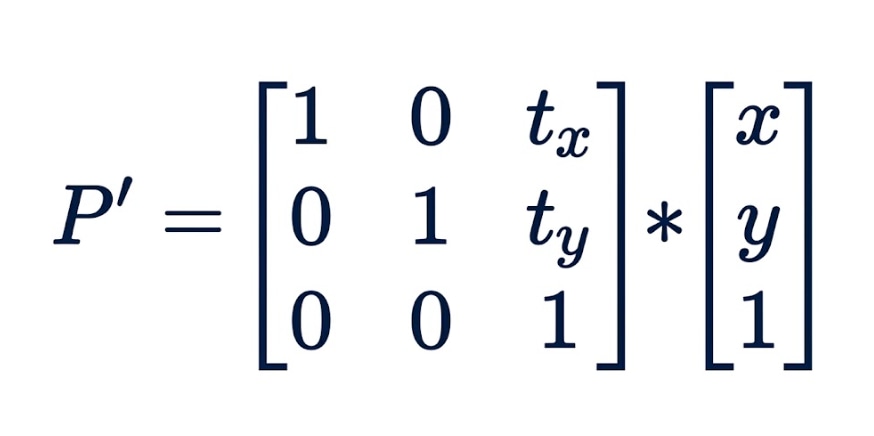
Translation: This operation moves an object from one location to another by adding displacement factors tx and ty to the original coordinates (x, y). To represent this as a matrix multiplication, we use the following translation matrix:
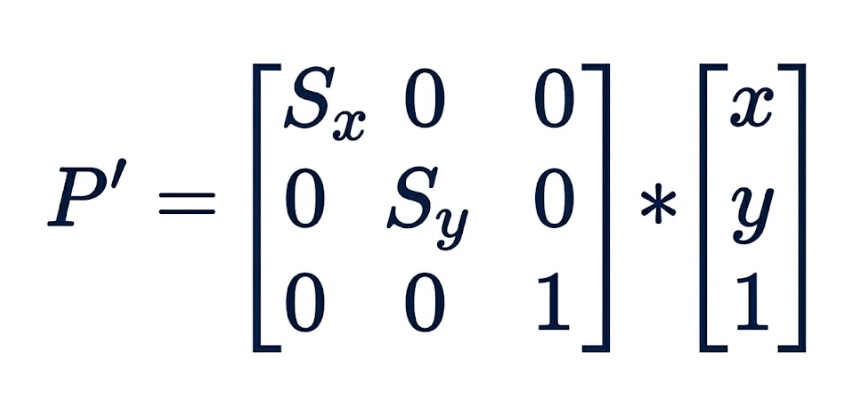
Scaling: This alters the size of an object by multiplying coordinates by factors Sx (horizontal) and Sy (vertical). The scaling transformation matrix is:
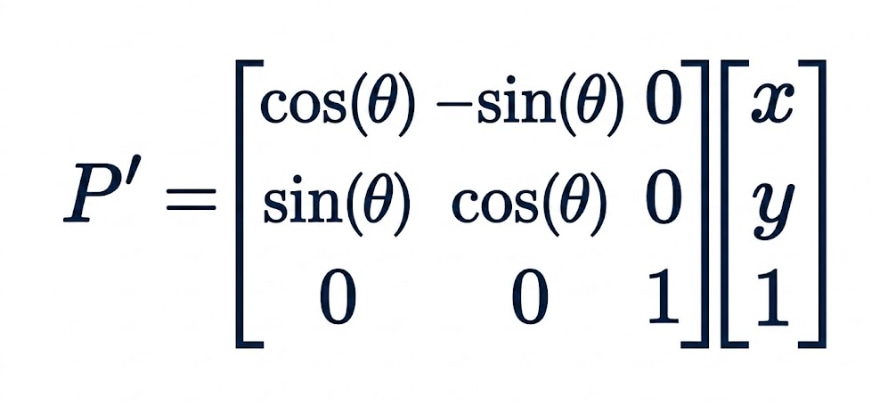
Rotation: This turns an object about the origin by an angle theta. The transformation matrix for rotation is:
Justification for Homogeneous Coordinates
In standard 2D Cartesian coordinates (x, y), translation cannot be represented as a simple matrix multiplication because it requires the addition of constants (x + tx, y + ty).
The Concept: Homogeneous coordinates expand the 2D point (x, y) into a 3-element vector (x, y, 1) by adding a third dimension 'w' (typically set to 1).
The Need: This shift allows all basic geometric transformations—translation, scaling, and rotation—to be expressed as 3 * 3 matrices.
Key Advantages:
Unified Pipeline: Because all transformations are now matrices, they can all be performed using the same matrix multiplication process.
Composition: Multiple transformations can be multiplied together into a single "Composite Matrix" (M = M3* M2 * M1). This is highly efficient for graphics hardware (GPUs) to process, as it reduces the number of operations needed for complex movements.