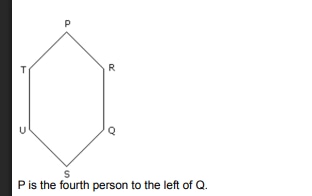
Six friends P, Q, R, S, T and U are sitting around a hexagonal table, one at…
2024
Six friends P, Q, R, S, T and U are sitting around a hexagonal table, one at each corner, facing the centre of the hexagon. P is second to the left of U. Q is a neighbour of both R and S. T is second to the left of S. Who is the fourth person to the left of Q?
Answer: A. P — ConceptIn a circular or polygonal seating arrangement where every person faces the centre, a person's own left-hand direction runs clockwise as seen in the…
- A.
P
- B.
U
- C.
R
- D.
Data inadequate
Attempted by 4 students.
Show answer & explanation
Correct answer: A
Concept
In a circular or polygonal seating arrangement where every person faces the centre, a person's own left-hand direction runs clockwise as seen in the layout (facing inward reverses left and right relative to an outward-facing view). So "X is second to the left of Y" means X sits two seats clockwise from Y, and "neighbour of" fixes the two seats immediately adjacent on either side.
Application
Fix Q's seat as a reference point. Since Q is a neighbour of both R and S, R and S must occupy the two seats immediately on either side of Q.
Test S in the seat clockwise of Q (so R takes the seat anticlockwise of Q). Apply "T is second to the left of S": moving two seats clockwise from S places T there.
Two seats now remain, for P and U. Apply "P is second to the left of U": moving two seats clockwise from U places P exactly on the one remaining seat, so the arrangement is fully consistent.
The complete clockwise order becomes: Q, S, U, T, P, R (and back to Q). Counting four seats clockwise ("to the left") from Q — S, U, T, P — lands on P.
Cross-check
On a 6-seat table, four seats to the left is the same seat as two seats to the right (6 minus 4 equals 2). Moving two seats anticlockwise from Q in the same order (Q, R, P) also lands on P, confirming the result independently. Testing the other neighbour assignment (R clockwise of Q instead of S) forces T onto a seat already taken by R, so it never produces a valid arrangement — the layout above is the only one that satisfies every clue, confirming the data is sufficient.
The fourth person to the left of Q is P.