Six friends P, Q, R, S, T and U are sitting around a hexagonal table, each at…
2025
Six friends P, Q, R, S, T and U are sitting around a hexagonal table, each at one corner, facing the centre of the hexagon. P is second to the left of U. Q is a neighbour of R and S. T is second to the left of S.
Who is sitting opposite P?
Answer: D. S — Concept: When people are seated around a table facing the centre, moving to a person's ‘left’ means moving one seat in the clockwise direction. Two people sit…
- A.
R
- B.
Q
- C.
T
- D.
S
Attempted by 6 students.
Show answer & explanation
Correct answer: D
Concept: When people are seated around a table facing the centre, moving to a person's ‘left’ means moving one seat in the clockwise direction. Two people sit directly opposite each other only when they are separated by exactly half the total seats — here, 3 of the 6 hexagon corners — counted in either direction.
Place U at any corner. Since P is second to the left of U, move two corners clockwise from U to fix P’s corner.
Check every remaining corner for Q, who must have both R and S as immediate neighbours. The corners next to P or U already have one neighbour occupied by P or U, so only one open corner — with both neighbouring corners still free — can hold Q; R and S take the corners on either side of it.
Apply ‘T is second to the left of S’: testing S on one side of Q sends T two corners clockwise onto a corner that is already occupied, so that placement fails; testing S on the other side of Q sends T two corners clockwise onto the one corner still empty. This fixes S, R and T uniquely.
With all six corners now fixed, count three corners clockwise from P (half of the six seats) to reach the corner directly opposite it — that corner is occupied by S.
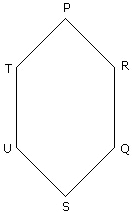
Cross-check: Reading the three original clues back against this completed arrangement confirms it is the only valid one — P is second to the left of U, Q is a neighbour of both R and S, and T is second to the left of S all hold simultaneously.
S is therefore the friend sitting directly opposite P.