Select the figure that will replace the question mark (?) in the following…
2023
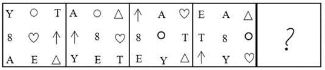
Select the figure that will replace the question mark (?) in the following figure series.
Attempted by 5 students.
Show answer & explanation
Concept: in a symbol-series question the same set of symbols reappears in every panel of the series — only the cells they occupy change. Each step of the series is therefore a fixed cell-to-cell movement rule, and a series may alternate between two such rules rather than repeat a single one. The reliable method is to read every panel out cell by cell, extract the rule of the first step, test that same rule on the third step, and then apply whichever rule falls due next to build the missing panel.
Application: label the four given panels grid 1 to grid 4 from left to right. Each is a 3×3 arrangement carrying the nine symbols Y, ○, T, 8, ♡, ↑, A, E and △ exactly once. Read out cell by cell they are:
Panel | Top row | Middle row | Bottom row |
|---|---|---|---|
grid 1 | Y, ○, T | 8, ♡, ↑ | A, E, △ |
grid 2 | A, ○, △ | ↑, 8, ♡ | Y, E, T |
grid 3 | ↑, A, ♡ | 8, ○, T | E, Y, △ |
grid 4 | E, A, △ | T, 8, ○ | ↑, Y, ♡ |
Read the first step, grid 1 to grid 2, and name it Rule P: in the left column the top and bottom entries exchange places (Y and A), in the right column the top and bottom entries exchange places (T and △), the middle column keeps its top and bottom entries where they are (○ and E), and the middle row moves one place to the right with wrap-around, so 8, ♡, ↑ becomes ↑, 8, ♡.
Test Rule P on the third step, grid 3 to grid 4: the left column exchanges ↑ and E, the right column exchanges ♡ and △, the middle column keeps A and Y in place, and the middle row 8, ○, T moves one place right to T, 8, ○. Rule P holds exactly, so the series alternates between two rules instead of repeating one.
Read the second step, grid 2 to grid 3, and name it Rule Q: the four cells of the top-left 2×2 block turn one place clockwise, so A, ○ above ↑, 8 becomes ↑, A above 8, ○; the right column moves one place up with wrap-around, so △, ♡, T becomes ♡, T, △; and the two left-hand cells of the bottom row exchange places, so Y, E becomes E, Y.
The order of the steps so far is P, Q, P, so the step from grid 4 to the missing panel is Rule Q.
Turn the top-left 2×2 block of grid 4 one place clockwise: E, A above T, 8 becomes T, E above 8, A.
Move the right column of grid 4 one place up with wrap-around: △, ○, ♡ read from top to bottom becomes ○, ♡, △.
Exchange the two left-hand cells of the bottom row of grid 4: ↑, Y becomes Y, ↑.
Assemble the three results: the top row is T, E, ○; the middle row is 8, A, ♡; the bottom row is Y, ↑, △.
Cross-check: verify the assembled panel by tracking two symbols on their own, independently of the two rules.
The digit 8 sits in the middle-row left cell in grid 1 and grid 3, and in the centre cell in grid 2 and grid 4, so it is due back in the middle-row left cell — and the assembled panel places it there.
The triangle △ sits in the bottom-right cell in grid 1 and grid 3, and in the top-right cell in grid 2 and grid 4, so it is due back in the bottom-right cell — and the assembled panel places it there.
All nine symbols Y, ○, T, 8, ♡, ↑, A, E and △ occur exactly once in the assembled panel, as they do in every panel of the series.
Result: the panel that replaces the question mark carries T, E, ○ in its top row, 8, A, ♡ in its middle row and Y, ↑, △ in its bottom row.