Identify the image given in the options which, when put in place of the…
2024
Identify the image given in the options which, when put in place of the question mark (?), will logically complete the series.
Attempted by 7 students.
Show answer & explanation
Concept: In a positional-cycling series the set of symbols never changes from one step to the next; only the seat each symbol occupies changes. Every symbol advances by exactly one place along a single fixed closed path that runs through all the available seats. Once that path has been read off from consecutive steps, every later step is completely determined by it.
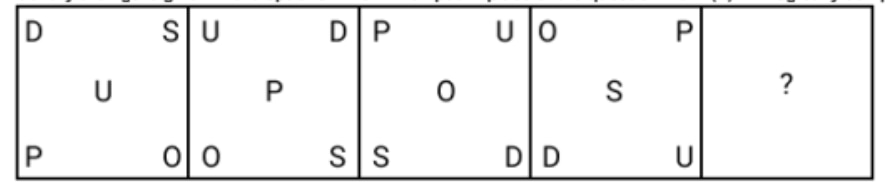
Application: Each box in this series carries the same five letters — D, O, P, S and U — in five seats: the top-left corner, the top-right corner, the centre, the bottom-left corner and the bottom-right corner. Recording the four given steps seat by seat:
Step | Top-left | Top-right | Centre | Bottom-left | Bottom-right |
|---|---|---|---|---|---|
Step 1 | D | S | U | P | O |
Step 2 | U | D | P | O | S |
Step 3 | P | U | O | S | D |
Step 4 | O | P | S | D | U |
Comparing each step with the one after it shows where the letter in every seat travels:
The letter in the centre moves to the top-left corner: U sits at the centre in step 1 and at the top-left in step 2; P does the same from step 2 to step 3; O does the same from step 3 to step 4.
The letter at the top-left corner moves to the top-right corner: D from step 1 to step 2, U from step 2 to step 3, P from step 3 to step 4.
The letter at the top-right corner moves to the bottom-right corner: S from step 1 to step 2, D from step 2 to step 3, U from step 3 to step 4.
The letter at the bottom-right corner moves to the bottom-left corner: O from step 1 to step 2, S from step 2 to step 3, D from step 3 to step 4.
The letter at the bottom-left corner moves to the centre: P from step 1 to step 2, O from step 2 to step 3, S from step 3 to step 4.
So the closed path is centre → top-left → top-right → bottom-right → bottom-left → centre, and every letter advances exactly one seat along it at each step.
Applying that single advance to step 4, which holds O at the top-left, P at the top-right, S at the centre, D at the bottom-left and U at the bottom-right:
S leaves the centre and takes the top-left corner.
O leaves the top-left corner and takes the top-right corner.
P leaves the top-right corner and takes the bottom-right corner.
U leaves the bottom-right corner and takes the bottom-left corner.
D leaves the bottom-left corner and takes the centre.
Hence the box that replaces the question mark carries S at the top-left corner, O at the top-right corner, D at the centre, U at the bottom-left corner and P at the bottom-right corner.
Cross-check: the same path also settles the arrangements that do not fit.
Running the path backwards from the result returns step 4 exactly: S goes back from the top-left to the centre, O from the top-right to the top-left, P from the bottom-right to the top-right, U from the bottom-left to the bottom-right and D from the centre to the bottom-left, giving O, P, S, D, U once more.
All five letters D, O, P, S and U appear exactly once, as they do in every given step; no letter is dropped, repeated or replaced.
An arrangement holding S at the top-left, D at the top-right, P at the centre, U at the bottom-left and O at the bottom-right breaks the path, because the letter that reaches the centre must be the one standing at the bottom-left of step 4, which is D and not P.
An arrangement holding U at the top-left, O at the top-right, S at the centre, P at the bottom-left and D at the bottom-right keeps S in the centre for a second step running, whereas the path moves every letter one seat at each step.
An arrangement holding S at the top-left, O at the top-right, U at the centre, P at the bottom-left and D at the bottom-right puts U in the centre, although U stands at the bottom-right of step 4 and the path sends that letter to the bottom-left corner.