Every command executed by a computer follows a specific structure known as the…
Every command executed by a computer follows a specific structure known as the 'Instruction Format.' Define this term and break down an instruction into its two primary components: the Opcode and the Operand. Briefly explain the function of each component, and describe the role of 'Addressing Modes' in determining how the processor locates the required data ?
Attempted by 142 students.
Show answer & explanation
Instruction Format is the defined structure of a machine instruction that specifies how an instruction is represented and interpreted by the CPU.
• Opcode: The Opcode (Operation Code) specifies what operation the processor has to perform, such as addition, subtraction, data transfer, or comparison.
• Operand: The Operand specifies on which data the operation is to be performed. It may represent actual data, a memory address, or a register reference.
• Instruction Breakdown: Every instruction is internally divided into these two parts so that the CPU clearly understands the task and the data involved.
• Role of Addressing Modes: Addressing Modes define how the operand is located, whether directly in memory, in a register, as an immediate value, or via an address calculation. This provides flexibility and efficient data access.
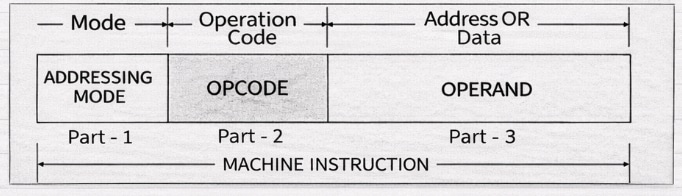
Example: In an ADD instruction, the opcode tells the CPU to add, while the addressing mode determines where the numbers are fetched from.