Select the option figure in which the given figure is embedded as its part…
2026
Select the option figure in which the given figure is embedded as its part (rotation is NOT allowed).
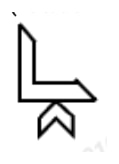
Attempted by 95 students.
Show answer & explanation
Concept: An embedded-figure item asks whether the given figure survives inside an answer figure as one complete, unbroken sub-part. Because rotation is barred, the match must be a pure translation: the shape may only be slid to a new place, never turned, flipped, stretched or split. Every segment of the given figure, every angle between two segments, and every junction where one part meets another must therefore reappear in the same direction and the same relative proportion.
Application: First break the given figure into its rigid parts, then look for that whole assembly inside each answer figure.
A narrow L-shaped strip of uniform width: its long arm runs vertically downward and its short arm turns to the right along the bottom, so the elbow of the strip lies at the bottom-left.
Each free end of the strip is closed by a slanting cut, one across the top of the vertical arm and one across the right end of the horizontal arm.
A hollow upward-pointing chevron hangs outside the strip, its tip meeting the lower edge of the horizontal arm at roughly the middle of that arm's length.
Now test the layouts. Take the answer figure whose long slanting line runs from the top-left corner to the bottom-right corner and whose small square sits in the upper-left quarter. There the outer left border and the square's left edge form the vertical arm, while the square's lower edge and the horizontal line at mid-height form the horizontal arm, so the elbow lies at the bottom-left exactly as required. The slant across the top-left corner closes the vertical arm, and the long slanting line closes the right end of the horizontal arm. The hollow chevron below the mid-height line points upward and meets that line at about the middle of the arm. Every part, every angle and the chevron's junction are reproduced by a pure shift, so the given figure is embedded there.
Cross-check: The remaining three layouts each break one of the two requirements.
Where the slanting line drops from the top-right corner to the bottom-left corner, the small square lies in the upper-right quarter and the upward chevron sits below the mid-height line on the right, the elbow of the strip falls at the bottom-right and its short arm runs to the left. That assembly is the left-right mirror image of the given figure, and a mirror is not a shift.
Where the slanting line rises from the bottom-left corner to the top-right corner and the small square lies in the lower-left quarter, the strip does carry its elbow at the bottom-left, but the hollow chevron stands away at mid-right and points to the left, so the chevron-to-strip junction of the given figure is never formed.
Where the slanting line runs from the top-right corner to the bottom-left corner with the small square in the upper-right quarter and the hollow chevron high on the left pointing to the right, the strip is mirrored and the chevron is detached from it, so both requirements fail together.
Result: The given figure is embedded, with no rotation at all, in the layout that carries the top-left-to-bottom-right slanting line, the upper-left small square and the upward chevron just under the mid-height line.