Process management is a key responsibility of the operating system. In this…
Process management is a key responsibility of the operating system. In this context, answer the following:
a) Explain the concept of a process and describe the main characteristics of a process during program execution.
b) Describe the different sections of process memory organization and explain their roles in program execution.
c) Explain the role of the Process Control Block (PCB) in process management and discuss how it helps the operating system perform context switching.
Attempted by 7 students.
Show answer & explanation
1. Concept and Characteristics of a Process
A process is a program that is currently in execution. It represents the active state of a program along with the resources required for its execution.
Characteristics of a Process
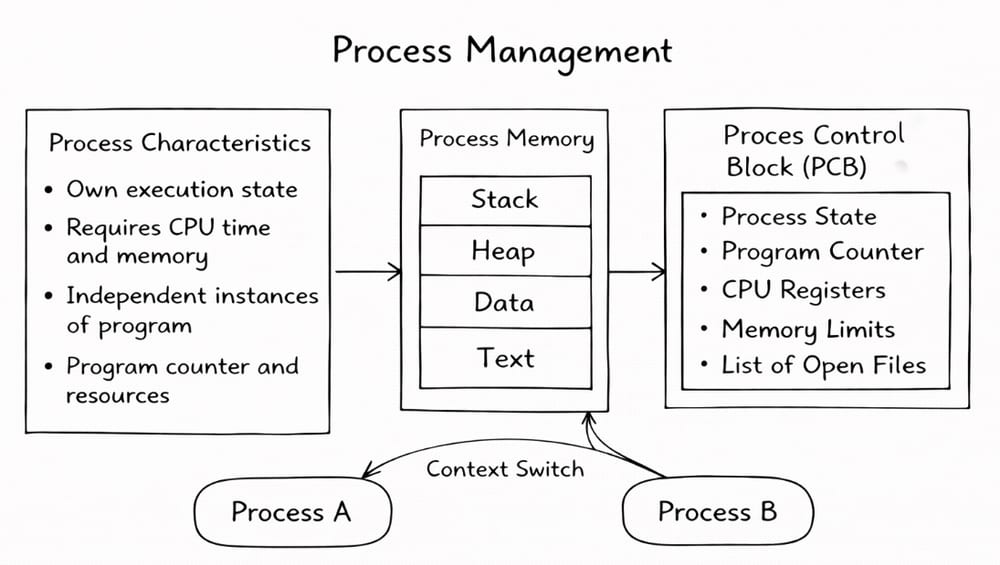
A process has its own execution state, such as running, waiting, or ready.
It requires system resources like CPU time, memory, and I/O devices.
Multiple processes can be created from the same program, but each process operates independently.
Each process has its own program counter, stack, and data sections.
2. Process Memory Organization
During execution, the memory of a process is divided into several sections.
Text Section
Contains the compiled program instructions.
Usually read-only and shared among processes.
Data Section
Stores global and static variables used in the program.
Heap
Used for dynamic memory allocation during runtime.
Memory is allocated and released as needed.
Stack
Stores local variables, function parameters, and return addresses.
Supports function call operations.
3. Role of Process Control Block (PCB)
The Process Control Block (PCB) is a data structure maintained by the operating system to store information about each process.
Information Stored in PCB
Process state
Program counter
CPU register values
Memory management information
List of open files
Role in Context Switching
When the CPU switches from one process to another, the OS saves the current process state in its PCB.
The PCB of the next process is then loaded to resume execution.
This mechanism allows efficient process scheduling and multitasking.