Two graphs A and B are shown below. Which one of the following statements is…
2012
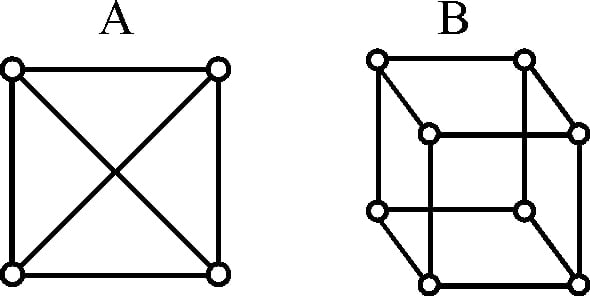
Two graphs A and B are shown below. Which one of the following statements is true?
Answer: A. Both A and B are planar. — Concept. A graph is planar when it can be drawn in the plane so that edges meet only at shared endpoints. Planarity belongs to the abstract graph, not to one…
- A.
Both A and B are planar.
- B.
Neither A nor B is planar.
- C.
A is planar and B is not.
- D.
B is planar and A is not.
Attempted by 27 students.
Show answer & explanation
Correct answer: A
Concept. A graph is planar when it can be drawn in the plane so that edges meet only at shared endpoints. Planarity belongs to the abstract graph, not to one picture of it: a drawing that shows crossings merely fails to witness planarity, it never rules planarity out. Kuratowski's theorem supplies the decisive test — a graph is non-planar exactly when it contains a subdivision of K5 or of K3,3.
Application. Read each drawing as a list of vertices and edges, identify the graph it represents, then look for a crossing-free redrawing.
Graph A has 4 vertices at the corners of a square, joined by the four sides together with both diagonals — 6 edges in all, with every pair of vertices adjacent. That is the complete graph K4.
Redraw K4 without crossings: draw the triangle on three of its vertices, place the fourth vertex inside that triangle, and join it to all three corners. All 6 edges are present and no two cross, so graph A is planar.
Graph B has 8 vertices — an outer square, a second square offset from it, and four edges joining corresponding corners — 12 edges in all, with every vertex of degree 3. That is the cube graph Q3, the skeleton of a cube.
Redraw Q3 without crossings: keep one square as the outer boundary, shrink the other square inside it, and join corresponding corners by four radial edges. All 12 edges are present and no two cross, so graph B is planar.
Cross-check. Euler's bound for a simple planar graph on v ≥ 3 vertices with e edges is e ≤ 3v − 6, and a triangle-free planar graph must further satisfy e ≤ 2v − 4. Both graphs stay inside their bounds, which is consistent with the crossing-free redrawings built above.
Graph | Vertices | Edges | Graph it represents | Euler check |
|---|---|---|---|---|
A | 4 | 6 | K4 (complete graph on 4 vertices) | 6 ≤ 3(4) − 6 = 6 |
B | 8 | 12 | Q3 (cube graph) | 12 ≤ 3(8) − 6 = 18 |
Contrast.
The claim that neither graph is planar breaks down on the 4-vertex graph: a K5 subdivision needs 5 branch vertices and a K3,3 subdivision needs 6, while only 4 vertices are available.
The claim that the cube graph is non-planar breaks down on the nested-square embedding, which draws all 12 edges with no crossing, leaving no room for a Kuratowski obstruction inside Q3.
The claim that K4 is non-planar breaks down on the triangle-with-an-interior-vertex drawing, which realises all 6 edges without a single crossing.
Result. Graph A is K4 and graph B is Q3, and both admit crossing-free drawings, so the true statement is that both A and B are planar.