G1 and G2 are two graphs as shown below. Which one of the following statements…
2012
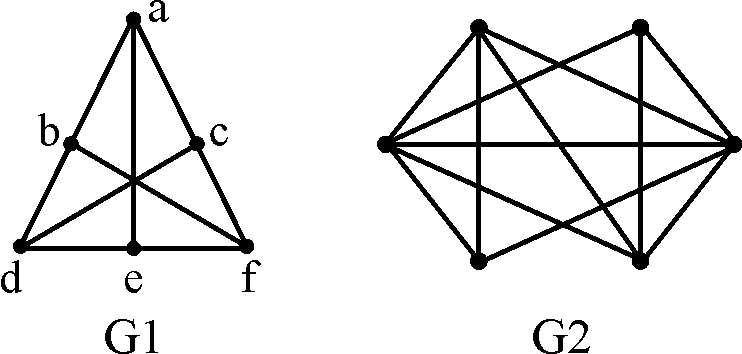
G1 and G2 are two graphs as shown below. Which one of the following statements is correct?
Answer: D. G1 is not planar and G2 is a planar graph. — CONCEPTA graph is planar when it can be drawn in the plane so that edges meet only at shared endpoints. Kuratowski’s theorem turns that into a checkable…
- A.
Both G1 and G2 are planar graphs.
- B.
Both G1 and G2 are not planar graphs.
- C.
G1 is planar and G2 is not a planar graph.
- D.
G1 is not planar and G2 is a planar graph.
Attempted by 19 students.
Show answer & explanation
Correct answer: D
CONCEPT
A graph is planar when it can be drawn in the plane so that edges meet only at shared endpoints. Kuratowski’s theorem turns that into a checkable structural property: a graph is non-planar if and only if it has a subgraph homeomorphic to K5 or to K3,3. Crossings in one particular drawing therefore prove nothing on their own — non-planarity is proved by exhibiting a Kuratowski subgraph, and planarity is proved by exhibiting one crossing-free redrawing.
APPLICATION — G1
Read the nine edges of G1 off the drawing: a–b, b–d, a–c, c–f, d–e, e–f, a–e, b–f and c–d. That is six vertices, nine edges, and every vertex of degree 3. Listing each vertex against its neighbours makes the structure visible:
Vertex of G1 | Its neighbours |
|---|---|
a | b, c, e |
d | b, c, e |
f | b, c, e |
b | a, d, f |
c | a, d, f |
e | a, d, f |
Each of a, d and f is joined to all three of b, c and e and to nothing else, and symmetrically each of b, c and e is joined to all three of a, d and f. That is precisely the complete bipartite graph K3,3 with parts {a, d, f} and {b, c, e} — one of the two Kuratowski graphs. So G1 is not planar, and the two crossings in its drawing are forced by the structure rather than by the layout.
APPLICATION — G2
G2 has six vertices and twelve edges. Naming its vertices by drawn position — P top-left, Q top-right, L left, R right, S bottom-left, T bottom-right — the edges are L–P, L–Q, L–R, L–S, L–T, P–R, P–S, P–T, Q–R, Q–T, S–R and T–R. A crossing-free drawing can be built in three steps:
L, R, P and T are mutually adjacent (L–R, L–P, L–T, P–R, P–T and R–T are all present), so they induce a K4. Draw it flat: triangle L–R–P with T placed inside it. Its four regions are the triangles LRT, LPT, RPT and the outer region LRP.
Q is joined to exactly L, R and T. Place Q inside the triangular region LRT and run its three edges to that region’s corners; no crossing is created.
S is joined to exactly L, R and P. Place S in the outer region LRP and run its three edges to those corners; again no crossing is created.
All six vertices and all twelve edges are now drawn with no crossing, so G2 is planar. It is in fact a maximal planar graph: with v = 6 and e = 12 it sits exactly on the bound e = 3v − 6, so the drawing is a triangulation whose 8 regions are all triangles.
CROSS-CHECK
The edge bound e ≤ 3v − 6 is necessary but never sufficient. G1 has v = 6 and e = 9 ≤ 12, so it passes the bound and is still non-planar; only the Kuratowski subgraph settles it. Counting edges can rule a graph out, never in.
G2 admits no K5 subdivision either: such a subdivision needs five branch vertices of degree at least 4, and G2’s degree sequence is 5, 5, 4, 4, 3, 3 — just four vertices reach degree 4.
Euler’s formula confirms the G2 drawing: v − e + f = 6 − 12 + 8 = 2, exactly as a plane triangulation on six vertices requires.
RESULT
G1 is not planar — it is K3,3 itself — while G2 is planar, being a six-vertex plane triangulation.