Consider the following memory hierarchy diagram: Which of the following…
2023
Consider the following memory hierarchy diagram:
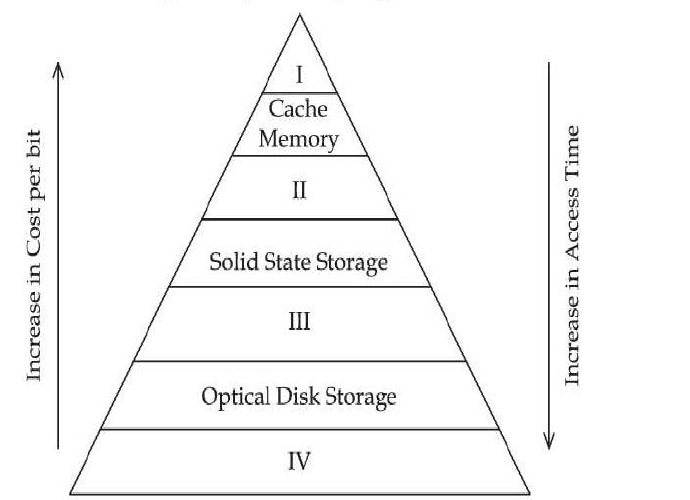
Which of the following memories A–D represent I, II, III and IV (in that order)?
A. Magnetic Tape
B. Magnetic Hard Disk
C. Random Access Memory
D. Processor Registers
Choose the correct answer from the options given below:
Answer: D. D, C, B, A — ConceptA memory hierarchy orders storage by access speed, cost per bit, and capacity. Levels nearer the processor are faster and costlier per bit, while lower…
- A.
D, C, A, B
- B.
A, B, C, D
- C.
B, C, D, A
- D.
D, C, B, A
Attempted by 36 students.
Show answer & explanation
Correct answer: D
Concept
A memory hierarchy orders storage by access speed, cost per bit, and capacity. Levels nearer the processor are faster and costlier per bit, while lower levels are slower, cheaper, and usually larger.
Registers are closest to the processor, followed by cache and main memory; persistent storage then progresses from solid-state devices to magnetic disks, optical disks, and archival magnetic tape.
Application
Position I lies above cache, so it represents D: Processor Registers.
Position II lies below cache and above solid-state storage, so it represents C: Random Access Memory.
Position III lies below solid-state storage and above optical-disk storage, so it represents B: Magnetic Hard Disk.
Position IV is below optical-disk storage, so it represents A: Magnetic Tape.
Cross-check
Reading downward gives increasing access time and decreasing cost per bit, which is consistent with registers → cache → RAM → solid-state storage → magnetic hard disk → optical disk → magnetic tape.
Therefore, I, II, III and IV are D, C, B and A, respectively.