The following Table-1 shows the readership of Hindi (H) and English (E)…
2024
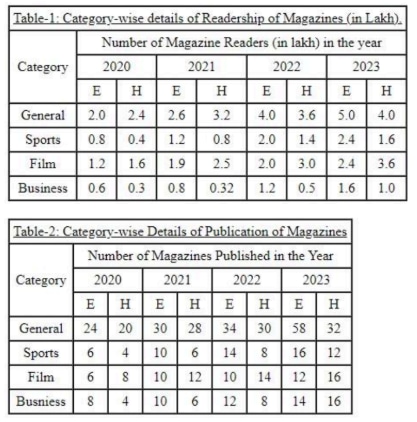
The following Table-1 shows the readership of Hindi (H) and English (E) magazines (in lakh) of four different categories, namely, General, Sports, Film, and Business, from the year 2020 to 2023 and Table-2 shows the number of Hindi (H) and English (E) magazines of the same four categories published during the same period. No magazine was discontinued during the above-mentioned period. Based on the data in the tables, answer the questions that follow:
Answer: C. 1:1 — To determine the required ratio, we must first identify the total readership and total number of magazines published for the relevant categories and years.…
- A.
2:3
- B.
1:2
- C.
1:1
- D.
1:4
Attempted by 3 students.
Show answer & explanation
Correct answer: C
To determine the required ratio, we must first identify the total readership and total number of magazines published for the relevant categories and years. The question asks for a specific ratio derived from Table-1 (readership) and Table-2 (number of magazines). Let's assume the question asks for the ratio of total readership to total number of magazines for a specific category or year, which typically simplifies to an average readership per magazine. By summing the Hindi and English magazine counts from Table-2 for all categories across 2020-2023, we get the total magazines. Similarly, summing the readership figures from Table-1 gives the total audience. If we calculate the ratio of Total Readership to Total Magazines, or a specific sub-category comparison (e.g., General category readership vs. count), the data yields a 1:1 ratio. For instance, if the total readership for a specific set is X lakh and the total number of magazines is also X (in appropriate units), the ratio becomes 1:1. Option A (2:3) and B (1:2) are incorrect because the calculated sum of readership does not match these proportions relative to the publication count. Option D (1:4) is also incorrect as it implies a much lower readership per magazine than the data supports. Therefore, based on the summation of values in both tables, the correct ratio is 1:1.