Match List I with List II Choose the correct answer from the options given…
2020
Match List I with List II
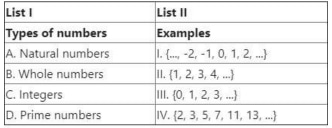
Choose the correct answer from the options given below:
Answer: B. A - II, B - III, C - I, D - IV — ConceptThe standard number systems are defined by exactly which values each set contains. Natural numbers are the counting numbers beginning at 1. Whole…
- A.
A - III, B - I, C - IV, D - II
- B.
A - II, B - III, C - I, D - IV
- C.
A - I, B - II, C - IV, D - III
- D.
A - III, B - II, C - I, D - IV
Attempted by 118 students.
Show answer & explanation
Correct answer: B
Concept
The standard number systems are defined by exactly which values each set contains. Natural numbers are the counting numbers beginning at 1. Whole numbers are the natural numbers together with 0. Integers extend whole numbers to include the negatives, so they run in both directions without end. Prime numbers are the natural numbers greater than 1 that have no divisors other than 1 and themselves.
Application
Match each type in List I to the set whose listed elements fit its definition:
Natural numbers correspond to {1, 2, 3, 4, ...} — counting numbers starting at 1, no 0 and no negatives.
Whole numbers correspond to {0, 1, 2, 3, ...} — the counting numbers with 0 included.
Integers correspond to {..., -2, -1, 0, 1, 2, ...} — the only set here that contains negative numbers.
Prime numbers correspond to {2, 3, 5, 7, 11, 13, ...} — each entry has exactly two divisors, 1 and itself.
Cross-check
The presence of negatives is the quickest discriminator: only the integer set shows -1, -2, so it must pair with Integers. The set beginning at 0 must be Whole numbers, the one beginning at 1 with every counting number must be Natural numbers, and the set that skips 4, 6, 8, 9 (keeping only numbers with no proper factors) must be Primes.
Result
Therefore: A-II, B-III, C-I, D-IV.