Match List I with List II Choose the correct answer from the options given…
2020
Match List I with List II
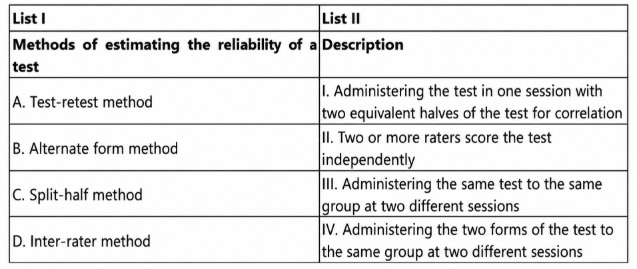
Choose the correct answer from the options given below:
Answer: D. A - III, B - IV, C - I, D - II — ConceptReliability is the consistency of the scores a test yields: measure the same trait again under comparable conditions and a reliable test returns much…
- A.
A - I, B - II, C - III, D - IV
- B.
A - II, B - I, C - IV, D - III
- C.
A - IV, B - III, C - II, D - I
- D.
A - III, B - IV, C - I, D - II
Attempted by 5 students.
Show answer & explanation
Correct answer: D
Concept
Reliability is the consistency of the scores a test yields: measure the same trait again under comparable conditions and a reliable test returns much the same result. Every classical method of estimating reliability works in one way — it lets a chosen source of inconsistency vary, keeps the remaining sources as fixed as the procedure allows, and correlates the two sets of scores that come out. The sources are these:
the occasion of testing, which yields stability over time;
the particular form of the test that is used, which yields equivalence of forms;
the particular items that make up a single form, which yields internal consistency;
the person who awards the score, which yields scorer agreement.
The isolation is not always perfect. Where a procedure changes the form and also separates the two administrations in time, the form and the occasion vary together, so the resulting coefficient reports equivalence and stability jointly rather than equivalence alone. Naming the source, or sources, that a procedure allows to vary is therefore what identifies the procedure it prescribes.
Applying it here
Test-retest method varies the occasion and nothing else: one and the same test is given to one and the same group on two different sittings, and the two score sets are correlated to yield a coefficient of stability. That is the description of administering the same test to the same group at two different sessions, which is item III.
Alternate form method changes the form: two parallel forms built to the same blueprint are given to the same group, here at two different sittings, so the form varies and, because of the interval between them, the occasion varies with it; the correlation between the forms is a coefficient of equivalence and stability. That is the description of administering two forms of the test to the same group at two different sessions, which is item IV.
Split-half method varies neither the occasion nor the form: a single administration in one session is divided into two equivalent halves, commonly the odd-numbered items against the even-numbered items, the halves are correlated, and the Spearman-Brown formula restores the value to full test length. That is the description of administering the test in one session with two equivalent halves for correlation, which is item I.
Inter-rater method varies the scorer: the same performance is scored independently by two or more raters and the agreement among them is indexed, for example by Cohen’s kappa or an intraclass correlation. That is the description of two or more raters scoring the test independently, which is item II.
Cross-check
Method | Source varied | Held constant | Coefficient |
|---|---|---|---|
A. Test-retest | Occasion of testing | Test, group | Stability |
B. Alternate form | Form of the test, plus the occasion | Blueprint, group | Equivalence and stability |
C. Split-half | Half of the test | Occasion, form, group | Internal consistency |
D. Inter-rater | Person scoring | Test, occasion, group | Scorer agreement |
Two pairs are easy to confuse. Test-retest and alternate form both need two sittings; they differ in whether the very same test or a parallel form is given on the second sitting. Split-half and inter-rater both need only one sitting; they differ in whether the division is made across the items of the test or across the people who score it.
So the pairing that survives every check is A - III, B - IV, C - I, D - II.