Direction : Study the following information carefully and answer the questions…
2019
Direction : Study the following information carefully and answer the questions given below:
Books which have different number of pages is shown below with their codes.
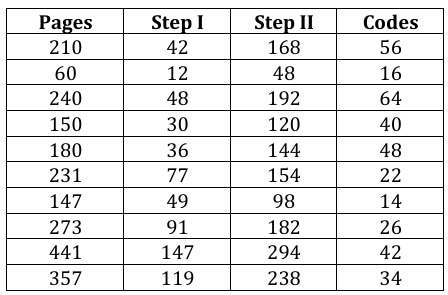
If number of pages in different books are 90, 120, 270, 300, 330, 315, 231, 567, 399, 525 then find the codes of these books as per the above-mentioned operations and placed these books in two different stores i.e. A and B. Arrange all codes in ascending order. After arranging the codes, first five codes are placed in store A and last five are placed in store B. Now, answer the given questions-
Which of the following pages book is not in store B?
Answer: E. 315 — ConceptEach book's page count is converted to a code through a fixed two-step operation that depends on the divisibility of the page count. A reference table…
- A.
270
- B.
300
- C.
330
- D.
525
- E.
315
Attempted by 24 students.
Show answer & explanation
Correct answer: E
Concept
Each book's page count is converted to a code through a fixed two-step operation that depends on the divisibility of the page count. A reference table fixes the rule:
If the page count is a multiple of 5: Step I = pages ÷ 5, Step II = pages − Step I (i.e. four-fifths of the pages), and Code = Step II ÷ 3 = (4 × pages) ÷ 15.
If the page count is a multiple of 3 (and the ÷5 path is not used): Step I = pages ÷ 3, Step II = pages − Step I (i.e. two-thirds of the pages), and Code = Step II ÷ 7 = (2 × pages) ÷ 21.
When a page count is a multiple of both 15 and 21 (such as 315 and 525), the ÷3 path is taken — it gives the smaller, integer code that keeps the arrangement well-defined. After every code is found, all ten codes are sorted in ascending order: the five smallest go to Store A, the five largest go to Store B.
Application
Compute the code for each of the ten books:
Pages | Rule used | Code |
|---|---|---|
231 | ÷3: (2×231)÷21 | 22 |
90 | ÷5: (4×90)÷15 | 24 |
315 | ÷3: (2×315)÷21 | 30 |
120 | ÷5: (4×120)÷15 | 32 |
399 | ÷3: (2×399)÷21 | 38 |
525 | ÷3: (2×525)÷21 | 50 |
567 | ÷3: (2×567)÷21 | 54 |
270 | ÷5: (4×270)÷15 | 72 |
300 | ÷5: (4×300)÷15 | 80 |
330 | ÷5: (4×330)÷15 | 88 |
Sorting the ten codes in ascending order: 22, 24, 30, 32, 38, 50, 54, 72, 80, 88.
Store A (five smallest codes 22, 24, 30, 32, 38) → books of 231, 90, 315, 120, 399 pages.
Store B (five largest codes 50, 54, 72, 80, 88) → books of 525, 567, 270, 300, 330 pages.
Checking the offered page counts against Store B: 270 (code 72), 300 (code 80), 330 (code 88) and 525 (code 50) all sit among the five largest codes, so all four are in Store B. The 315-page book has code 30, which falls among the five smallest, so it sits in Store A — it is the one page count not in Store B.
Cross-check
The cutoff is between the 5th code (38) and the 6th code (50). The 315-page book's code is 30, well below the cutoff, so it is firmly in Store A; every other offered book has a code of 50 or more, placing it in Store B. This confirms 315 is the only offered page count outside Store B.