Direction : Study the following information carefully and answer the questions…
2019
Direction : Study the following information carefully and answer the questions given below:
Books which have different number of pages is shown below with their codes.
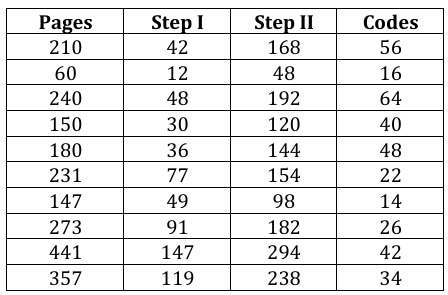
If number of pages in different books are 90, 120, 270, 300, 330, 315, 231, 567, 399, 525 then find the codes of these books as per the above-mentioned operations and placed these books in two different stores i.e. A and B. Arrange all codes in ascending order. After arranging the codes, first five codes are placed in store A and last five are placed in store B. Now, answer the given questions-
Which of the following page book have highest code in store A?
Answer: E. 567 — ConceptThis is a coding–decoding (input–output) problem. A fixed two-step arithmetic operation converts the number of pages of a book into its code. The rule…
- A.
315
- B.
120
- C.
399
- D.
525
- E.
567
Attempted by 22 students.
Show answer & explanation
Correct answer: E
Concept
This is a coding–decoding (input–output) problem. A fixed two-step arithmetic operation converts the number of pages of a book into its code. The rule branches on divisibility: numbers ending in 5 or 0 (multiples of 5) follow one chain, while the remaining numbers (multiples of 3) follow another. Read the rule from the given table first, then apply it uniformly to every value.
The coding rule (read from the table)
From the sample rows in the table, two consistent chains emerge:
If the number of pages is a multiple of 5: Step I = pages ÷ 5, Step II = Step I × 4, Code = Step II ÷ 3.
If the number of pages is a multiple of 3 (and not of 5): Step I = pages ÷ 3, Step II = Step I × 2, Code = Step II ÷ 7.
Check on a table row — 210 (multiple of 5): 210 ÷ 5 = 42, 42 × 4 = 168, 168 ÷ 3 = 56. And 231 (multiple of 3): 231 ÷ 3 = 77, 77 × 2 = 154, 154 ÷ 7 = 22. Both match the table, so the rule is confirmed.
Application — code every book
Applying the same two chains to the ten given page-counts:
Pages | Multiple of | Step I | Step II | Code |
|---|---|---|---|---|
90 | 5 | 18 | 72 | 24 |
120 | 5 | 24 | 96 | 32 |
270 | 5 | 54 | 216 | 72 |
300 | 5 | 60 | 240 | 80 |
330 | 5 | 66 | 264 | 88 |
315 | 5 | 63 | 252 | 84 |
231 | 3 | 77 | 154 | 22 |
567 | 3 | 189 | 378 | 54 |
399 | 3 | 133 | 266 | 38 |
525 | 5 | 105 | 420 | 140 |
Arrange in ascending order and split into stores
Sort the books by their code, smallest first. The first five codes go to Store A; the last five go to Store B.
Rank | Code | Pages | Store |
|---|---|---|---|
1 | 22 | 231 | A |
2 | 24 | 90 | A |
3 | 32 | 120 | A |
4 | 38 | 399 | A |
5 | 54 | 567 | A |
6 | 72 | 270 | B |
7 | 80 | 300 | B |
8 | 84 | 315 | B |
9 | 88 | 330 | B |
10 | 140 | 525 | B |
Result
Store A holds the five smallest codes: 22, 24, 32, 38 and 54. The largest of these is 54, which is the code of the 567-page book. Therefore the book with the highest code in Store A is the one with 567 pages.
Cross-check
567 is a multiple of 3, so it uses the ÷3 chain: 567 ÷ 3 = 189, 189 × 2 = 378, 378 ÷ 7 = 54 — confirming code 54. Since 54 is the fifth-smallest code overall, the 567-page book sits exactly at the top of Store A, just below 72 (the smallest code in Store B).