Directions : Read the following bar graph and line chart carefully and answer…
2024
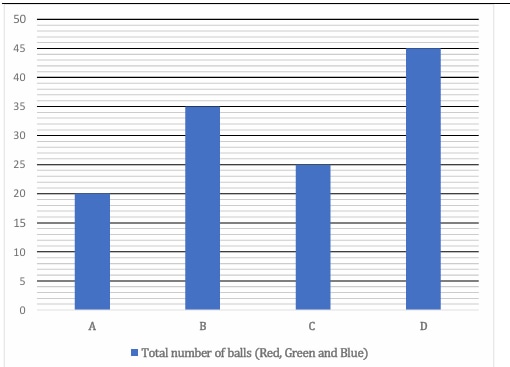
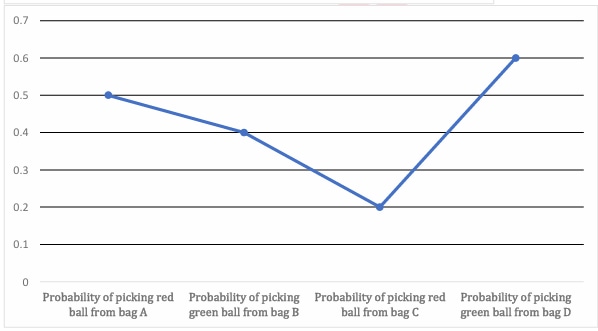
Directions : Read the following bar graph and line chart carefully and answer the questions given below. The bar graph shows total number of balls (Red, Green and Blue) in four different bags. The line graph shows the probability of picking a red ball from bag A and C and the probability of picking green ball from bag B and D each.
The number of blue balls in bag A is 5 less than the difference between the number of green balls in bags B and D. If the average number of green balls in all four bags is 12, then the difference between the number of blue balls in bag C and the number of green balls in bag A is 'P'. Which of the following option is correct about 'P'.
Answer: C. Both (b) & (d) — ConceptIn a data-interpretation set, first translate every probability into an actual count using count = probability x total. Once individual colour counts…
- A.
P is multiple of 11
- B.
P is a prime number
- C.
Both (b) & (d)
- D.
65 is completely divisible by P
- E.
Both (a) & (b)
Attempted by 1 students.
Show answer & explanation
Correct answer: C
Concept
In a data-interpretation set, first translate every probability into an actual count using count = probability x total. Once individual colour counts are fixed, use the given verbal constraints (a difference, an average) to pin down the unknown counts, then compute the required quantity. Within one bag: red + green + blue = total.
Reading the data
Bar graph (total balls): A = 20, B = 35, C = 25, D = 45. Line chart: P(red from A) = 0.5, P(green from B) = 0.4, P(red from C) = 0.2, P(green from D) = 0.6.
Step-by-step
Red in A = 0.5 x 20 = 10; Green in B = 0.4 x 35 = 14; Red in C = 0.2 x 25 = 5; Green in D = 0.6 x 45 = 27.
Blue in A = (difference between green in B and D) - 5 = (27 - 14) - 5 = 13 - 5 = 8.
Bag A has total 20, so Green in A = 20 - red(10) - blue(8) = 2.
Average green over four bags = 12, so total green = 12 x 4 = 48. Hence Green in C = 48 - greenA(2) - greenB(14) - greenD(27) = 5.
Bag C has total 25, so Blue in C = 25 - red(5) - green(5) = 15.
P = | Blue in C - Green in A | = | 15 - 2 | = 13.
Cross-check
Greens are 2 + 14 + 5 + 27 = 48, giving an average of 12 - matching the given condition, so the counts are consistent. Now test P = 13: it is a prime number, and 65 / 13 = 5 so 65 is exactly divisible by 13; however 13 is not a multiple of 11. Therefore both 'P is prime' and '65 is divisible by P' are true, while 'P is a multiple of 11' is false. The statement combining the prime fact and the 65-divisibility fact is the correct one.