Consider the following logic circuit whose inputs are functions and whose…
2002
Consider the following logic circuit whose inputs are functions and whose output is f.
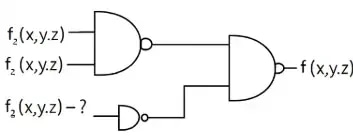
Figure label note: the three input functions from top to bottom are f1(x, y, z), f2(x, y, z), and f3(x, y, z), respectively.
Given that
f1(x, y, z) = ∑(0, 1, 3, 5),
f2(x, y, z) = ∑(6, 7) and
f(x, y, z) = ∑(1, 4, 5),
f3 is:
Answer: A. ∑(1, 4, 5) — From the circuit, the first NAND gate gives (f1 f2)' and the lower inverter gives f3'. These two signals enter the final NAND gate, so f = [(f1 f2)' · f3']' =…
- A.
∑(1, 4, 5)
- B.
∑(6, 7)
- C.
∑(0, 1, 3, 5)
- D.
None of these
Attempted by 61 students.
Show answer & explanation
Correct answer: A
From the circuit, the first NAND gate gives (f1 f2)' and the lower inverter gives f3'. These two signals enter the final NAND gate, so f = [(f1 f2)' · f3']' = f1 f2 + f3 by De Morgan's law. Now f1 = Σ(0, 1, 3, 5) and f2 = Σ(6, 7). Their minterm sets have no intersection, so f1 f2 = 0. Hence f = f3. Since the given output is f = Σ(1, 4, 5), we get f3 = Σ(1, 4, 5).
Explore the full course: Iocl Engineers Officers Grade A Paper 2