In each of the following questions two statements are given and these…
2025202520242025
In each of the following questions two statements are given and these statements are followed by two conclusions numbered (1) and (2). You have to take the given two statements to be true even if they seem to be at variance from commonly known facts. Read the conclusions and then decide which of the given conclusions logically follows from the two given statements, disregarding commonly known facts.
Statements: (1) All the actors are girls. (2) All the girls are beautiful.
Conclusions: (1) All the actors are beautiful. (2) Some girls are actors.
Answer: E. Both (1) and (2) follow — Concept: Two universal ('All A are B') statements combine using two standard syllogism rules — transitivity across a chain of universal statements, and…
- A.
Only (1) conclusion follows
- B.
Only (2) conclusion follows
- C.
Either (1) or (2) follows
- D.
Neither (1) nor (2) follows
- E.
Both (1) and (2) follow
Attempted by 15 students.
Show answer & explanation
Correct answer: E
Concept: Two universal ('All A are B') statements combine using two standard syllogism rules — transitivity across a chain of universal statements, and conversion of a single universal statement to a particular one.
Transitivity: if 'All A are B' and 'All B are C' both hold, then 'All A are C' necessarily follows.
Conversion: a universal statement 'All A are B' converts to 'Some B are A', valid under the standard assumption used throughout these problems that the subject class A is non-empty.
Application to this item:
Statement 1 gives Actors ⊆ Girls, and Statement 2 gives Girls ⊆ Beautiful.
Chaining the two by transitivity: Actors ⊆ Girls ⊆ Beautiful, so conclusion (1) 'All the actors are beautiful' follows.
Converting Statement 1 under the non-empty-subject assumption: 'All actors are girls' gives 'Some girls are actors', so conclusion (2) follows.
Cross-check: take one actor, P. Since all actors are girls, P is a girl; since all girls are beautiful, P is beautiful — so every actor is beautiful, confirming (1). Also, P is a girl who is an actor, so at least one girl is an actor, confirming (2).
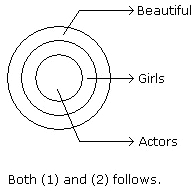
Both conclusions hold, so 'Both (1) and (2) follow' is correct.