Jack starts from point A, walks 4 meters to the East to point B, then turns…
Jack starts from point A, walks 4 meters to the East to point B, then turns left and walks 3 meters to point C. He again turns left and walks 7 meters to reach point D. What is the distance between point A and point D?
Answer: C. 3√2 meters — Concept: In a direction-and-distance problem where the path changes direction more than once, the straight-line distance between the start and end points is…
- A.
4 meters
- B.
5 meters
- C.
3√2 meters
- D.
7 meters
Attempted by 1 students.
Show answer & explanation
Correct answer: C
Concept: In a direction-and-distance problem where the path changes direction more than once, the straight-line distance between the start and end points is NOT the sum of the individual legs walked. It is found from the NET horizontal displacement and the NET vertical displacement, combined using the Pythagorean theorem: distance = √(net horizontal² + net vertical²).
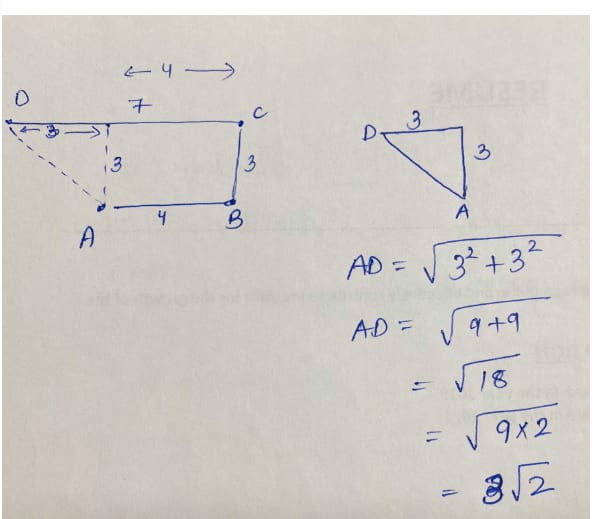
Jack walks 4 m East from A to B, so the net displacement so far is 4 m East and 0 m North-South.
Facing East, a left turn faces North. He walks 3 m to C, so the net displacement becomes 4 m East and 3 m North.
Facing North, a left turn faces West. He walks 7 m to D. The net East-West displacement is now 4 − 7 = −3 m, i.e. 3 m West; the net North-South displacement stays 3 m North.
The straight line AD is the hypotenuse of a right triangle whose legs are the net displacements: 3 m and 3 m.
Apply the Pythagorean theorem: AD = √(3² + 3²) = √18 = 3√2 meters.
Cross-check: placing A at the origin (0, 0) gives B = (4, 0), C = (4, 3), and D = (−3, 3). The distance formula gives AD = √((−3 − 0)² + (3 − 0)²) = √(9 + 9) = √18 = 3√2 m ≈ 4.24 m, confirming the result.